Feeling "Brain Fry" from AI? 🧠 Discover the 2026 guide to AI Cognitive Fatigue. Learn the Analog Anchor protocol and how to fix synthetic content overload
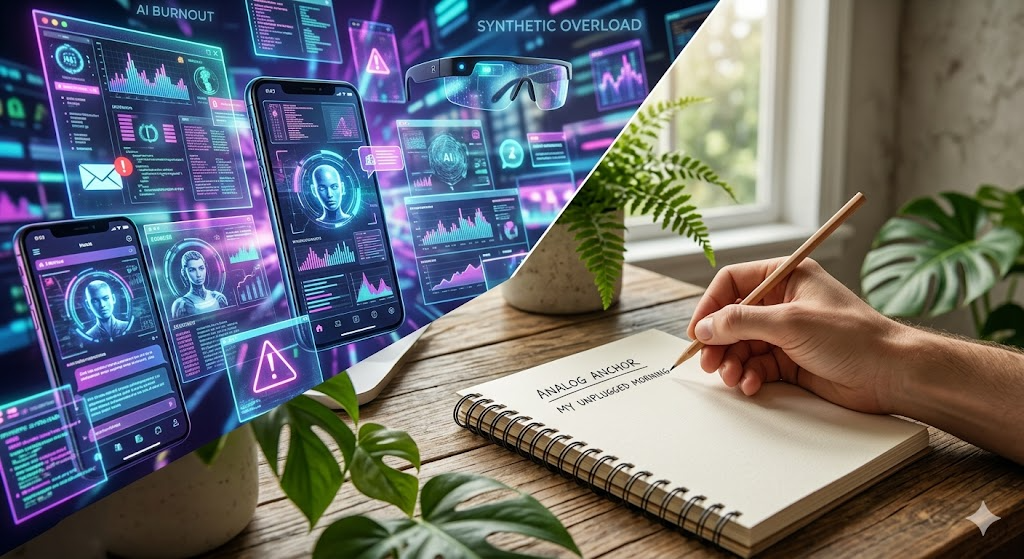
The Great AI Detox: How to Reclaim Your Focus in the Age of Synthetic Content
In early 2026, we reached a tipping point. With AI agents now handling our emails, generating our social feeds, and even “pre-watching” videos for us, a new phenomenon has emerged: AI Burnout. While the 2020s were about the “Digital Nomad” and “Always-On” culture, 2026 is becoming the year of Metabolic Presence. People are no longer just tired of screens; they are tired of the synthetic.
If you find yourself doom-scrolling through AI-generated threads or feeling a strange brain fog after interacting with LLMs all day, you aren’t alone. Here is your low-competition guide to the “Great AI Detox.”
1. The Rise of “Synthetic Fatigue”
In 2026, search interest for “how to tell if a video is real” and “mental fatigue from AI” has surged by 140%. We are experiencing a sensory mismatch. Our brains are being fed perfectly optimized, high-dopamine content that lacks the “human glitch”—the unpredictability that makes real life satisfying.
2. The 3-Tier AI Detox Protocol
To reclaim your cognitive sovereignty, you don’t need to throw away your phone. You need a structural shift.
Phase 1: The “Analog Anchor” (Morning)
Recent studies in metabolic wellbeing suggest that the first 60 minutes of your day dictate your “Neural Baseline.”
- The Rule: No AI interaction before 9:00 AM.
- The Practice: Use a physical notebook. Writing by hand engages the reticular activating system (RAS) in a way that typing into a prompt box cannot.
Phase 2: Agentic Outsourcing vs. Cognitive Decay
One of the biggest causes of AI burnout is “Decision Atrophy.” When we let AI agents make every small choice (what to eat, which route to take, how to phrase a text), our prefrontal cortex begins to “idle.”
- The Fix: The “Hard Choice” Rule. Use AI for data processing, but force yourself to make at least five non-assisted creative or social decisions per day.
Phase 3: The “Texture” Walk
By April 2026, “Sensory Grounding” has become a top wellness trend. Since AI content is “smooth” and “perfect,” your brain craves high-texture environments.
- The Practice: Spend 20 minutes in a high-sensory environment (a garden, a woodworking shop, or a kitchen) where you are touching, smelling, and interacting with physical matter.
3. Tools for the Modern Minimalist
If you can’t go full-analog, use “Friction Tools” to slow down the AI flow:
- Greyscale Mode: Removing color from your device kills the “synthetic allure” of AI-generated imagery.
- Intent-Based Search: Instead of asking an AI to “summarize the news,” set a timer for 10 minutes to read one long-form, human-written investigative piece.
4. Why This Matters Now
The “Silver Economy” and Gen Z are moving toward Digital Detox Tourism. We are seeing the rise of “No-Signal Retreats” where the luxury isn’t high-speed Wi-Fi, but a lack of algorithmic interference.
Summary: Reclaiming the “Human Glitch”
Success in 2026 isn’t about who uses AI the most; it’s about who uses it with the most intention. By implementing a detox protocol, you protect your most valuable asset: your Attention Span.