
Find comprehensive, step-by-step solutions for NCERT Class 11 Maths Chapter 4 Exercise 4.1 . Master the process of expressing complex numbers in the standard $\mathbf{a + ib}$ form, including simplifying powers of $i$ (e.g., $i^{-39}$, $i^{19}$) and expanding complex numbers raised to a power (e.g., $(1-i)^4$, $(1/3 + 3i)^3$). Learn how to efficiently calculate the multiplicative inverse ($z^{-1}$) using the conjugate and modulus.
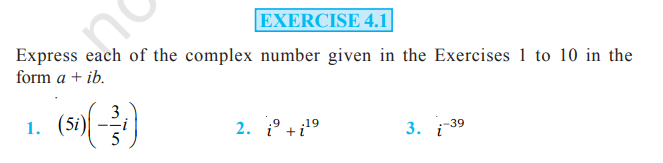

This exercise covers expressing complex numbers in the standard form $a + ib$ and finding the multiplicative inverse. The key identities for powers of $i$ are: $i^2 = -1$, $i^3 = -i$, and $i^4 = 1$.
Expressing Complex Numbers in $a + ib$ Form (Exercises 1-10)
1. $\left(\frac{5}{i}\right) \left(-\frac{i}{5}\right)$
$$\left(\frac{5}{i}\right) \left(-\frac{i}{5}\right) = \frac{5 \cdot (-i)}{i \cdot 5} = \frac{-5i}{5i} = -1$$
In $a + ib$ form: $\mathbf{-1 + i0}$.
2. $i^9 + i^{19}$
We divide the exponent by 4 and use the remainder. $i^n = i^{4q+r} = (i^4)^q \cdot i^r = 1^q \cdot i^r = i^r$.
$$i^9 = i^{4 \cdot 2 + 1} = i^1 = i$$
$$i^{19} = i^{4 \cdot 4 + 3} = i^3 = -i$$
$$i^9 + i^{19} = i + (-i) = 0$$
In $a + ib$ form: $\mathbf{0 + i0}$.
3. $i^{-39}$
$$i^{-39} = \frac{1}{i^{39}}$$
$$i^{39} = i^{4 \cdot 9 + 3} = i^3 = -i$$
$$i^{-39} = \frac{1}{-i}$$
To express in $a+ib$ form, multiply the numerator and denominator by $i$:
$$i^{-39} = \frac{1}{-i} \times \frac{i}{i} = \frac{i}{-i^2} = \frac{i}{-(-1)} = i$$
In $a + ib$ form: $\mathbf{0 + i1}$.
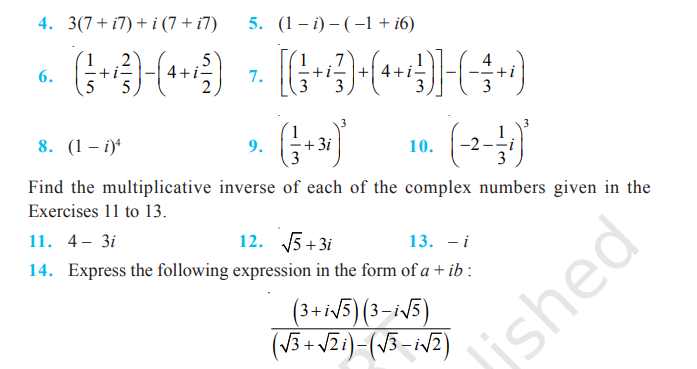
4. $3(7 + i7) + i (7 + i7)$
$$3(7 + 7i) + i(7 + 7i) = 21 + 21i + 7i + 7i^2$$
Substitute $i^2 = -1$:
$$= 21 + 21i + 7i – 7$$
Group the real and imaginary parts:
$$= (21 – 7) + (21 + 7)i = \mathbf{14 + 28i}$$
5. $(1 – i) – ( -1 + i6)$
$$(1 – i) – ( -1 + 6i) = 1 – i + 1 – 6i$$
Group the real and imaginary parts:
$$= (1 + 1) + (-1 – 6)i = \mathbf{2 – 7i}$$
6. $\left(\frac{1}{5} + i\frac{2}{5}\right) – \left(4 + i\frac{5}{2}\right)$
$$\left(\frac{1}{5} + \frac{2}{5}i\right) – \left(4 + \frac{5}{2}i\right) = \frac{1}{5} + \frac{2}{5}i – 4 – \frac{5}{2}i$$
Group the real and imaginary parts:
$$= \left(\frac{1}{5} – 4\right) + \left(\frac{2}{5} – \frac{5}{2}\right)i$$
Find the common denominator for each group:
$$= \left(\frac{1 – 20}{5}\right) + \left(\frac{4 – 25}{10}\right)i = \mathbf{-\frac{19}{5} – \frac{21}{10}i}$$
7. $\left[\left(\frac{1}{3} + i\frac{7}{3}\right) + \left(4 + i\frac{1}{3}\right)\right] – \left(-\frac{4}{3} + i\right)$
First, combine the terms inside the square brackets:
$$\left(\frac{1}{3} + 4\right) + i\left(\frac{7}{3} + \frac{1}{3}\right) = \left(\frac{1 + 12}{3}\right) + i\left(\frac{8}{3}\right) = \frac{13}{3} + \frac{8}{3}i$$
Now subtract the last term:
$$\left(\frac{13}{3} + \frac{8}{3}i\right) – \left(-\frac{4}{3} + i\right) = \frac{13}{3} + \frac{8}{3}i + \frac{4}{3} – i$$
Group the real and imaginary parts:
$$= \left(\frac{13}{3} + \frac{4}{3}\right) + i\left(\frac{8}{3} – 1\right)$$
$$= \frac{17}{3} + i\left(\frac{8 – 3}{3}\right) = \mathbf{\frac{17}{3} + \frac{5}{3}i}$$
8. $(1 – i)^4$
We can write $(1 – i)^4 = ((1 – i)^2)^2$.
$$(1 – i)^2 = 1^2 – 2(1)(i) + i^2 = 1 – 2i – 1 = -2i$$
Now square the result:
$$(1 – i)^4 = (-2i)^2 = (-2)^2 i^2 = 4(-1) = -4$$
In $a + ib$ form: $\mathbf{-4 + i0}$.
9. $\left(\frac{1}{3} + 3i\right)^3$
We use the binomial expansion formula $(a + b)^3 = a^3 + 3a^2 b + 3ab^2 + b^3$.
Let $a = \frac{1}{3}$ and $b = 3i$:
$$\left(\frac{1}{3}\right)^3 + 3\left(\frac{1}{3}\right)^2 (3i) + 3\left(\frac{1}{3}\right) (3i)^2 + (3i)^3$$
$$= \frac{1}{27} + 3\left(\frac{1}{9}\right) (3i) + 3\left(\frac{1}{3}\right) (9i^2) + 27i^3$$
Substitute $i^2 = -1$ and $i^3 = -i$:
$$= \frac{1}{27} + \frac{9}{9}i + 9(-1) – 27i$$
$$= \frac{1}{27} + i – 9 – 27i$$
Group the real and imaginary parts:
$$= \left(\frac{1}{27} – 9\right) + (1 – 27)i$$
$$= \left(\frac{1 – 243}{27}\right) + (-26)i = \mathbf{-\frac{242}{27} – 26i}$$
10. $\left(-2 – \frac{1}{3}i\right)^3$
Factor out $-1$:
$$\left(-2 – \frac{1}{3}i\right)^3 = \left(-\left(2 + \frac{1}{3}i\right)\right)^3 = (-1)^3 \left(2 + \frac{1}{3}i\right)^3 = -\left(2 + \frac{1}{3}i\right)^3$$
Now expand $\left(2 + \frac{1}{3}i\right)^3$ using $(a + b)^3 = a^3 + 3a^2 b + 3ab^2 + b^3$.
Let $a = 2$ and $b = \frac{1}{3}i$:
$$(2)^3 + 3(2)^2 \left(\frac{1}{3}i\right) + 3(2) \left(\frac{1}{3}i\right)^2 + \left(\frac{1}{3}i\right)^3$$
$$= 8 + 3(4)\left(\frac{1}{3}i\right) + 6\left(\frac{1}{9}i^2\right) + \frac{1}{27}i^3$$
Substitute $i^2 = -1$ and $i^3 = -i$:
$$= 8 + 4i + \frac{6}{9}(-1) + \frac{1}{27}(-i)$$
$$= 8 + 4i – \frac{2}{3} – \frac{1}{27}i$$
Group the real and imaginary parts:
$$= \left(8 – \frac{2}{3}\right) + \left(4 – \frac{1}{27}\right)i$$
$$= \left(\frac{24 – 2}{3}\right) + \left(\frac{108 – 1}{27}\right)i = \frac{22}{3} + \frac{107}{27}i$$
Finally, apply the negative sign from the beginning:
$$-\left(\frac{22}{3} + \frac{107}{27}i\right) = \mathbf{-\frac{22}{3} – \frac{107}{27}i}$$
Finding the Multiplicative Inverse (Exercises 11-13)
The multiplicative inverse of a complex number $z = a + ib$ is $z^{-1} = \frac{1}{z}$, which can be calculated using the formula $z^{-1} = \frac{\bar{z}}{|z|^2}$ or by rationalizing the denominator.
11. $z = 4 – 3i$
Using the formula $z^{-1} = \frac{\bar{z}}{|z|^2}$:
- Conjugate $\bar{z}$: $\bar{z} = 4 + 3i$
- Modulus squared $|z|^2$: $|z|^2 = 4^2 + (-3)^2 = 16 + 9 = 25$$$z^{-1} = \frac{4 + 3i}{25} = \mathbf{\frac{4}{25} + \frac{3}{25}i}$$
12. $z = \sqrt{5} + 3i$
Using the formula $z^{-1} = \frac{\bar{z}}{|z|^2}$:
- Conjugate $\bar{z}$: $\bar{z} = \sqrt{5} – 3i$
- Modulus squared $|z|^2$: $|z|^2 = (\sqrt{5})^2 + (3)^2 = 5 + 9 = 14$$$z^{-1} = \frac{\sqrt{5} – 3i}{14} = \mathbf{\frac{\sqrt{5}}{14} – \frac{3}{14}i}$$
13. $z = -i$
The complex number is $z = 0 – i$.
Using the formula $z^{-1} = \frac{\bar{z}}{|z|^2}$:
- Conjugate $\bar{z}$: $\bar{z} = i$
- Modulus squared $|z|^2$: $|z|^2 = 0^2 + (-1)^2 = 1$$$z^{-1} = \frac{i}{1} = \mathbf{i}$$
(Alternatively, $z^{-1} = \frac{1}{-i} = \frac{1}{-i} \times \frac{i}{i} = \frac{i}{-i^2} = i$.)
14. Expressing an Expression in $a + ib$ form
$$\frac{(3 + i\sqrt{5})(3 – i\sqrt{5})}{(\sqrt{3} + i\sqrt{2}) – (\sqrt{3} – i\sqrt{2})}$$
- Simplify the Numerator (Difference of Squares):$$(3 + i\sqrt{5})(3 – i\sqrt{5})$$This is in the form $(a+b)(a-b) = a^2 – b^2$.$$(3)^2 – (i\sqrt{5})^2 = 9 – (i^2 \cdot 5) = 9 – (-1 \cdot 5) = 9 + 5 = 14$$
- Simplify the Denominator:$$(\sqrt{3} + i\sqrt{2}) – (\sqrt{3} – i\sqrt{2}) = \sqrt{3} + i\sqrt{2} – \sqrt{3} + i\sqrt{2}$$$$= (\sqrt{3} – \sqrt{3}) + (i\sqrt{2} + i\sqrt{2}) = 0 + 2i\sqrt{2}$$
- Perform the Division:$$\frac{14}{2i\sqrt{2}} = \frac{7}{i\sqrt{2}}$$Rationalize the denominator by multiplying by $\frac{i}{i}$:$$\frac{7}{i\sqrt{2}} \times \frac{i}{i} = \frac{7i}{i^2 \sqrt{2}} = \frac{7i}{-\sqrt{2}}$$Multiply numerator and denominator by $\sqrt{2}$:$$\frac{-7i}{\sqrt{2}} \times \frac{\sqrt{2}}{\sqrt{2}} = \frac{-7\sqrt{2}i}{2}$$
In $a + ib$ form: $\mathbf{0 – \frac{7\sqrt{2}}{2}i}$ or $\mathbf{-\frac{7\sqrt{2}}{2}i}$.