
Get detailed, step-by-step solutions for NCERT Class 11 Maths Chapter 5 Miscellaneous Exercise . Learn to solve compound inequalities involving three parts (Q.1-6) and find the intersection of solution sets for multiple inequalities (Q.7-10), representing them graphically on the number line. Master real-world applications including temperature conversion (Fahrenheit/Celsius) and solution mixture/dilution problems involving percentages (Q.12-13) and IQ/Mental Age calculation (Q.14).
This exercise involves solving compound linear inequalities, finding the graphical representation of solution sets, and solving application-based problems.
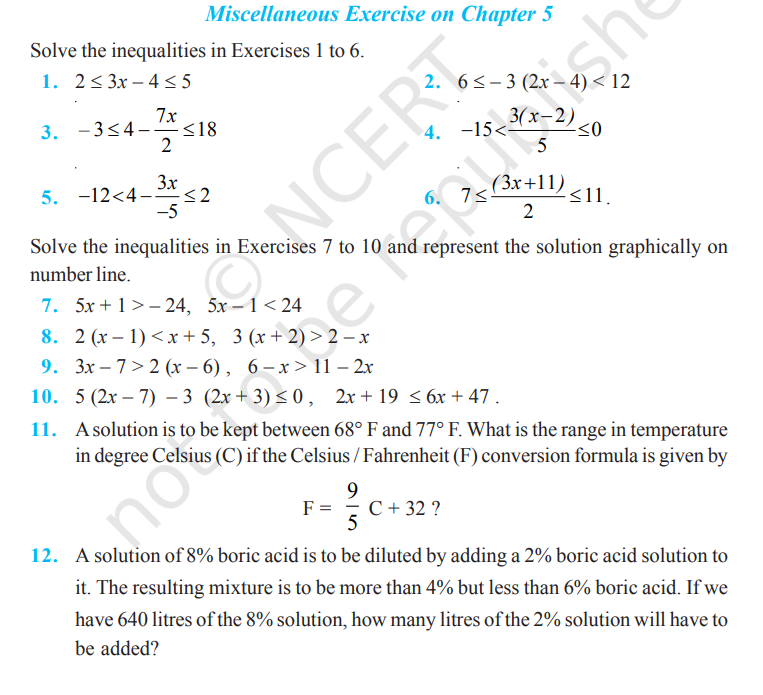

Solving Compound Inequalities (Exercises 1-6)
A compound inequality $a \le f(x) \le b$ is solved by isolating the variable $x$ in the middle.
1. $2 \le 3x – 4 \le 5$
- Add 4 to all three parts:$$2 + 4 \le 3x – 4 + 4 \le 5 + 4$$$$6 \le 3x \le 9$$
- Divide by 3:$$\frac{6}{3} \le \frac{3x}{3} \le \frac{9}{3}$$$$\mathbf{2 \le x \le 3}$$$$\text{Solution: } [2, 3]$$
2. $6 \le – 3 (2x – 4) < 12$
- Divide by $-3$ and reverse the inequality signs:$$\frac{6}{-3} \ge 2x – 4 > \frac{12}{-3}$$$$-2 \ge 2x – 4 > -4$$Rewrite in standard order:$$-4 < 2x – 4 \le -2$$
- Add 4 to all three parts:$$-4 + 4 < 2x – 4 + 4 \le -2 + 4$$$$0 < 2x \le 2$$
- Divide by 2:$$\frac{0}{2} < \frac{2x}{2} \le \frac{2}{2}$$$$\mathbf{0 < x \le 1}$$$$\text{Solution: } (0, 1]$$
3. $-\frac{7}{2} \le \frac{3x + 11}{2} \le \frac{18}{2}$
(Note: Assuming the question meant $\frac{3x + 11}{2}$ is the middle term, based on similar textbook problems. The expression is interpreted as $-\frac{7}{2} \le \frac{3x+11}{2} \le 9$.)
- Multiply by 2:$$2 \cdot \left(-\frac{7}{2}\right) \le 2 \cdot \frac{3x + 11}{2} \le 2 \cdot 9$$$$-7 \le 3x + 11 \le 18$$
- Subtract 11:$$-7 – 11 \le 3x + 11 – 11 \le 18 – 11$$$$-18 \le 3x \le 7$$
- Divide by 3:$$\frac{-18}{3} \le \frac{3x}{3} \le \frac{7}{3}$$$$\mathbf{-6 \le x \le \frac{7}{3}}$$$$\text{Solution: } \left[-6, \frac{7}{3}\right]$$
4. $-15 < \frac{3(x – 2)}{5} \le 0$
- Multiply by 5:$$5 \cdot (-15) < 5 \cdot \frac{3(x – 2)}{5} \le 5 \cdot 0$$$$-75 < 3(x – 2) \le 0$$
- Divide by 3:$$\frac{-75}{3} < \frac{3(x – 2)}{3} \le \frac{0}{3}$$$$-25 < x – 2 \le 0$$
- Add 2:$$-25 + 2 < x – 2 + 2 \le 0 + 2$$$$\mathbf{-23 < x \le 2}$$$$\text{Solution: } (-23, 2]$$
5. $-12 < 4 – \frac{3x}{5} \le 2$
- Subtract 4:$$-12 – 4 < 4 – 4 – \frac{3x}{5} \le 2 – 4$$$$-16 < -\frac{3x}{5} \le -2$$
- Multiply by $-5$ and reverse the inequality signs:$$(-16) \cdot (-5) > -\frac{3x}{5} \cdot (-5) \ge (-2) \cdot (-5)$$$$80 > 3x \ge 10$$Rewrite in standard order:$$10 \le 3x < 80$$
- Divide by 3:$$\frac{10}{3} \le \frac{3x}{3} < \frac{80}{3}$$$$\mathbf{\frac{10}{3} \le x < \frac{80}{3}}$$$$\text{Solution: } \left[\frac{10}{3}, \frac{80}{3}\right]$$
6. $-\frac{3}{2} \le \frac{3x + 11}{2} \le \frac{7}{2}$
- Multiply by 2:$$2 \cdot \left(-\frac{3}{2}\right) \le 2 \cdot \frac{3x + 11}{2} \le 2 \cdot \frac{7}{2}$$$$-3 \le 3x + 11 \le 7$$
- Subtract 11:$$-3 – 11 \le 3x + 11 – 11 \le 7 – 11$$$$-14 \le 3x \le -4$$
- Divide by 3:$$\frac{-14}{3} \le \frac{3x}{3} \le \frac{-4}{3}$$$$\mathbf{-\frac{14}{3} \le x \le -\frac{4}{3}}$$$$\text{Solution: } \left[-\frac{14}{3}, -\frac{4}{3}\right]$$
Compound Inequalities and Graphical Representation (Exercises 7-10)
These problems involve finding the intersection of the solution sets of two separate inequalities.
7. $5x + 1 > – 24$ and $5x – 1 < 24$
Inequality 1: $5x + 1 > -24$
$$5x > -25$$
$$x > -5$$
$$\text{Solution 1: } (-5, \infty)$$
Inequality 2: $5x – 1 < 24$
$$5x < 25$$
$$x < 5$$
$$\text{Solution 2: } (-\infty, 5)$$
Intersection: The values of $x$ that are greater than $-5$ AND less than $5$.
$$\mathbf{\text{Solution: } (-5, 5)}$$
Graph: Shaded region between open circles at $-5$ and $5$.

8. $2 (x – 1) < x + 5$ and $3 (x + 2) > 2 – x$
Inequality 1: $2x – 2 < x + 5$
$$2x – x < 5 + 2$$
$$x < 7$$
$$\text{Solution 1: } (-\infty, 7)$$
Inequality 2: $3x + 6 > 2 – x$
$$3x + x > 2 – 6$$
$$4x > -4$$
$$x > -1$$
$$\text{Solution 2: } (-1, \infty)$$
Intersection: The values of $x$ that are greater than $-1$ AND less than $7$.
$$\mathbf{\text{Solution: } (-1, 7)}$$
Graph: Shaded region between open circles at $-1$ and $7$.

9. $3x – 7 > 2 (x – 6)$ and $6 – x > 11 – 2x$
Inequality 1: $3x – 7 > 2x – 12$
$$3x – 2x > -12 + 7$$
$$x > -5$$
$$\text{Solution 1: } (-5, \infty)$$
Inequality 2: $6 – x > 11 – 2x$
$$-x + 2x > 11 – 6$$
$$x > 5$$
$$\text{Solution 2: } (5, \infty)$$
Intersection: The values of $x$ that are greater than $-5$ AND greater than $5$. For both to be true, $x$ must be greater than the larger lower bound.
$$\mathbf{\text{Solution: } (5, \infty)}$$
Graph: Open circle at $5$, with shading to the right.

10. $5 (2x – 7) – 3 (2x + 3) \le 0$ and $2x + 19 \le 6x + 47$
Inequality 1: $10x – 35 – 6x – 9 \le 0$
$$4x – 44 \le 0$$
$$4x \le 44$$
$$x \le 11$$
$$\text{Solution 1: } (-\infty, 11]$$
Inequality 2: $2x + 19 \le 6x + 47$
$$19 – 47 \le 6x – 2x$$
$$-28 \le 4x$$
$$\frac{-28}{4} \le x$$
$$-7 \le x \quad \text{or } x \ge -7$$
$$\text{Solution 2: } [-7, \infty)$$
Intersection: The values of $x$ that are greater than or equal to $-7$ AND less than or equal to $11$.
$$\mathbf{\text{Solution: } [-7, 11]}$$
Graph: Shaded region between closed circles at $-7$ and $11$.

Application Problems (Exercises 11-14)
11. Temperature Conversion (Fahrenheit to Celsius)
The given temperature range is $68^\circ \text{F} \le F \le 77^\circ \text{F}$.
The conversion formula is $F = \frac{9}{5} C + 32$.
Substitute the formula into the inequality:
$$68 \le \frac{9}{5} C + 32 \le 77$$
- Subtract 32:$$68 – 32 \le \frac{9}{5} C \le 77 – 32$$$$36 \le \frac{9}{5} C \le 45$$
- Multiply by $\frac{5}{9}$:$$\frac{5}{9} \cdot 36 \le \frac{5}{9} \cdot \frac{9}{5} C \le \frac{5}{9} \cdot 45$$$$5 \cdot 4 \le C \le 5 \cdot 5$$$$\mathbf{20^\circ \text{C} \le C \le 25^\circ \text{C}}$$The range in temperature in degree Celsius is $20^\circ \text{C}$ to $25^\circ \text{C}$.
12. Dilution of Boric Acid Solution
Let $x$ be the number of litres of the $2\%$ boric acid solution added.
- Total quantity of $8\%$ solution: $640$ litres.
- Quantity of $2\%$ solution added: $x$ litres.
- Total volume of mixture: $(640 + x)$ litres.
Total Boric Acid Content in the mixture:
$$(\text{Acid in } 8\% \text{ solution}) + (\text{Acid in } 2\% \text{ solution})$$
$$= 0.08(640) + 0.02(x)$$
$$= 51.2 + 0.02x$$
The concentration of the resulting mixture must be $> 4\%$ but $< 6\%$:
$$0.04 < \frac{\text{Total Acid}}{\text{Total Volume}} < 0.06$$
$$0.04 < \frac{51.2 + 0.02x}{640 + x} < 0.06$$
We solve this as two separate inequalities. Since volume $(640 + x)$ is positive, we can multiply without reversing the inequality.
Inequality 1: Lower Bound ($> 4\%$):
$$0.04 < \frac{51.2 + 0.02x}{640 + x}$$
$$0.04(640 + x) < 51.2 + 0.02x$$
$$25.6 + 0.04x < 51.2 + 0.02x$$
$$0.04x – 0.02x < 51.2 – 25.6$$
$$0.02x < 25.6$$
$$x < \frac{25.6}{0.02} \implies x < 1280 \quad (*1)$$
Inequality 2: Upper Bound ($< 6\%$):
$$\frac{51.2 + 0.02x}{640 + x} < 0.06$$
$$51.2 + 0.02x < 0.06(640 + x)$$
$$51.2 + 0.02x < 38.4 + 0.06x$$
$$51.2 – 38.4 < 0.06x – 0.02x$$
$$12.8 < 0.04x$$
$$x > \frac{12.8}{0.04} \implies x > 320 \quad (*2)$$
Combining (*1) and (*2): $320 < x < 1280$.
The number of litres of $2\%$ solution added must be more than 320 litres and less than 1280 litres.
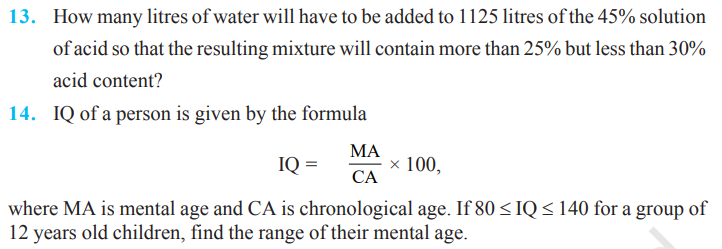
13. Dilution of Acid Solution (Adding Water)
Let $x$ be the number of litres of water added.
- Total quantity of $45\%$ solution: $1125$ litres.
- Quantity of water added: $x$ litres.
- Total volume of mixture: $(1125 + x)$ litres.
Total Acid Content in the mixture: Water has $0\%$ acid.
$$\text{Acid} = 0.45(1125) + 0(x) = 506.25 \text{ litres}$$
The concentration of the resulting mixture must be $> 25\%$ but $< 30\%$ acid:
$$0.25 < \frac{\text{Total Acid}}{\text{Total Volume}} < 0.30$$
$$0.25 < \frac{506.25}{1125 + x} < 0.30$$
Inequality 1: Lower Bound ($> 25\%$):
$$\frac{506.25}{1125 + x} > 0.25$$
$$506.25 > 0.25(1125 + x)$$
$$506.25 > 281.25 + 0.25x$$
$$506.25 – 281.25 > 0.25x$$
$$225 > 0.25x$$
$$x < \frac{225}{0.25} \implies x < 900 \quad (*1)$$
Inequality 2: Upper Bound ($< 30\%$):
$$\frac{506.25}{1125 + x} < 0.30$$
$$506.25 < 0.30(1125 + x)$$
$$506.25 < 337.5 + 0.30x$$
$$506.25 – 337.5 < 0.30x$$
$$168.75 < 0.30x$$
$$x > \frac{168.75}{0.30} \implies x > 562.5 \quad (*2)$$
Combining (*1) and (*2): $562.5 < x < 900$.
The number of litres of water added must be more than 562.5 litres and less than 900 litres.
14. Range of Mental Age (IQ Formula)
The given formula is $\text{IQ} = \frac{\text{MA}}{\text{CA}} \times 100$.
Given:
- $80 \le \text{IQ} \le 140$
- Chronological Age ($\text{CA}$) $= 12$ years.
Let $\text{MA}$ (Mental Age) be $M$. Substitute the known values into the IQ range inequality:
$$80 \le \frac{M}{12} \times 100 \le 140$$
$$80 \le \frac{100M}{12} \le 140$$
$$80 \le \frac{25M}{3} \le 140$$
- Multiply by 3:$$3 \cdot 80 \le 3 \cdot \frac{25M}{3} \le 3 \cdot 140$$$$240 \le 25M \le 420$$
- Divide by 25:$$\frac{240}{25} \le M \le \frac{420}{25}$$$$9.6 \le M \le 16.8$$
The range of the children’s mental age is 9.6 years to 16.8 years.