
This exercise focuses on converting line equations between different forms, calculating distances, and finding equations for parallel/perpendicular lines.
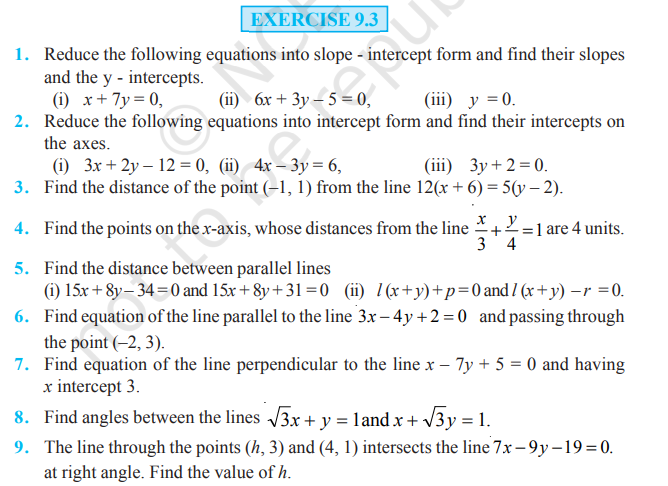
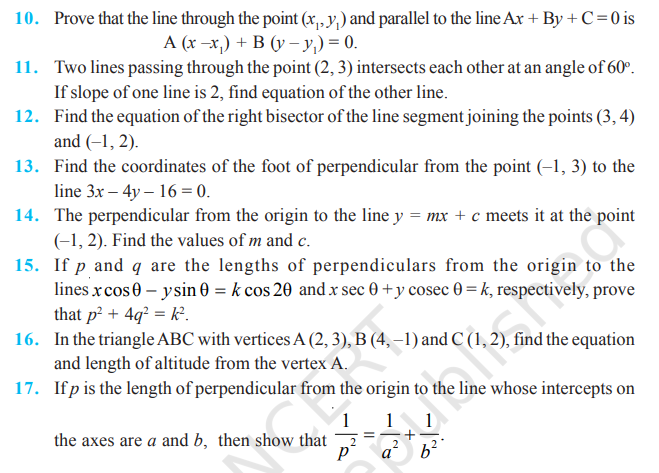

1. Slope-Intercept Form ($y = mx + c$)
The slope-intercept form is $y = mx + c$, where $m$ is the slope and $c$ is the $y$-intercept.
(i) $x + 7y = 0$
$$7y = -x$$
$$y = -\frac{1}{7}x + 0$$
- Slope ($m$): $\mathbf{-\frac{1}{7}}$
- $y$-intercept ($c$): $\mathbf{0}$
(ii) $6x + 3y – 5 = 0$
$$3y = -6x + 5$$
$$y = \frac{-6}{3}x + \frac{5}{3}$$
$$y = -2x + \frac{5}{3}$$
- Slope ($m$): $\mathbf{-2}$
- $y$-intercept ($c$): $\mathbf{\frac{5}{3}}$
(iii) $y = 0$
The equation is already in the form $y = 0x + 0$.
- Slope ($m$): $\mathbf{0}$
- $y$-intercept ($c$): $\mathbf{0}$
2. Intercept Form ($\frac{x}{a} + \frac{y}{b} = 1$)
The intercept form is $\frac{x}{a} + \frac{y}{b} = 1$, where $a$ is the $x$-intercept and $b$ is the $y$-intercept.
(i) $3x + 2y – 12 = 0$
$$3x + 2y = 12$$
Divide by 12:
$$\frac{3x}{12} + \frac{2y}{12} = \frac{12}{12}$$
$$\frac{x}{4} + \frac{y}{6} = 1$$
- $x$-intercept ($a$): $\mathbf{4}$
- $y$-intercept ($b$): $\mathbf{6}$
(ii) $4x – 3y = 6$
Divide by 6:
$$\frac{4x}{6} – \frac{3y}{6} = \frac{6}{6}$$
$$\frac{2x}{3} – \frac{y}{2} = 1$$
$$\frac{x}{3/2} + \frac{y}{-2} = 1$$
- $x$-intercept ($a$): $\mathbf{\frac{3}{2}}$
- $y$-intercept ($b$): $\mathbf{-2}$
(iii) $3y + 2 = 0$
$$3y = -2$$
$$y = -\frac{2}{3}$$
This is a line parallel to the $x$-axis. It does not intersect the $x$-axis (the $x$-intercept is infinite or undefined).
Write it as:
$$\frac{y}{-2/3} = 1$$
- $x$-intercept ($a$): None (line is parallel to x-axis)
- $y$-intercept ($b$): $\mathbf{-\frac{2}{3}}$
3. Distance of a Point from a Line
Find the distance of the point $(-1, 1)$ from the line $12(x + 6) = 5(y – 2)$.
1. Convert the line equation to the General Form $Ax + By + C = 0$:
$$12x + 72 = 5y – 10$$
$$12x – 5y + 72 + 10 = 0$$
$$12x – 5y + 82 = 0$$
So, $A=12$, $B=-5$, $C=82$. The point is $(x_1, y_1) = (-1, 1)$.
2. Use the Distance Formula: $d = \frac{|Ax_1 + By_1 + C|}{\sqrt{A^2 + B^2}}$
$$d = \frac{|12(-1) + (-5)(1) + 82|}{\sqrt{12^2 + (-5)^2}}$$
$$d = \frac{|-12 – 5 + 82|}{\sqrt{144 + 25}}$$
$$d = \frac{|65|}{\sqrt{169}} = \frac{65}{13} = \mathbf{5 \text{ units}}$$
4. Points on $x$-axis Equidistant from a Line
Find the points on the $x$-axis, $P(x_1, 0)$, whose distances from the line $\frac{x}{3} + \frac{y}{4} = 1$ are 4 units.
1. Convert the line equation to the General Form $Ax + By + C = 0$:
$$\frac{x}{3} + \frac{y}{4} = 1$$
Multiply by $12$:
$$4x + 3y = 12$$
$$4x + 3y – 12 = 0$$
So, $A=4$, $B=3$, $C=-12$. The point is $(x_1, 0)$. Distance $d=4$.
2. Use the Distance Formula and solve for $x_1$:
$$4 = \frac{|4(x_1) + 3(0) – 12|}{\sqrt{4^2 + 3^2}}$$
$$4 = \frac{|4x_1 – 12|}{\sqrt{16 + 9}}$$
$$4 = \frac{|4x_1 – 12|}{5}$$
$$20 = |4x_1 – 12|$$
This absolute value equation leads to two cases:
- Case 1: $4x_1 – 12 = 20$$$4x_1 = 32$$$$x_1 = 8$$The point is $\mathbf{(8, 0)}$.
- Case 2: $4x_1 – 12 = -20$$$4x_1 = -8$$$$x_1 = -2$$The point is $\mathbf{(-2, 0)}$.
5. Distance Between Parallel Lines ($Ax + By + C_1 = 0$ and $Ax + By + C_2 = 0$)
The distance $d$ between two parallel lines is $d = \frac{|C_1 – C_2|}{\sqrt{A^2 + B^2}}$.
(i) $15x + 8y – 34 = 0$ and $15x + 8y + 31 = 0$
Here $A=15$, $B=8$, $C_1=-34$, $C_2=31$.
$$d = \frac{|-34 – 31|}{\sqrt{15^2 + 8^2}}$$
$$d = \frac{|-65|}{\sqrt{225 + 64}} = \frac{65}{\sqrt{289}}$$
$$d = \frac{65}{17} \text{ units}$$
(ii) $l(x + y) + p = 0$ and $l(x + y) – r = 0$
$$lx + ly + p = 0 \quad (C_1 = p)$$
$$lx + ly – r = 0 \quad (C_2 = -r)$$
Here $A=l$, $B=l$.
$$d = \frac{|p – (-r)|}{\sqrt{l^2 + l^2}}$$
$$d = \frac{|p + r|}{\sqrt{2l^2}} = \mathbf{\frac{|p + r|}{|l|\sqrt{2}} \text{ units}}$$
6. Equation of a Parallel Line
Find equation of the line parallel to $3x – 4y + 2 = 0$ and passing through $(-2, 3)$.
1. Find the slope of the given line.
$$4y = 3x + 2$$
$$y = \frac{3}{4}x + \frac{1}{2}$$
The slope is $m = \frac{3}{4}$.
2. Find the required line equation.
Since the required line is parallel, its slope $m_{req} = \frac{3}{4}$.
Use the point-slope form with $(-2, 3)$:
$$y – 3 = \frac{3}{4}(x – (-2))$$
$$4(y – 3) = 3(x + 2)$$
$$4y – 12 = 3x + 6$$
Rearrange:
$$\mathbf{3x – 4y + 18 = 0}$$
7. Equation of a Perpendicular Line with $x$-intercept
Find equation of the line perpendicular to $x – 7y + 5 = 0$ and having $x$-intercept 3.
1. Find the slope $m_1$ of the given line.
$$7y = x + 5$$
$$y = \frac{1}{7}x + \frac{5}{7}$$
The slope is $m_1 = \frac{1}{7}$.
2. Find the slope $m_{req}$ of the perpendicular line.
$$m_{req} = -\frac{1}{m_1} = -\frac{1}{1/7} = -7$$
3. Find the required line equation.
The $x$-intercept is 3, meaning the line passes through the point $(3, 0)$.
Use the point-slope form with $(3, 0)$ and $m_{req} = -7$:
$$y – 0 = -7(x – 3)$$
$$y = -7x + 21$$
Rearrange:
$$\mathbf{7x + y – 21 = 0}$$
8. Angles Between the Lines
Find angles between the lines $y – \sqrt{3}x – 1 = 0$ and $y – \frac{1}{\sqrt{3}}x – 1 = 0$.
1. Find the slopes of the two lines $m_1$ and $m_2$.
$$L_1: y = \sqrt{3}x + 1 \implies m_1 = \sqrt{3}$$
$$L_2: y = \frac{1}{\sqrt{3}}x + 1 \implies m_2 = \frac{1}{\sqrt{3}}$$
2. Find the angles $\theta_1$ and $\theta_2$ the lines make with the $x$-axis.
$$\tan \theta_1 = \sqrt{3} \implies \theta_1 = 60^\circ$$
$$\tan \theta_2 = \frac{1}{\sqrt{3}} \implies \theta_2 = 30^\circ$$
3. Find the angle $\phi$ between the lines.
The angle $\phi$ between the lines is $\phi = |\theta_1 – \theta_2|$ (acute angle).
$$\phi = |60^\circ – 30^\circ| = 30^\circ$$
The two angles between the lines are the acute angle ($\phi$) and the obtuse angle ($180^\circ – \phi$).
- Acute angle: $\mathbf{30^\circ}$
- Obtuse angle: $180^\circ – 30^\circ = \mathbf{150^\circ}$
9. Right Angle Intersection
The line through $(h, 3)$ and $(4, 1)$ intersects the line $7x – 9y – 19 = 0$ at right angles. Find $h$.
1. Find the slope $m_1$ of the line through $(h, 3)$ and $(4, 1)$.
$$m_1 = \frac{1 – 3}{4 – h} = \frac{-2}{4 – h}$$
2. Find the slope $m_2$ of the line $7x – 9y – 19 = 0$.
$$9y = 7x – 19$$
$$y = \frac{7}{9}x – \frac{19}{9}$$
$$m_2 = \frac{7}{9}$$
3. Use the perpendicularity condition: $m_1 m_2 = -1$.
$$\left(\frac{-2}{4 – h}\right) \left(\frac{7}{9}\right) = -1$$
$$\frac{-14}{9(4 – h)} = -1$$
$$-14 = -9(4 – h)$$
$$14 = 36 – 9h$$
$$9h = 36 – 14$$
$$9h = 22$$
$$h = \mathbf{\frac{22}{9}}$$
10. Equation of a Parallel Line (Proof)
Prove that the line through $(x_1, y_1)$ and parallel to $Ax + By + C = 0$ is $A(x – x_1) + B(y – y_1) = 0$.
1. Find the slope $m$ of the given line $Ax + By + C = 0$:
$$By = -Ax – C$$
$$y = -\frac{A}{B}x – \frac{C}{B}$$
The slope is $m = -\frac{A}{B}$.
2. Find the equation of the required line using the point-slope form:
Since the required line is parallel, its slope is also $m = -\frac{A}{B}$, and it passes through $(x_1, y_1)$.
$$y – y_1 = m(x – x_1)$$
$$y – y_1 = -\frac{A}{B}(x – x_1)$$
3. Simplify to the required form:
Multiply by $B$:
$$B(y – y_1) = -A(x – x_1)$$
Bring all terms to one side:
$$A(x – x_1) + B(y – y_1) = 0$$
(Proved)
11. Finding the Other Line with Angle
Two lines passing through $(2, 3)$ intersect at $60^\circ$. If slope of one line is $m_1 = 2$, find equation of the other line ($L_2$).
1. Use the Angle between Lines Formula $\tan \theta = \left|\frac{m_2 – m_1}{1 + m_1 m_2}\right|$:
Here $\theta = 60^\circ$, $\tan 60^\circ = \sqrt{3}$, and $m_1 = 2$. Let $m_2$ be the unknown slope.
$$\sqrt{3} = \left|\frac{m_2 – 2}{1 + 2m_2}\right|$$
This leads to two cases:
- Case 1: Positive value$$\sqrt{3} = \frac{m_2 – 2}{1 + 2m_2}$$$$\sqrt{3} + 2\sqrt{3}m_2 = m_2 – 2$$$$m_2(2\sqrt{3} – 1) = -2 – \sqrt{3}$$$$m_2 = \frac{-(2 + \sqrt{3})}{2\sqrt{3} – 1}$$Rationalize: $m_2 = \frac{-(2 + \sqrt{3})(2\sqrt{3} + 1)}{(2\sqrt{3})^2 – 1^2} = \frac{-(4\sqrt{3} + 2 + 6 + \sqrt{3})}{12 – 1} = \frac{-(8 + 5\sqrt{3})}{11}$$$m_2 = -\frac{8 + 5\sqrt{3}}{11}$$
- Case 2: Negative value$$\sqrt{3} = -\left(\frac{m_2 – 2}{1 + 2m_2}\right) = \frac{2 – m_2}{1 + 2m_2}$$$$\sqrt{3} + 2\sqrt{3}m_2 = 2 – m_2$$$$m_2(2\sqrt{3} + 1) = 2 – \sqrt{3}$$$$m_2 = \frac{2 – \sqrt{3}}{2\sqrt{3} + 1}$$Rationalize: $m_2 = \frac{(2 – \sqrt{3})(2\sqrt{3} – 1)}{(2\sqrt{3})^2 – 1^2} = \frac{4\sqrt{3} – 2 – 6 + \sqrt{3}}{12 – 1} = \frac{5\sqrt{3} – 8}{11}$$$m_2 = \frac{5\sqrt{3} – 8}{11}$$
2. Find the equation of the two possible lines (using point-slope form with $(2, 3)$):
- Line $L_{2a}$: $m_2 = -\frac{8 + 5\sqrt{3}}{11}$$$y – 3 = -\frac{8 + 5\sqrt{3}}{11} (x – 2)$$$$\mathbf{11(y – 3) + (8 + 5\sqrt{3})(x – 2) = 0}$$
- Line $L_{2b}$: $m_2 = \frac{5\sqrt{3} – 8}{11}$$$y – 3 = \frac{5\sqrt{3} – 8}{11} (x – 2)$$$$\mathbf{11(y – 3) – (5\sqrt{3} – 8)(x – 2) = 0}$$
12. Right Bisector Equation
Find the equation of the right bisector of the line segment joining $A(3, 4)$ and $B(-1, 2)$.
A right bisector is a line perpendicular to the segment and passing through its mid-point.
1. Find the mid-point $M$ of $AB$.
$$M = \left(\frac{3 + (-1)}{2}, \frac{4 + 2}{2}\right) = \left(\frac{2}{2}, \frac{6}{2}\right) = (1, 3)$$
2. Find the slope $m_{AB}$ of the segment $AB$.
$$m_{AB} = \frac{2 – 4}{-1 – 3} = \frac{-2}{-4} = \frac{1}{2}$$
3. Find the slope $m_{req}$ of the perpendicular bisector.
$$m_{req} = -\frac{1}{m_{AB}} = -\frac{1}{1/2} = -2$$
4. Find the equation of the line with $m_{req} = -2$ passing through $M(1, 3)$.
Use the point-slope form:
$$y – 3 = -2(x – 1)$$
$$y – 3 = -2x + 2$$
Rearrange:
$$\mathbf{2x + y – 5 = 0}$$
13. Foot of Perpendicular
Find the coordinates of the foot of perpendicular $N$ from $P(-1, 3)$ to the line $L: 3x – 4y – 16 = 0$.
The foot of the perpendicular $N(h, k)$ is the intersection of $L$ and the line $PN$.
1. Find the slope $m_L$ of the given line $L$.
$$4y = 3x – 16$$
$$y = \frac{3}{4}x – 4$$
$$m_L = \frac{3}{4}$$
2. Find the slope $m_{PN}$ of the perpendicular line $PN$.
$$m_{PN} = -\frac{1}{m_L} = -\frac{4}{3}$$
3. Find the equation of the line $PN$ through $P(-1, 3)$.
$$y – 3 = -\frac{4}{3}(x – (-1))$$
$$3(y – 3) = -4(x + 1)$$
$$3y – 9 = -4x – 4$$
$$4x + 3y – 5 = 0 \quad \text{(i)}$$
4. Solve the system of equations for the intersection point $N(h, k)$.
Line $L$: $\quad 3x – 4y = 16 \quad \text{(ii)}$
Line $PN$: $4x + 3y = 5 \quad \text{(i)}$
Multiply (i) by 4 and (ii) by 3:
$$16x + 12y = 20$$
$$9x – 12y = 48$$
Add the two new equations:
$$25x = 68 \implies x = \frac{68}{25}$$
Substitute $x$ back into (i):
$$4\left(\frac{68}{25}\right) + 3y = 5$$
$$\frac{272}{25} + 3y = 5$$
$$3y = 5 – \frac{272}{25} = \frac{125 – 272}{25} = \frac{-147}{25}$$
$$y = \frac{-147}{3 \times 25} = \frac{-49}{25}$$
The foot of the perpendicular is $\mathbf{\left(\frac{68}{25}, -\frac{49}{25}\right)}$.
14. Perpendicular from Origin
The perpendicular from the origin $O(0, 0)$ to the line $y = mx + c$ meets it at $P(-1, 2)$. Find $m$ and $c$.
The line $L: y = mx + c$ passes through $P(-1, 2)$, and is perpendicular to $OP$.
1. Find the slope $m_{OP}$ of the perpendicular segment $OP$.
$$m_{OP} = \frac{2 – 0}{-1 – 0} = -2$$
2. Find the slope $m$ of the required line $L$.
Since $L \perp OP$, $m \cdot m_{OP} = -1$.
$$m (-2) = -1 \implies m = \mathbf{\frac{1}{2}}$$
3. Find the $y$-intercept $c$.
Since the line $y = mx + c$ passes through $P(-1, 2)$ with $m = \frac{1}{2}$:
$$2 = \left(\frac{1}{2}\right)(-1) + c$$
$$2 = -\frac{1}{2} + c$$
$$c = 2 + \frac{1}{2} = \frac{5}{2}$$
$$c = \mathbf{\frac{5}{2}}$$
15. Perpendicular Distance and Identity (Trigonometric Lines)
If $p$ and $q$ are the lengths of perpendiculars from the origin to the lines:
$L_1: x \cos \theta – y \sin \theta = k \cos 2\theta$
$L_2: x \sec \theta + y \operatorname{cosec} \theta = k$
Prove that $p^2 + 4q^2 = k^2$.
The length of the perpendicular from the origin $(0, 0)$ to $Ax + By + C = 0$ is $d = \frac{|C|}{\sqrt{A^2 + B^2}}$.
1. Calculate $p$ (distance to $L_1$):
$L_1$: $x \cos \theta – y \sin \theta – k \cos 2\theta = 0$.
$A = \cos \theta$, $B = -\sin \theta$, $C = -k \cos 2\theta$.
$$p = \frac{|-k \cos 2\theta|}{\sqrt{\cos^2 \theta + (-\sin \theta)^2}} = \frac{|k \cos 2\theta|}{\sqrt{1}}$$
$$p = |k \cos 2\theta| \implies p^2 = k^2 \cos^2 2\theta \quad \text{(i)}$$
2. Calculate $q$ (distance to $L_2$):
$L_2$: $x \sec \theta + y \operatorname{cosec} \theta – k = 0$.
$A = \sec \theta$, $B = \operatorname{cosec} \theta$, $C = -k$.
$$q = \frac{|-k|}{\sqrt{\sec^2 \theta + \operatorname{cosec}^2 \theta}}$$
Use $\sec \theta = 1/\cos \theta$ and $\operatorname{cosec} \theta = 1/\sin \theta$:
$$q = \frac{|k|}{\sqrt{\frac{1}{\cos^2 \theta} + \frac{1}{\sin^2 \theta}}} = \frac{|k|}{\sqrt{\frac{\sin^2 \theta + \cos^2 \theta}{\cos^2 \theta \sin^2 \theta}}} = \frac{|k|}{\sqrt{\frac{1}{\cos^2 \theta \sin^2 \theta}}}$$
$$q = |k \cos \theta \sin \theta| = \left|k \frac{\sin 2\theta}{2}\right| = \frac{|k \sin 2\theta|}{2}$$
$$q^2 = \frac{k^2 \sin^2 2\theta}{4} \implies 4q^2 = k^2 \sin^2 2\theta \quad \text{(ii)}$$
3. Prove $p^2 + 4q^2 = k^2$ using (i) and (ii):
$$p^2 + 4q^2 = k^2 \cos^2 2\theta + k^2 \sin^2 2\theta$$
$$p^2 + 4q^2 = k^2 (\cos^2 2\theta + \sin^2 2\theta)$$
Using the identity $\cos^2 x + \sin^2 x = 1$:
$$p^2 + 4q^2 = k^2 (1)$$
$$\mathbf{p^2 + 4q^2 = k^2}$$
(Proved)
16. Altitude of a Triangle
In $\triangle ABC$ with $A(2, 3)$, $B(4, -1)$ and $C(1, 2)$, find the equation and length of altitude from vertex $A$.
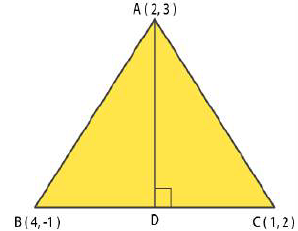
The altitude from $A$ is the line through $A$ perpendicular to $BC$.
1. Find the slope $m_{BC}$ of the base $BC$.
$$m_{BC} = \frac{2 – (-1)}{1 – 4} = \frac{3}{-3} = -1$$
2. Find the slope $m_{alt}$ of the altitude from $A$.
$$m_{alt} = -\frac{1}{m_{BC}} = -\frac{1}{-1} = 1$$
3. Find the equation of the altitude with $m_{alt} = 1$ passing through $A(2, 3)$.
$$y – 3 = 1(x – 2)$$
$$y – 3 = x – 2$$
Equation of altitude: $\mathbf{x – y + 1 = 0}$.
4. Find the length of the altitude (distance of $A$ from line $BC$).
Find the equation of line $BC$ using $m_{BC} = -1$ and $C(1, 2)$:
$$y – 2 = -1(x – 1)$$
$$y – 2 = -x + 1$$
$x + y – 3 = 0$. (General form: $A=1, B=1, C=-3$)
Length (distance of $A(2, 3)$ from $x + y – 3 = 0$):
$$\text{Length} = \frac{|1(2) + 1(3) – 3|}{\sqrt{1^2 + 1^2}}$$
$$\text{Length} = \frac{|2 + 3 – 3|}{\sqrt{2}} = \frac{2}{\sqrt{2}} = \mathbf{\sqrt{2} \text{ units}}$$
17. Perpendicular Length and Intercepts (Proof)
If $p$ is the length of perpendicular from the origin to the line whose intercepts on the axes are $a$ and $b$, show that $\frac{1}{p^2} = \frac{1}{a^2} + \frac{1}{b^2}$.
The equation of the line with intercepts $a$ and $b$ is the intercept form:
$$\frac{x}{a} + \frac{y}{b} = 1$$
1. Convert to the General Form $Ax + By + C = 0$:
Multiply by $ab$:
$$bx + ay = ab$$
$$bx + ay – ab = 0$$
So, $A=b$, $B=a$, $C=-ab$.
2. Use the distance formula for $p$ (distance from origin $(0, 0)$):
$$p = \frac{|b(0) + a(0) – ab|}{\sqrt{b^2 + a^2}}$$
$$p = \frac{|-ab|}{\sqrt{a^2 + b^2}}$$
3. Square both sides:
$$p^2 = \frac{a^2 b^2}{a^2 + b^2}$$
4. Take the reciprocal of both sides to obtain $\frac{1}{p^2}$:
$$\frac{1}{p^2} = \frac{a^2 + b^2}{a^2 b^2}$$
5. Separate the fraction:
$$\frac{1}{p^2} = \frac{a^2}{a^2 b^2} + \frac{b^2}{a^2 b^2}$$
$$\frac{1}{p^2} = \frac{1}{b^2} + \frac{1}{a^2}$$
$$\mathbf{\frac{1}{p^2} = \frac{1}{a^2} + \frac{1}{b^2}}$$
(Proved)