

Get detailed, step-by-step solutions for NCERT Class 11 Maths Chapter 11 Exercise 11.2
Master the distance formula in 3D to find the distance between pairs of points (Q.1). Apply the distance formula to test for collinearity (Q.2), and verify the properties of isosceles and right-angled triangles (Q.3). Find the equation of the locus of points equidistant from two fixed points (a plane, Q.4) and the locus where the sum of distances is constant (an ellipsoid, Q.5).
This exercise uses the distance formula in three-dimensional space. The distance $D$ between two points $P(x_1, y_1, z_1)$ and $Q(x_2, y_2, z_2)$ is given by:
$$D = \sqrt{(x_2 – x_1)^2 + (y_2 – y_1)^2 + (z_2 – z_1)^2}$$
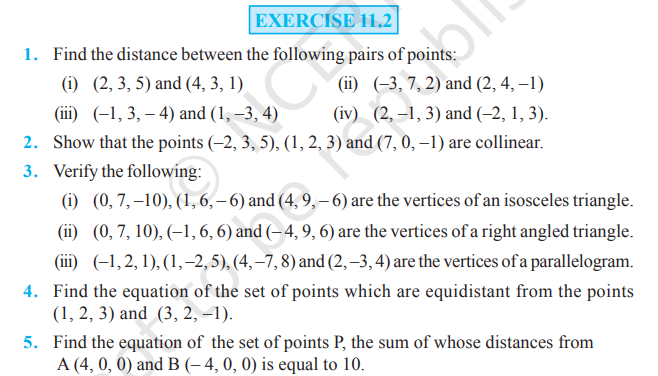

1. Finding the Distance Between Pairs of Points
(i) $(2, 3, 5)$ and $(4, 3, 1)$
$$D = \sqrt{(4 – 2)^2 + (3 – 3)^2 + (1 – 5)^2}$$
$$D = \sqrt{2^2 + 0^2 + (-4)^2} = \sqrt{4 + 0 + 16} = \sqrt{20}$$
$$\mathbf{D = 2\sqrt{5}}$$
(ii) $(-3, 7, 2)$ and $(2, 4, -1)$
$$D = \sqrt{(2 – (-3))^2 + (4 – 7)^2 + (-1 – 2)^2}$$
$$D = \sqrt{5^2 + (-3)^2 + (-3)^2} = \sqrt{25 + 9 + 9} = \sqrt{43}$$
$$\mathbf{D = \sqrt{43}}$$
(iii) $(-1, 3, -4)$ and $(1, -3, 4)$
$$D = \sqrt{(1 – (-1))^2 + (-3 – 3)^2 + (4 – (-4))^2}$$
$$D = \sqrt{2^2 + (-6)^2 + 8^2} = \sqrt{4 + 36 + 64} = \sqrt{104}$$
$$\mathbf{D = 2\sqrt{26}}$$
(iv) $(2, -1, 3)$ and $(-2, 1, 3)$
$$D = \sqrt{(-2 – 2)^2 + (1 – (-1))^2 + (3 – 3)^2}$$
$$D = \sqrt{(-4)^2 + 2^2 + 0^2} = \sqrt{16 + 4 + 0} = \sqrt{20}$$
$$\mathbf{D = 2\sqrt{5}}$$
2. Showing Collinearity
Points $A$, $B$, and $C$ are collinear if the sum of the distances between two pairs of points equals the distance of the third pair (e.g., $AB + BC = AC$).
Let $A = (-2, 3, 5)$, $B = (1, 2, 3)$, and $C = (7, 0, -1)$.
- Distance $AB$:$$AB = \sqrt{(1 – (-2))^2 + (2 – 3)^2 + (3 – 5)^2} = \sqrt{3^2 + (-1)^2 + (-2)^2} = \sqrt{9 + 1 + 4} = \sqrt{14}$$
- Distance $BC$:$$BC = \sqrt{(7 – 1)^2 + (0 – 2)^2 + (-1 – 3)^2} = \sqrt{6^2 + (-2)^2 + (-4)^2} = \sqrt{36 + 4 + 16} = \sqrt{56} = 2\sqrt{14}$$
- Distance $AC$:$$AC = \sqrt{(7 – (-2))^2 + (0 – 3)^2 + (-1 – 5)^2} = \sqrt{9^2 + (-3)^2 + (-6)^2} = \sqrt{81 + 9 + 36} = \sqrt{126} = 3\sqrt{14}$$
Since $AB + BC = \sqrt{14} + 2\sqrt{14} = 3\sqrt{14} = AC$, the points are collinear.
3. Verification of Triangle Properties
(i) Isosceles Triangle
Let $A = (0, 7, -10)$, $B = (1, 6, -6)$, and $C = (4, 9, -6)$. An isosceles triangle has at least two sides of equal length.
- $AB^2$: $(1 – 0)^2 + (6 – 7)^2 + (-6 – (-10))^2 = 1^2 + (-1)^2 + 4^2 = 1 + 1 + 16 = 18$$$AB = \sqrt{18}$$
- $BC^2$: $(4 – 1)^2 + (9 – 6)^2 + (-6 – (-6))^2 = 3^2 + 3^2 + 0^2 = 9 + 9 + 0 = 18$$$BC = \sqrt{18}$$
- $AC^2$: $(4 – 0)^2 + (9 – 7)^2 + (-6 – (-10))^2 = 4^2 + 2^2 + 4^2 = 16 + 4 + 16 = 36$$$$AC = \sqrt{36} = 6$$
Since $AB = BC = \sqrt{18}$, the triangle is isosceles.
(ii) Right-Angled Triangle
Let $A = (0, 7, 10)$, $B = (-1, 6, 6)$, and $C = (-4, 9, 6)$. A right-angled triangle satisfies the Pythagorean theorem ($a^2 + b^2 = c^2$).
- $AB^2$: $(-1 – 0)^2 + (6 – 7)^2 + (6 – 10)^2 = (-1)^2 + (-1)^2 + (-4)^2 = 1 + 1 + 16 = 18$
- $BC^2$: $(-4 – (-1))^2 + (9 – 6)^2 + (6 – 6)^2 = (-3)^2 + 3^2 + 0^2 = 9 + 9 + 0 = 18$
- $AC^2$: $(-4 – 0)^2 + (9 – 7)^2 + (6 – 10)^2 = (-4)^2 + 2^2 + (-4)^2 = 16 + 4 + 16 = 36$
Check Pythagorean theorem: $AB^2 + BC^2 = 18 + 18 = 36$, and $AC^2 = 36$.
Since $AB^2 + BC^2 = AC^2$, the triangle is a right-angled triangle (with the right angle at $B$).
(iii) Parallelogram
Let $A = (-1, 2, 1)$, $B = (1, -2, 5)$, $C = (4, -7, 8)$, and $D = (2, -3, 4)$. A quadrilateral is a parallelogram if its opposite sides are equal in length (i.e., $AB = CD$ and $BC = DA$).
- $AB^2$: $(1 – (-1))^2 + (-2 – 2)^2 + (5 – 1)^2 = 2^2 + (-4)^2 + 4^2 = 4 + 16 + 16 = 36$
- $BC^2$: $(4 – 1)^2 + (-7 – (-2))^2 + (8 – 5)^2 = 3^2 + (-5)^2 + 3^2 = 9 + 25 + 9 = 43$
- $CD^2$: $(2 – 4)^2 + (-3 – (-7))^2 + (4 – 8)^2 = (-2)^2 + 4^2 + (-4)^2 = 4 + 16 + 16 = 36$
- $DA^2$: $(-1 – 2)^2 + (2 – (-3))^2 + (1 – 4)^2 = (-3)^2 + 5^2 + (-3)^2 = 9 + 25 + 9 = 43$
Since $AB^2 = CD^2 = 36$ and $BC^2 = DA^2 = 43$, the opposite sides are equal. The points form a parallelogram.
4. Equation of Equidistant Points (Plane)
Find the equation of the set of points $P(x, y, z)$ which are equidistant from $A(1, 2, 3)$ and $B(3, 2, -1)$.
$P$ is equidistant from $A$ and $B$, so $PA = PB$, which means $PA^2 = PB^2$.
$$PA^2 = (x – 1)^2 + (y – 2)^2 + (z – 3)^2$$
$$PB^2 = (x – 3)^2 + (y – 2)^2 + (z – (-1))^2$$
Set $PA^2 = PB^2$:
$$(x – 1)^2 + (y – 2)^2 + (z – 3)^2 = (x – 3)^2 + (y – 2)^2 + (z + 1)^2$$
Cancel the $(y – 2)^2$ term from both sides:
$$(x^2 – 2x + 1) + (z^2 – 6z + 9) = (x^2 – 6x + 9) + (z^2 + 2z + 1)$$
Cancel $x^2$ and $z^2$ from both sides:
$$-2x + 1 – 6z + 9 = -6x + 9 + 2z + 1$$
$$-2x – 6z + 10 = -6x + 2z + 10$$
Simplify and rearrange into the form of a plane equation ($Ax + By + Cz + D = 0$):
$$-2x + 6x – 6z – 2z + 10 – 10 = 0$$
$$4x – 8z = 0$$
Divide by 4:
$$\mathbf{x – 2z = 0}$$
The locus of $P$ is a plane perpendicular to the line segment $AB$.
5. Equation of Set of Points with Constant Sum of Distances (Ellipse)
Find the equation of the set of points $P(x, y, z)$, the sum of whose distances from $A(4, 0, 0)$ and $B(-4, 0, 0)$ is equal to $10$.
This is the definition of an ellipsoid in 3D, where the sum of distances from $P$ to the two fixed points (foci) is constant ($PA + PB = 10$).
$$PA + PB = 10 \implies PA = 10 – PB$$
Square both sides: $PA^2 = (10 – PB)^2 = 100 – 20PB + PB^2$.
- Calculate $PA^2$ and $PB^2$:$$PA^2 = (x – 4)^2 + y^2 + z^2 = x^2 – 8x + 16 + y^2 + z^2$$$$PB^2 = (x – (-4))^2 + y^2 + z^2 = x^2 + 8x + 16 + y^2 + z^2$$
- Substitute into the equation $PA^2 = 100 – 20PB + PB^2$:$$(x^2 – 8x + 16 + y^2 + z^2) = 100 – 20PB + (x^2 + 8x + 16 + y^2 + z^2)$$
- Simplify: Cancel $x^2, y^2, z^2,$ and $16$ from both sides:$$-8x = 100 – 20PB + 8x$$$$20PB = 100 + 16x$$Divide by 4:$$\mathbf{5PB = 25 + 4x}$$
- Square the result to eliminate the radical in $PB$:$$(5PB)^2 = (25 + 4x)^2$$$$25 PB^2 = 625 + 200x + 16x^2$$
- Substitute $PB^2$ from Step 1:$$25(x^2 + 8x + 16 + y^2 + z^2) = 625 + 200x + 16x^2$$$$25x^2 + 200x + 400 + 25y^2 + 25z^2 = 625 + 200x + 16x^2$$
- Rearrange terms:$$(25x^2 – 16x^2) + 25y^2 + 25z^2 = 625 – 400$$$$9x^2 + 25y^2 + 25z^2 = 225$$
- Divide by 225 to get the standard form of an ellipsoid:$$\frac{9x^2}{225} + \frac{25y^2}{225} + \frac{25z^2}{225} = 1$$$$\mathbf{\frac{x^2}{25} + \frac{y^2}{9} + \frac{z^2}{9} = 1}$$The locus of $P$ is an ellipsoid (a 3D ellipse).