

Get step-by-step NCERT Solutions for Class 9 Maths Chapter 1, Exercise 1.5. Master the Laws of Exponents for real numbers, including fractional and negative powers (e.g., $64^{\frac{1}{2}}, 125^{-\frac{1}{3}}$). Essential for CBSE/RBSE students.
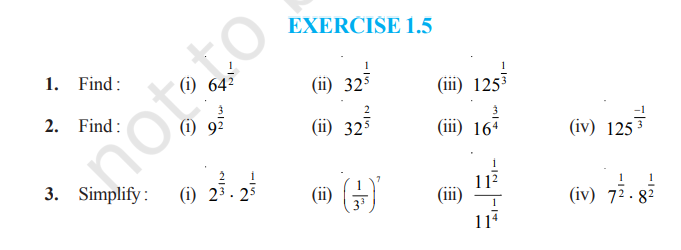
1. Find:
We will use the law $a^{\frac{1}{n}} = \sqrt[n]{a}$, which is the $n^{th}$ root of $a$.
(i) $64^{\frac{1}{2}}$
$$64^{\frac{1}{2}} = \sqrt{64}$$
Since $8 \times 8 = 64$:
$$64^{\frac{1}{2}} = 8$$
(ii) $32^{\frac{1}{5}}$
$$32^{\frac{1}{5}} = \sqrt[5]{32}$$
Since $2 \times 2 \times 2 \times 2 \times 2 = 2^5 = 32$:
$$32^{\frac{1}{5}} = (2^5)^{\frac{1}{5}} = 2^{5 \times \frac{1}{5}} = 2^1 = 2$$
(iii) $125^{\frac{1}{3}}$
$$125^{\frac{1}{3}} = \sqrt[3]{125}$$
Since $5 \times 5 \times 5 = 5^3 = 125$:
$$125^{\frac{1}{3}} = (5^3)^{\frac{1}{3}} = 5^{3 \times \frac{1}{3}} = 5^1 = 5$$
2. Find:
We will use the law $(a^m)^n = a^{mn}$.
(i) $9^{\frac{3}{2}}$
Write $9$ as a power of 3 ($9 = 3^2$):
$$9^{\frac{3}{2}} = (3^2)^{\frac{3}{2}}$$
$$= 3^{2 \times \frac{3}{2}}$$
$$= 3^3$$
$$= 27$$
(ii) $32^{\frac{2}{5}}$
Write $32$ as a power of 2 ($32 = 2^5$):
$$32^{\frac{2}{5}} = (2^5)^{\frac{2}{5}}$$
$$= 2^{5 \times \frac{2}{5}}$$
$$= 2^2$$
$$= 4$$
(iii) $16^{\frac{3}{4}}$
Write $16$ as a power of 2 ($16 = 2^4$):
$$16^{\frac{3}{4}} = (2^4)^{\frac{3}{4}}$$
$$= 2^{4 \times \frac{3}{4}}$$
$$= 2^3$$
$$= 8$$
(iv) $125^{-\frac{1}{3}}$
Use the law $a^{-m} = \frac{1}{a^m}$ and write $125$ as $5^3$:
$$125^{-\frac{1}{3}} = \frac{1}{125^{\frac{1}{3}}}$$
$$= \frac{1}{(5^3)^{\frac{1}{3}}}$$
$$= \frac{1}{5^{3 \times \frac{1}{3}}}$$
$$= \frac{1}{5^1} = \frac{1}{5}$$
3. Simplify:
We will apply the various laws of exponents: $a^m \cdot a^n = a^{m+n}$, $\frac{a^m}{a^n} = a^{m-n}$, and $a^m b^m = (ab)^m$.
(i) $2^{\frac{2}{3}} \cdot 2^{\frac{1}{5}}$
Use the law $a^m \cdot a^n = a^{m+n}$:
$$2^{\frac{2}{3}} \cdot 2^{\frac{1}{5}} = 2^{\frac{2}{3} + \frac{1}{5}}$$
Find the common denominator (15) for the exponents:
$$= 2^{\frac{(2 \times 5) + (1 \times 3)}{15}}$$
$$= 2^{\frac{10 + 3}{15}}$$
$$= 2^{\frac{13}{15}}$$
(ii) $\left(\frac{1}{3^3}\right)^7$
Use the laws $(\frac{a}{b})^m = \frac{a^m}{b^m}$ and $\frac{1}{a^m} = a^{-m}$, then $(a^m)^n = a^{mn}$:
$$\left(\frac{1}{3^3}\right)^7 = \frac{1^7}{(3^3)^7}$$
$$= \frac{1}{3^{3 \times 7}}$$
$$= \frac{1}{3^{21}} \quad \text{or} \quad 3^{-21}$$
(iii) $\frac{11^{\frac{1}{2}}}{11^{\frac{1}{4}}}$
Use the law $\frac{a^m}{a^n} = a^{m-n}$:
$$\frac{11^{\frac{1}{2}}}{11^{\frac{1}{4}}} = 11^{\frac{1}{2} – \frac{1}{4}}$$
Find the common denominator (4) for the exponents:
$$= 11^{\frac{2}{4} – \frac{1}{4}}$$
$$= 11^{\frac{1}{4}}$$
(iv) $7^{\frac{1}{2}} \cdot 8^{\frac{1}{2}}$
Use the law $a^m b^m = (ab)^m$:
$$7^{\frac{1}{2}} \cdot 8^{\frac{1}{2}} = (7 \times 8)^{\frac{1}{2}}$$
$$= 56^{\frac{1}{2}} \quad \text{or} \quad \sqrt{56}$$
❓ Frequently Asked Questions (FAQs) on Laws of Exponents
Q: What is the rule for multiplying powers with the same base?
A: When multiplying two terms with the same base, you add the exponents. The rule is $a^m \cdot a^n = a^{m+n}$. For example, $2^{\frac{2}{3}} \cdot 2^{\frac{1}{5}} = 2^{\frac{2}{3} + \frac{1}{5}} = 2^{\frac{13}{15}}$.
Q: How do you simplify a number raised to a negative exponent?
A: A number raised to a negative exponent is equal to the reciprocal of the base raised to the positive exponent. The rule is $a^{-m} = \frac{1}{a^m}$. For example, $125^{-\frac{1}{3}} = \frac{1}{125^{\frac{1}{3}}} = \frac{1}{5}$.
Q: What does a fractional exponent like $a^{\frac{1}{n}}$ mean?
A: A fractional exponent $a^{\frac{1}{n}}$ means finding the $n^{th}$ root of the base $a$. For example, $64^{\frac{1}{2}}$ means the square root of 64, which is 8. Similarly, $125^{\frac{1}{3}}$ means the cube root of 125, which is 5.
Q: What is the rule for simplifying powers that have the same exponent?
A: When multiplying two terms with different bases but the same exponent, you can multiply the bases together and raise the product to that common exponent. The rule is $a^m b^m = (ab)^m$. For example, $7^{\frac{1}{2}} \cdot 8^{\frac{1}{2}} = (7 \times 8)^{\frac{1}{2}} = 56^{\frac{1}{2}}$.