
Get step-by-step solutions for NCERT Class 12 Maths Exercise 13.1 (Probability). Master the Conditional Probability formula,
This exercise focuses on calculating conditional probability, defined as:
$$P(E|F) = \frac{P(E \cap F)}{P(F)}, \quad \text{where } P(F) > 0$$
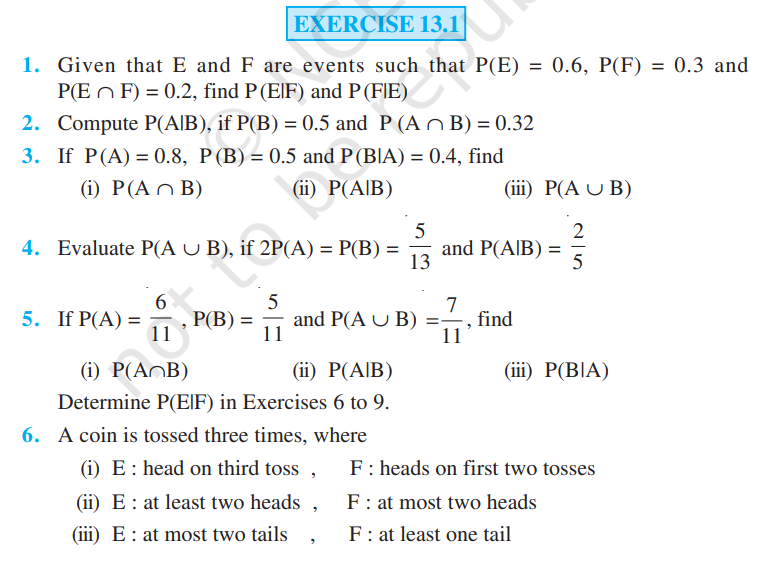
1. Given $P(E) = 0.6$, $P(F) = 0.3$, and $P(E \cap F) = 0.2$. Find $P(E|F)$ and $P(F|E)$.
- $P(E|F) = \frac{P(E \cap F)}{P(F)} = \frac{0.2}{0.3} = \mathbf{2/3}$
- $P(F|E) = \frac{P(E \cap F)}{P(E)} = \frac{0.2}{0.6} = \mathbf{1/3}$
2. Compute $P(A|B)$, if $P(B) = 0.5$ and $P(A \cap B) = 0.32$.
- $P(A|B) = \frac{P(A \cap B)}{P(B)} = \frac{0.32}{0.5} = \frac{32}{50} = \mathbf{16/25}$ or 0.64
3. If $P(A) = 0.8$, $P(B) = 0.5$ and $P(B|A) = 0.4$, find (i) $P(A \cap B)$, (ii) $P(A|B)$, (iii) $P(A \cup B)$.
(i) $P(A \cap B)$
Using $P(B|A) = \frac{P(A \cap B)}{P(A)}$:
$$P(A \cap B) = P(B|A) \cdot P(A) = 0.4 \times 0.8 = \mathbf{0.32}$$
(ii) $P(A|B)$
Using $P(A|B) = \frac{P(A \cap B)}{P(B)}$:
$$P(A|B) = \frac{0.32}{0.5} = \mathbf{0.64}$$
(iii) $P(A \cup B)$
Using $P(A \cup B) = P(A) + P(B) – P(A \cap B)$:
$$P(A \cup B) = 0.8 + 0.5 – 0.32 = 1.3 – 0.32 = \mathbf{0.98}$$
4. Evaluate $P(A \cup B)$, if $2P(A) = P(B) = 5/13$ and $P(A|B) = 2/5$.
- Find $P(A)$ and $P(B)$:
- $P(B) = 5/13$
- $P(A) = \frac{1}{2} P(B) = \frac{1}{2} \times \frac{5}{13} = 5/26$
- Find $P(A \cap B)$:Using $P(A|B) = \frac{P(A \cap B)}{P(B)}$:$$P(A \cap B) = P(A|B) \cdot P(B) = \frac{2}{5} \times \frac{5}{13} = 2/13$$
- Find $P(A \cup B)$:$$P(A \cup B) = P(A) + P(B) – P(A \cap B)$$$$P(A \cup B) = \frac{5}{26} + \frac{5}{13} – \frac{2}{13} = \frac{5}{26} + \frac{10}{26} – \frac{4}{26} = \frac{5 + 10 – 4}{26} = \mathbf{11/26}$$
5. If $P(A) = 6/11$, $P(B) = 5/11$ and $P(A \cup B) = 7/11$, find (i) $P(A \cap B)$, (ii) $P(A|B)$, (iii) $P(B|A)$.
(i) $P(A \cap B)$
Using $P(A \cap B) = P(A) + P(B) – P(A \cup B)$:
$$P(A \cap B) = \frac{6}{11} + \frac{5}{11} – \frac{7}{11} = \frac{11 – 7}{11} = \mathbf{4/11}$$
(ii) $P(A|B)$
$$P(A|B) = \frac{P(A \cap B)}{P(B)} = \frac{4/11}{5/11} = \mathbf{4/5}$$
(iii) $P(B|A)$
$$P(B|A) = \frac{P(A \cap B)}{P(A)} = \frac{4/11}{6/11} = 4/6 = \mathbf{2/3}$$
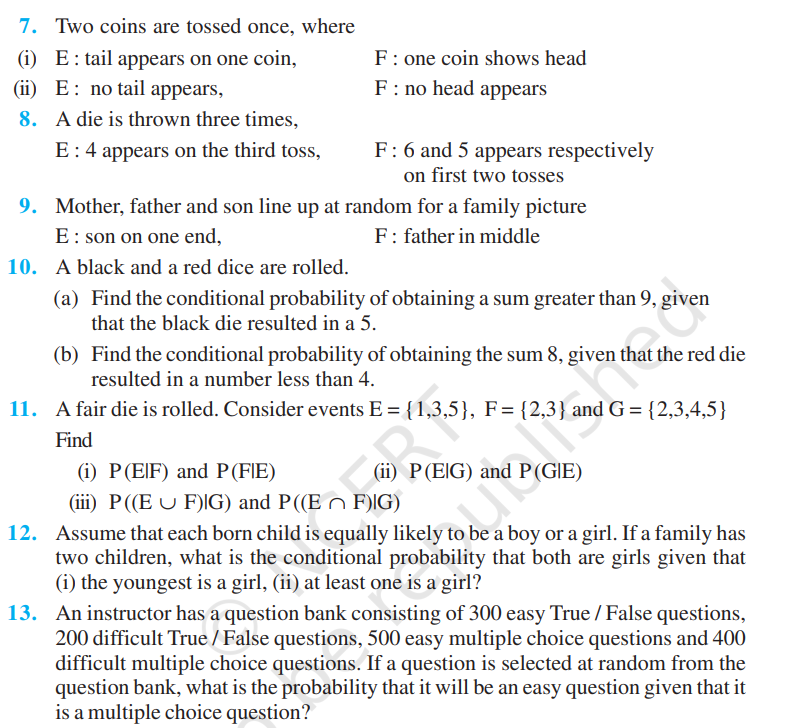
Determine $P(E|F)$ in Exercises 6 to 9.
6. A coin is tossed three times. $S = \{HHH, HHT, HTH, THH, HTT, THT, TTH, TTT\}$, $|S|=8$.
(i) $E$ : head on third toss, $F$ : heads on first two tosses
- $E = \{HHH, HTH, THH, TTH\}$
- $F = \{HHH, HHT\}$
- $E \cap F = \{HHH\}$
- $P(E \cap F) = 1/8$, $P(F) = 2/8 = 1/4$$$P(E|F) = \frac{P(E \cap F)}{P(F)} = \frac{1/8}{1/4} = \mathbf{1/2}$$
(ii) $E$ : at least two heads, $F$ : at most two heads
- $E = \{HHH, HHT, HTH, THH\}$
- $F = \{HHT, HTH, THH, HTT, THT, TTH, TTT\}$ (All outcomes except HHH)
- $E \cap F = \{HHT, HTH, THH\}$
- $P(E \cap F) = 3/8$, $P(F) = 7/8$$$P(E|F) = \frac{P(E \cap F)}{P(F)} = \frac{3/8}{7/8} = \mathbf{3/7}$$
(iii) $E$ : at most two tails, $F$ : at least one tail
- $E = \{HHH, HHT, HTH, THH, HTT, THT, TTH\}$ (All outcomes except TTT)
- $F = \{HHT, HTH, THH, HTT, THT, TTH, TTT\}$ (All outcomes except HHH)
- $E \cap F = \{HHT, HTH, THH, HTT, THT, TTH\}$
- $P(E \cap F) = 6/8 = 3/4$, $P(F) = 7/8$$$P(E|F) = \frac{P(E \cap F)}{P(F)} = \frac{6/8}{7/8} = \mathbf{6/7}$$
7. Two coins are tossed once. $S = \{HH, HT, TH, TT\}$, $|S|=4$.
(i) $E$ : tail appears on one coin, $F$ : one coin shows head
- $E = \{HT, TH\}$
- $F = \{HT, TH\}$
- $E \cap F = \{HT, TH\}$
- $P(E \cap F) = 2/4 = 1/2$, $P(F) = 2/4 = 1/2$$$P(E|F) = \frac{1/2}{1/2} = \mathbf{1}$$
(ii) $E$ : no tail appears, $F$ : no head appears
- $E = \{HH\}$
- $F = \{TT\}$
- $E \cap F = \emptyset$
- $P(E \cap F) = 0$, $P(F) = 1/4$$$P(E|F) = \frac{0}{1/4} = \mathbf{0}$$
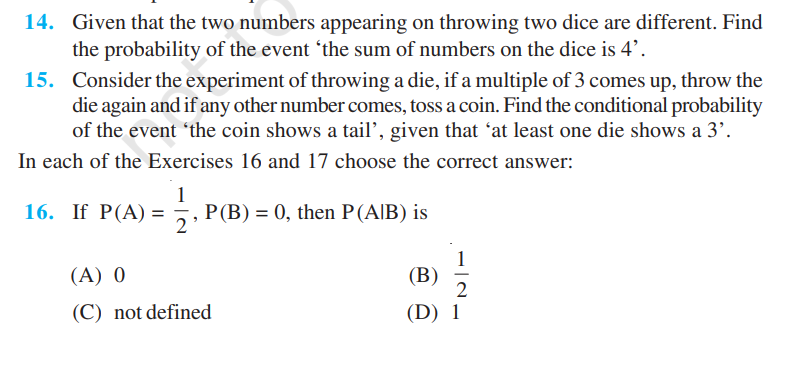
8. A die is thrown three times. $|S| = 6^3 = 216$.
$E$ : 4 appears on the third toss, $F$ : 6 and 5 appears respectively on first two tosses
- $F$ is the event that the first toss is 6 and the second toss is 5. The third toss can be any of $\{1, 2, 3, 4, 5, 6\}$.$$F = \{(6, 5, 1), (6, 5, 2), (6, 5, 3), (6, 5, 4), (6, 5, 5), (6, 5, 6)\}, |F|=6$$
- $E$ is the event that the third toss is 4.
- $E \cap F$ is the event that (1st is 6, 2nd is 5, 3rd is 4).$$E \cap F = \{(6, 5, 4)\}, |E \cap F|=1$$
- $P(E \cap F) = 1/216$, $P(F) = 6/216$$$P(E|F) = \frac{P(E \cap F)}{P(F)} = \frac{1/216}{6/216} = \mathbf{1/6}$$
9. Mother, father and son line up at random for a family picture. $|S| = 3! = 6$.
Let M, F, S denote Mother, Father, Son.
$S = \{MFS, MSF, FMS, FSM, SMF, SFM\}$
$E$ : son on one end, $F$ : father in middle
- $E = \{S\underline{MF}, S\underline{FM}, \underline{MF}S, \underline{FM}S\}$, $|E|=4$
- $F = \{MFS, S\underline{FM}\}$, $|F|=2$
- $E \cap F = \{MFS, SFM\}$
- $P(E \cap F) = 2/6 = 1/3$, $P(F) = 2/6 = 1/3$$$P(E|F) = \frac{1/3}{1/3} = \mathbf{1}$$
10. A black and a red die are rolled. $|S| = 36$.
Let B be the result on the black die and R be the result on the red die.
(a) Conditional probability of obtaining a sum greater than 9, given that the black die resulted in a 5.
- $E$: Sum greater than $9 \implies E = \{(4, 6), (5, 5), (5, 6), (6, 4), (6, 5), (6, 6)\}$.
- $F$: Black die resulted in a $5 \implies F = \{(5, 1), (5, 2), (5, 3), (5, 4), (5, 5), (5, 6)\}$.
- $E \cap F = \{(5, 5), (5, 6)\}$, $|E \cap F|=2$, $|F|=6$$$P(E|F) = \frac{|E \cap F|}{|F|} = 2/6 = \mathbf{1/3}$$
(b) Conditional probability of obtaining the sum 8, given that the red die resulted in a number less than 4.
- $E$: Sum $8 \implies E = \{(2, 6), (3, 5), (4, 4), (5, 3), (6, 2)\}$.
- $F$: Red die resulted in a number $< 4 \implies R \in \{1, 2, 3\}$. $|F| = 6 \times 3 = 18$.
- $E \cap F$: Sum is 8 and Red die is 1, 2, or 3.$$E \cap F = \{(5, 3), (6, 2)\}$$
- $|E \cap F|=2$, $|F|=18$$$P(E|F) = \frac{|E \cap F|}{|F|} = 2/18 = \mathbf{1/9}$$
11. A fair die is rolled. $S = \{1, 2, 3, 4, 5, 6\}$. $E = \{1, 3, 5\}$, $F = \{2, 3\}$, $G = \{2, 3, 4, 5\}$.
- $P(E) = 3/6 = 1/2$, $P(F) = 2/6 = 1/3$, $P(G) = 4/6 = 2/3$.
(i) $P(E|F)$ and $P(F|E)$
- $E \cap F = \{3\}$. $P(E \cap F) = 1/6$.$$P(E|F) = \frac{P(E \cap F)}{P(F)} = \frac{1/6}{2/6} = \mathbf{1/2}$$$$P(F|E) = \frac{P(E \cap F)}{P(E)} = \frac{1/6}{3/6} = \mathbf{1/3}$$
(ii) $P(E|G)$ and $P(G|E)$
- $E \cap G = \{3, 5\}$. $P(E \cap G) = 2/6 = 1/3$.$$P(E|G) = \frac{P(E \cap G)}{P(G)} = \frac{2/6}{4/6} = \mathbf{1/2}$$
- $P(G|E) = \frac{P(E \cap G)}{P(E)} = \frac{2/6}{3/6} = \mathbf{2/3}$$
(iii) $P((E \cup F)|G)$ and $P((E \cap F)|G)$
- $E \cup F = \{1, 2, 3, 5\}$.
- $(E \cup F) \cap G = \{2, 3, 5\}$. $P((E \cup F) \cap G) = 3/6 = 1/2$.$$P((E \cup F)|G) = \frac{P((E \cup F) \cap G)}{P(G)} = \frac{3/6}{4/6} = \mathbf{3/4}$$
- $E \cap F = \{3\}$.
- $(E \cap F) \cap G = \{3\}$. $P((E \cap F) \cap G) = 1/6$.$$P((E \cap F)|G) = \frac{P((E \cap F) \cap G)}{P(G)} = \frac{1/6}{4/6} = \mathbf{1/4}$$
12. Family with two children. $S = \{BB, BG, GB, GG\}$, $|S|=4$.
(i) Conditional probability that both are girls ($E$), given that the youngest is a girl ($F$).
- $E$: Both girls $\implies E = \{GG\}$
- $F$: Youngest is a girl $\implies F = \{BG, GG\}$
- $E \cap F = \{GG\}$$$P(E|F) = \frac{|E \cap F|}{|F|} = 1/2$$
(ii) Conditional probability that both are girls ($E$), given that at least one is a girl ($F$).
- $E$: Both girls $\implies E = \{GG\}$
- $F$: At least one girl $\implies F = \{BG, GB, GG\}$
- $E \cap F = \{GG\}$$$P(E|F) = \frac{|E \cap F|}{|F|} = \mathbf{1/3}$$
13. Question bank probability.
Total number of questions $= 300 + 200 + 500 + 400 = 1400$.
- $E$: Question is easy. $|E| = 300 (\text{T/F}) + 500 (\text{MC}) = 800$.
- $F$: Question is multiple choice. $|F| = 500 (\text{Easy}) + 400 (\text{Difficult}) = 900$.
- $E \cap F$: Question is easy AND multiple choice. $|E \cap F| = 500$.
Find $P(E|F) = \frac{|E \cap F|}{|F|}$.
$$P(E|F) = \frac{500}{900} = \mathbf{5/9}$$
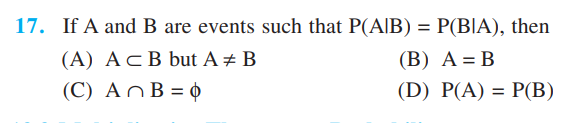
14. Two dice are thrown. Find $P(E|F)$.
- $F$: The two numbers appearing are different.$|F| = 36 – 6 (\text{doubles}) = 30$.
- $E$: The sum of numbers on the dice is 4.$E = \{(1, 3), (2, 2), (3, 1)\}$.
- $E \cap F$: Sum is 4 AND numbers are different.$E \cap F = \{(1, 3), (3, 1)\}$. $|E \cap F| = 2$.$$P(E|F) = \frac{|E \cap F|}{|F|} = \mathbf{2/30} = \mathbf{1/15}$$
15. Throwing a die and potentially a coin/die.
Let $S$ be the sample space.
Rule: If multiple of 3 ($\{3, 6\}$) comes up, throw die again ($\{1, \dots, 6\}$). If any other number ($\{1, 2, 4, 5\}$) comes up, toss a coin ($\{H, T\}$).
- $E$: The coin shows a tail.$E$ occurs when the first throw is $\{1, 2, 4, 5\}$ AND the coin toss is $T$.$$E = \{(1, T), (2, T), (4, T), (5, T)\}. |E|=4$$
- $F$: At least one die shows a 3.$F$ occurs if:
- First throw is $3$ (and second is anything): $3 \times \{1, 2, 3, 4, 5, 6\}$. Outcomes containing 3: $(3, 1), (3, 2), (3, 3), (3, 4), (3, 5), (3, 6)$.
- First throw is $6$ (and second is $3$): $(6, 3)$.
- First throw is $1, 2, 4, 5$ (coin toss, so no 3 involved).$$F = \{(3, 1), (3, 2), (3, 3), (3, 4), (3, 5), (3, 6), (6, 3)\}. |F|=7$$
- $E \cap F$: The intersection is the set of outcomes where a coin is tossed AND at least one die shows 3.Since $E$ involves a coin toss, the first die must be $\{1, 2, 4, 5\}$. None of these outcomes can involve a die showing 3, so $E \cap F = \emptyset$.Wait, the definition of the experiment must be used to define the conditional probability. Let’s use the total probability approach.
Sample Space and Probability (Total 10 outcomes $\times$ 6 die/2 coin possibilities)
- $P(\text{First is } 3 \text{ or } 6) = 2/6 = 1/3$.
- $P(\text{First is } 1, 2, 4, 5) = 4/6 = 2/3$.The total probability space sums to 1.$$P(S) = P(\{3, 6\} \times \{1, \dots, 6\}) + P(\{1, 2, 4, 5\} \times \{H, T\}) = 1$$$$P(3, k) = P(6, k) = (1/6) \times (1/6) = 1/36 \quad (k=1 \dots 6)$$$$P(j, H) = P(j, T) = (1/6) \times (1/2) = 1/12 \quad (j=1, 2, 4, 5)$$
- $E$: Coin shows a tail.$$P(E) = P(1, T) + P(2, T) + P(4, T) + P(5, T) = 4 \times 1/12 = 4/12 = 1/3$$
- $F$: At least one die shows a 3.$$F = \{(3, 1), (3, 2), (3, 3), (3, 4), (3, 5), (3, 6), (6, 3)\}$$$$P(F) = 7 \times 1/36 = 7/36$$
- $E \cap F$: No outcome in $E$ can be in $F$, since $E$ only includes first throws of $\{1, 2, 4, 5\}$ and the second outcome is a coin toss (not a die throw). Thus, $P(E \cap F) = 0$.$$P(E|F) = \frac{P(E \cap F)}{P(F)} = \frac{0}{7/36} = \mathbf{0}$$
Multiple Choice Questions
16. If $P(A) = 1/2$, $P(B) = 0$, then $P(A|B)$ is
The conditional probability $P(A|B) = \frac{P(A \cap B)}{P(B)}$ is only defined when $P(B) > 0$. Since $P(B) = 0$, $P(A|B)$ is not defined.
Answer: (C) not defined
17. If $A$ and $B$ are events such that $P(A|B) = P(B|A)$, then
Given $P(A|B) = P(B|A)$. Using the definition:
$$\frac{P(A \cap B)}{P(B)} = \frac{P(A \cap B)}{P(A)}$$
Assuming $P(A \cap B) \ne 0$:
$$\frac{1}{P(B)} = \frac{1}{P(A)}$$
$$P(A) = P(B)$$
Answer: (D) $P(A) = P(B)$