
Get step-by-step Rbse Solutions for Class 9 Maths Chapter 1 Exercise 1.4. Master classifying rational/irrational numbers, simplifying surds, and learning the crucial technique of rationalizing denominators. Ideal for CBSE/RBSE students.
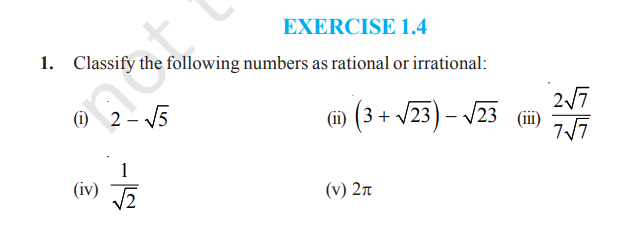

1. Classify the following numbers as rational or irrational:
(i) $2\sqrt{5} – 5$
Classification: Irrational
Reason: The product of a non-zero rational number ($2$) and an irrational number ($\sqrt{5}$) is irrational ($2\sqrt{5}$). The difference between an irrational number ($2\sqrt{5}$) and a rational number ($5$) is always irrational.
(ii) $(3 + \sqrt{23}) – \sqrt{23}$
Classification: Rational
Reason: Simplify the expression:
$$(3 + \sqrt{23}) – \sqrt{23} = 3 + \sqrt{23} – \sqrt{23} = 3$$
Since $3 = \frac{3}{1}$, it is a rational number.
(iii) $\frac{2\sqrt{7}}{7\sqrt{7}}$
Classification: Rational
Reason: Simplify the expression by canceling the common irrational factor $\sqrt{7}$:
$$\frac{2\sqrt{7}}{7\sqrt{7}} = \frac{2}{7}$$
Since $\frac{2}{7}$ is in the form $\frac{p}{q}$, it is a rational number.
(iv) $\frac{1}{\sqrt{2}}$
Classification: Irrational
Reason: The quotient of a rational number ($1$) and an irrational number ($\sqrt{2}$) is always irrational.
(v) $2\pi$
Classification: Irrational
Reason: $\pi$ is an irrational number. The product of a non-zero rational number ($2$) and an irrational number ($\pi$) is always irrational.
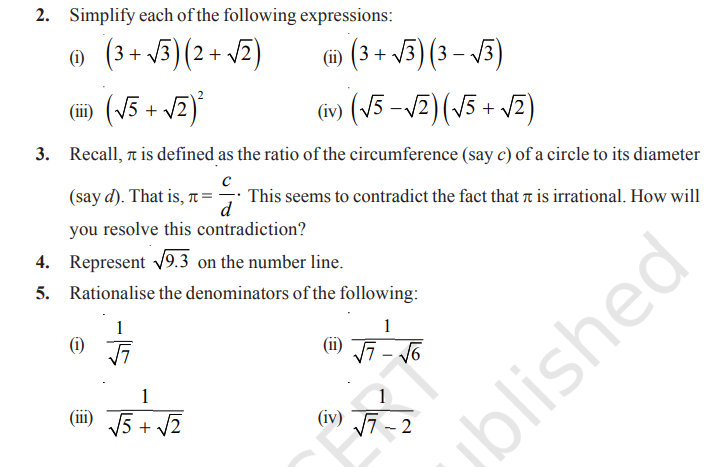
2. Simplify each of the following expressions:
(i) $(3 + \sqrt{3})(2 + \sqrt{2})$
Use the distributive property (FOIL method):
$$(3 + \sqrt{3})(2 + \sqrt{2}) = 3(2) + 3(\sqrt{2}) + \sqrt{3}(2) + \sqrt{3}(\sqrt{2})$$
$$= 6 + 3\sqrt{2} + 2\sqrt{3} + \sqrt{6}$$
(ii) $(3 + \sqrt{3})(3 – \sqrt{3})$
Use the identity $(a+b)(a-b) = a^2 – b^2$, where $a=3$ and $b=\sqrt{3}$:
$$(3)^2 – (\sqrt{3})^2$$
$$= 9 – 3$$
$$= 6$$
(iii) $(\sqrt{5} + \sqrt{2})^2$
Use the identity $(a+b)^2 = a^2 + 2ab + b^2$, where $a=\sqrt{5}$ and $b=\sqrt{2}$:
$$(\sqrt{5})^2 + 2(\sqrt{5})(\sqrt{2}) + (\sqrt{2})^2$$
$$= 5 + 2\sqrt{10} + 2$$
$$= 7 + 2\sqrt{10}$$
(iv) $(\sqrt{5} – \sqrt{2})(\sqrt{5} + \sqrt{2})$
Use the identity $(a-b)(a+b) = a^2 – b^2$, where $a=\sqrt{5}$ and $b=\sqrt{2}$:
$$(\sqrt{5})^2 – (\sqrt{2})^2$$
$$= 5 – 2$$
$$= 3$$
3. Recall, $\pi$ is defined as the ratio of the circumference ($c$) of a circle to its diameter ($d$). That is, $\pi = \frac{c}{d}$. This seems to contradict the fact that $\pi$ is irrational. How will you resolve this contradiction?
Answer:
There is no contradiction.
The definition $\pi = \frac{c}{d}$ means that $\pi$ is the ratio of two measurements (circumference $c$ and diameter $d$).
The conflict arises because we assume that since $c$ and $d$ are measurable lengths, they must be rational numbers. However, when we measure a length using any device, we only get an approximate rational value.
Resolution:
In the ratio $\frac{c}{d}$, at least one of the two quantities, $c$ or $d$, must be irrational. We cannot simultaneously have two lengths, $c$ and $d$, that are both rational and whose ratio is an irrational number ($\pi$).
When we measure $c$ and $d$, we are only finding rational approximations. The precise, theoretical lengths $c$ and $d$ are such that their ratio is the irrational number $\pi$.
4. Represent $\sqrt{9.3}$ on the number line.
Answer:
Representing $\sqrt{x}$ on the number line (where $x$ is a decimal like $9.3$) requires a specific geometric construction based on a semi-circle.
Construction Steps:
- Mark AB: Draw a line segment $AB = 9.3$ units on the number line.
- Mark C: Extend $AB$ by 1 unit to a point $C$. So, $BC = 1$ unit. $AC = 9.3 + 1 = 10.3$ units.
- Find Midpoint O: Find the midpoint O of $AC$. ($O = \frac{10.3}{2} = 5.15$ units from A).
- Draw Semi-Circle: With $O$ as the center and $OA$ (or $OC$) as the radius, draw a semi-circle.
- Draw Perpendicular: Draw a line segment $BD$ perpendicular to $AC$ at point $B$, intersecting the semi-circle at $D$.
- Geometric Fact: The length of $BD$ will be $\sqrt{9.3}$.
- Mark $\sqrt{9.3}$: With $B$ as the center and $BD$ as the radius, draw an arc that intersects the number line at point E.
The point E on the number line represents $\sqrt{9.3}$.
5. Rationalise the denominators of the following:
(i) $\frac{1}{\sqrt{7}}$
Multiply the numerator and denominator by $\sqrt{7}$:
$$\frac{1}{\sqrt{7}} \times \frac{\sqrt{7}}{\sqrt{7}} = \frac{\sqrt{7}}{7}$$
(ii) $\frac{1}{\sqrt{7} – \sqrt{6}}$
Multiply the numerator and denominator by the conjugate of the denominator, which is $\sqrt{7} + \sqrt{6}$:
$$\frac{1}{\sqrt{7} – \sqrt{6}} \times \frac{\sqrt{7} + \sqrt{6}}{\sqrt{7} + \sqrt{6}}$$
Use the identity $(a-b)(a+b) = a^2 – b^2$ in the denominator:
$$= \frac{\sqrt{7} + \sqrt{6}}{(\sqrt{7})^2 – (\sqrt{6})^2}$$
$$= \frac{\sqrt{7} + \sqrt{6}}{7 – 6}$$
$$= \sqrt{7} + \sqrt{6}$$
(iii) $\frac{1}{\sqrt{5} + \sqrt{2}}$
Multiply by the conjugate, $\sqrt{5} – \sqrt{2}$:
$$\frac{1}{\sqrt{5} + \sqrt{2}} \times \frac{\sqrt{5} – \sqrt{2}}{\sqrt{5} – \sqrt{2}}$$
$$= \frac{\sqrt{5} – \sqrt{2}}{(\sqrt{5})^2 – (\sqrt{2})^2}$$
$$= \frac{\sqrt{5} – \sqrt{2}}{5 – 2}$$
$$= \frac{\sqrt{5} – \sqrt{2}}{3}$$
(iv) $\frac{1}{\sqrt{7} – 2}$
Multiply by the conjugate, $\sqrt{7} + 2$:
$$\frac{1}{\sqrt{7} – 2} \times \frac{\sqrt{7} + 2}{\sqrt{7} + 2}$$
$$= \frac{\sqrt{7} + 2}{(\sqrt{7})^2 – (2)^2}$$
$$= \frac{\sqrt{7} + 2}{7 – 4}$$
$$= \frac{\sqrt{7} + 2}{3}$$
❓ Frequently Asked Questions (FAQs) on Operations with Irrational Numbers
Q: How do you classify a sum or product involving an irrational number?
A: Generally, the sum, difference, product, or quotient of a rational number and an irrational number is always irrational. For example, $2 + \sqrt{5}$ is irrational. The only exception is the product of an irrational number and the rational number zero, which results in $0$ (a rational number).
Q: What is the rule for simplifying the product of two irrational terms like $(3 + \sqrt{3})(3 – \sqrt{3})$?
A: These expressions use the algebraic identity $(a+b)(a-b) = a^2 – b^2$. In this specific case, the result is $(3)^2 – (\sqrt{3})^2 = 9 – 3 = 6$. This identity is crucial because it allows the irrational parts to cancel out, resulting in a rational number.
Q: Why is $\pi = \frac{c}{d}$ not a contradiction to the fact that $\pi$ is irrational?
A: The relationship $\pi = \frac{c}{d}$ means $\pi$ is a ratio of two lengths. This is not a contradiction because in this ratio, at least one of the measured lengths ($c$ or $d$) must be irrational. We only find rational approximations when we use a physical measuring device, but mathematically, the ratio only holds true if one quantity is irrational.
Q: What is the purpose of rationalizing the denominator?
A: Rationalizing the denominator is a technique used to convert an expression with an irrational number in the denominator (e.g., $\frac{1}{\sqrt{7}}$ or $\frac{1}{\sqrt{7}-2}$) into an equivalent expression where the denominator is a rational number (e.g., $\frac{\sqrt{7}}{7}$). This makes the expression easier to calculate and manipulate mathematically.