
Rbse Solutions for Class 9 Maths Chapter 4 Exercise 4.2
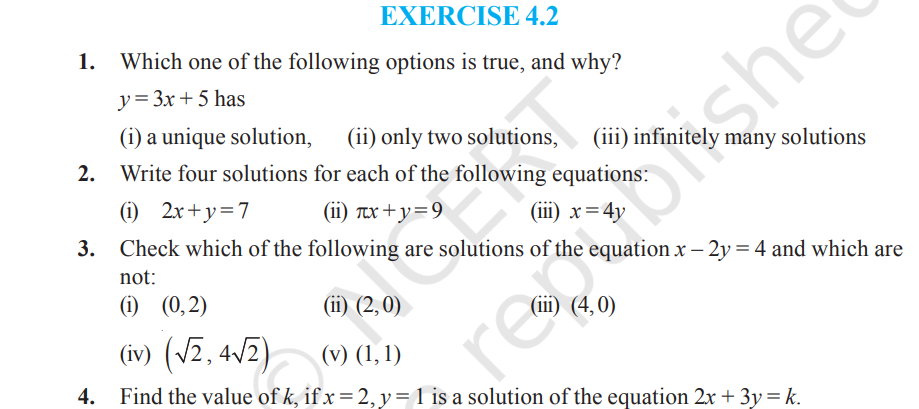

1. Which one of the following options is true, and why?
The equation $y = 3x + 5$ has:
(i) a unique solution, (ii) only two solutions, (iii) infinitely many solutions
Answer: (iii) Infinitely many solutions is the correct option.
Reason:
A linear equation in two variables (like $y = 3x + 5$) represents a straight line when graphed on the Cartesian plane. Since a straight line is made up of an infinite number of points, and every point on the line corresponds to a solution, the equation has infinitely many solutions.
For every real value you choose for $x$, you can calculate a corresponding unique real value for $y$, forming an ordered pair $(x, y)$ that satisfies the equation.
2. Write four solutions for each of the following equations:
To find solutions, choose any value for one variable (say $x$) and solve for the other variable ($y$).
(i) $2x + y = 7$
Rewrite the equation as $y = 7 – 2x$.
- Let $x = 0$:$y = 7 – 2(0) = 7$.Solution: (0, 7)
- Let $x = 1$:$y = 7 – 2(1) = 7 – 2 = 5$.Solution: (1, 5)
- Let $x = -1$:$y = 7 – 2(-1) = 7 + 2 = 9$.Solution: (-1, 9)
- Let $x = 2$:$y = 7 – 2(2) = 7 – 4 = 3$.Solution: (2, 3)
(ii) $\pi x + y = 9$
Rewrite the equation as $y = 9 – \pi x$.
- Let $x = 0$:$y = 9 – \pi(0) = 9$.Solution: (0, 9)
- Let $x = 1$:$y = 9 – \pi(1) = 9 – \pi$.Solution: (1, 9 – $\pi$)
- Let $x = 2$:$y = 9 – \pi(2) = 9 – 2\pi$.Solution: (2, 9 – $2\pi$)
- Let $x = \frac{9}{\pi}$:$y = 9 – \pi(\frac{9}{\pi}) = 9 – 9 = 0$.Solution: ($\frac{9}{\pi}$, 0)
(iii) $x = 4y$
Rewrite the equation as $y = \frac{x}{4}$.
- Let $y = 0$:$x = 4(0) = 0$.Solution: (0, 0)
- Let $y = 1$:$x = 4(1) = 4$.Solution: (4, 1)
- Let $y = -1$:$x = 4(-1) = -4$.Solution: (-4, -1)
- Let $y = 2$:$x = 4(2) = 8$.Solution: (8, 2)
3. Check which of the following are solutions of the equation $x – 2y = 4$ and which are not:
A pair $(x, y)$ is a solution if substituting the values into the equation results in a true statement (LHS = RHS).
(i) $(0, 2)$
LHS $= x – 2y = (0) – 2(2) = -4$
Since $-4 \neq 4$ (RHS), it is not a solution.
(ii) $(2, 0)$
LHS $= x – 2y = (2) – 2(0) = 2 – 0 = 2$
Since $2 \neq 4$ (RHS), it is not a solution.
(iii) $(4, 0)$
LHS $= x – 2y = (4) – 2(0) = 4 – 0 = 4$
Since $4 = 4$ (RHS), it is a solution.
(iv) $(\sqrt{2}, 4\sqrt{2})$
LHS $= x – 2y = (\sqrt{2}) – 2(4\sqrt{2}) = \sqrt{2} – 8\sqrt{2} = -7\sqrt{2}$
Since $-7\sqrt{2} \neq 4$ (RHS), it is not a solution.
(v) $(1, 1)$
LHS $= x – 2y = (1) – 2(1) = 1 – 2 = -1$
Since $-1 \neq 4$ (RHS), it is not a solution.
4. Find the value of $k$, if $x = 2, y = 1$ is a solution of the equation $2x + 3y = k$.
Since $x=2$ and $y=1$ is a solution, substituting these values into the equation must satisfy it.
$$2x + 3y = k$$
Substitute $x=2$ and $y=1$:
$$2(2) + 3(1) = k$$
$$4 + 3 = k$$
$$\mathbf{k = 7}$$