
Get detailed, step-by-step solutions for NCERT Class 11 Maths Chapter 14 Exercise 14.1
Learn to define the Sample Space and precisely describe events for experiments involving single dice, a pair of dice, and three tossed coins (Q.2-3). Master the concept of mutually exclusive events ($E \cap F = \emptyset$) (Q.1, Q.4). Solutions cover finding unions ($A \cup B$), intersections ($A \cap B$), complements ($A’$), and set differences ($A-C$). Practice classifying events as simple or compound and determining if a set of events is exhaustive (Q.4-7).
This exercise deals with describing events and testing for mutual exclusivity in experiments involving rolling a die or tossing coins.

1. Mutually Exclusive Events (Single Die)
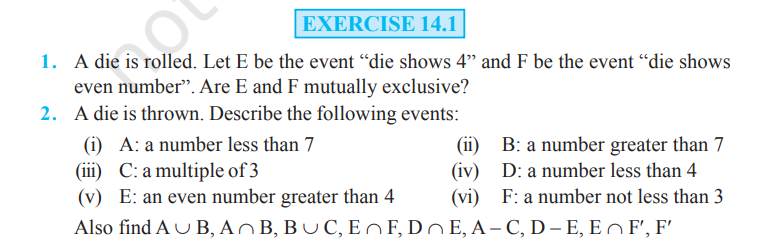
Experiment: Rolling a single die. Sample Space ($S$): $\{1, 2, 3, 4, 5, 6\}$.
- Event $E$: “die shows 4” $\implies E = \{4\}$.
- Event $F$: “die shows even number” $\implies F = \{2, 4, 6\}$.
Two events are mutually exclusive if their intersection is the empty set ($\emptyset$).
$$E \cap F = \{4\} \cap \{2, 4, 6\} = \{4\}$$
Since $E \cap F \neq \emptyset$, the events $E$ and $F$ are not mutually exclusive.
2. Describing and Combining Events (Single Die)
Experiment: Rolling a single die. Sample Space ($S$): $\{1, 2, 3, 4, 5, 6\}$.
Event Descriptions:
- (i) $A$: a number less than 7 $\implies A = \{1, 2, 3, 4, 5, 6\} = S$
- (ii) $B$: a number greater than 7 $\implies B = \{\}$ (Impossible event)
- (iii) $C$: a multiple of 3 $\implies C = \{3, 6\}$
- (iv) $D$: a number less than 4 $\implies D = \{1, 2, 3\}$
- (v) $E$: an even number greater than 4 $\implies E = \{6\}$
- (vi) $F$: a number not less than 3 (i.e., $\ge 3$) $\implies F = \{3, 4, 5, 6\}$
Combined Events:
- $A \cup B = \{1, 2, 3, 4, 5, 6\} \cup \{\} = \mathbf{\{1, 2, 3, 4, 5, 6\}}$
- $A \cap B = \{1, 2, 3, 4, 5, 6\} \cap \{\} = \mathbf{\emptyset}$
- $B \cup C = \{\} \cup \{3, 6\} = \mathbf{\{3, 6\}}$
- $E \cap F = \{6\} \cap \{3, 4, 5, 6\} = \mathbf{\{6\}}$
- $D \cap E = \{1, 2, 3\} \cap \{6\} = \mathbf{\emptyset}$
- $A – C = \{1, 2, 3, 4, 5, 6\} – \{3, 6\} = \mathbf{\{1, 2, 4, 5\}}$
- $D – E = \{1, 2, 3\} – \{6\} = \mathbf{\{1, 2, 3\}}$
Complements:
- $F’ = S – F = \{1, 2, 3, 4, 5, 6\} – \{3, 4, 5, 6\} = \{1, 2\}$
- $E \cap F’ = \{6\} \cap \{1, 2\} = \mathbf{\emptyset}$
3. Mutually Exclusive Events (Pair of Dice)
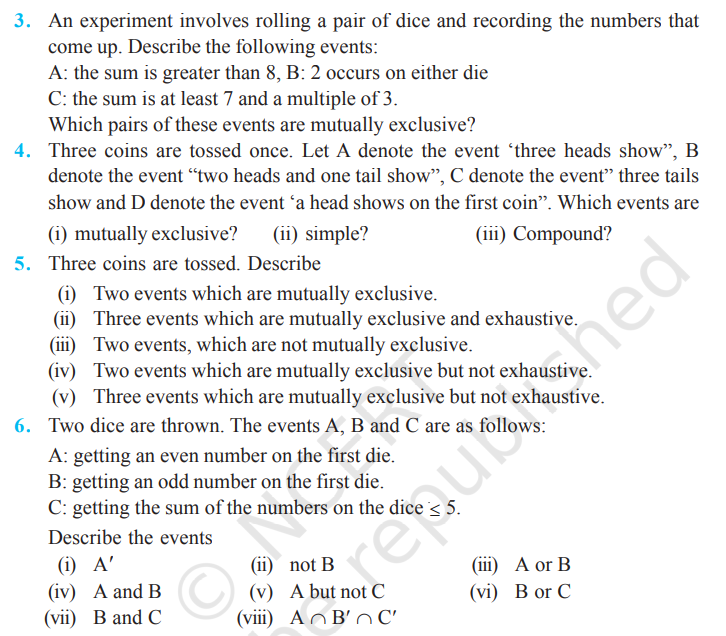
Experiment: Rolling a pair of dice. Sample Space ($S$): 36 outcomes, $(x, y)$ where $x, y \in \{1, \dots, 6\}$.
Event Descriptions:
- $A$ (Sum $> 8$): Sums are 9, 10, 11, 12.$$A = \{(3, 6), (4, 5), (5, 4), (6, 3), (4, 6), (5, 5), (6, 4), (5, 6), (6, 5), (6, 6)\}$$
- $B$ ($2$ occurs on either die):$$B = \{(2, 1), (2, 2), (2, 3), (2, 4), (2, 5), (2, 6), (1, 2), (3, 2), (4, 2), (5, 2), (6, 2)\}$$
- $C$ (Sum $\ge 7$ AND multiple of $3$): Sums can be 9 or 12.$$C = \{(3, 6), (4, 5), (5, 4), (6, 3), (6, 6)\}$$
Mutually Exclusive Pairs:
Two events $E_1, E_2$ are mutually exclusive if $E_1 \cap E_2 = \emptyset$.
- $A$ and $B$:$$A \cap B = \{(x, y) \in A \mid x=2 \text{ or } y=2\}$$The possible sums in $A$ are $9, 10, 11, 12$. The maximum sum involving a 2 is $2+6=8$.Since none of the pairs in $A$ contain a $2$, $$A \cap B = \emptyset$$$\implies A$ and $B$ are mutually exclusive.
- $B$ and $C$:$$B \cap C = \{(x, y) \in B \mid \text{sum is 9 or 12}\}$$The pairs in $B$ have maximum sum 8. None of the pairs in $B$ have a sum of 9 or 12.$$B \cap C = \emptyset$$$\implies B$ and $C$ are mutually exclusive.
- $A$ and $C$:$$A \cap C = \{(3, 6), (4, 5), (5, 4), (6, 3), (6, 6)\} = C$$Since $A \cap C \neq \emptyset$, $A$ and $C$ are not mutually exclusive.
4. Classifying Events (Three Coins)
Experiment: Tossing three coins. Sample Space ($S$): $\{HHH, HHT, HTH, THH, HTT, THT, TTH, TTT\}$.
Event Descriptions:
- $A$: ‘three heads show’ $\implies A = \{HHH\}$
- $B$: ‘two heads and one tail show’ $\implies B = \{HHT, HTH, THH\}$
- $C$: ‘three tails show’ $\implies C = \{TTT\}$
- $D$: ‘a head shows on the first coin’ $\implies D = \{HHH, HHT, HTH, HTT\}$
(i) Mutually Exclusive Events:
We check the intersection of all pairs:
- $A \cap B = \emptyset$
- $A \cap C = \emptyset$
- $B \cap C = \emptyset$
- $A \cap D = \{HHH\} = A \neq \emptyset$
- $B \cap D = \{HHT, HTH\} \neq \emptyset$
- $C \cap D = \emptyset$
Mutually exclusive pairs are: $\mathbf{(A, B), (A, C), (B, C), (C, D)}$.
(ii) Simple Events:
An event is simple if it has only one sample point.
The simple events are $\mathbf{A}$ and $\mathbf{C}$.
(iii) Compound Events:
An event is compound if it has more than one sample point.
The compound events are $\mathbf{B}$ and $\mathbf{D}$.
5. Describing Events (Three Coins)
Experiment: Tossing three coins. $S = \{HHH, HHT, HTH, THH, HTT, THT, TTH, TTT\}$.
- (i) Two events which are mutually exclusive:$E_1$: Getting exactly two heads. $E_1 = \{HHT, HTH, THH\}$.$E_2$: Getting exactly three tails. $E_2 = \{TTT\}$.$E_1 \cap E_2 = \mathbf{\emptyset}$.
- (ii) Three events which are mutually exclusive and exhaustive: (The union covers $S$)$E_1$: Getting exactly 0 heads. $E_1 = \{TTT\}$.$E_2$: Getting exactly 1 head. $E_2 = \{HTT, THT, TTH\}$.$E_3$: Getting at least 2 heads. $E_3 = \{HHH, HHT, HTH, THH\}$.$E_1, E_2, E_3$ are pairwise mutually exclusive and $E_1 \cup E_2 \cup E_3 = \mathbf{S}$.
- (iii) Two events, which are not mutually exclusive: (Intersection is not $\emptyset$)$E_1$: Head on the first flip. $E_1 = \{HHH, HHT, HTH, HTT\}$.$E_2$: Getting exactly two heads. $E_2 = \{HHT, HTH, THH\}$.$E_1 \cap E_2 = \{HHT, HTH\} \neq \mathbf{\emptyset}$.
- (iv) Two events which are mutually exclusive but not exhaustive: (Intersection is $\emptyset$, union is not $S$)$E_1$: Getting exactly 3 heads. $E_1 = \{HHH\}$.$E_2$: Getting exactly 3 tails. $E_2 = \{TTT\}$.$E_1 \cap E_2 = \emptyset$, but $E_1 \cup E_2 \neq \mathbf{S}$.
- (v) Three events which are mutually exclusive but not exhaustive:$E_1$: Getting exactly 3 heads. $E_1 = \{HHH\}$.$E_2$: Getting exactly 1 head. $E_2 = \{HTT, THT, TTH\}$.$E_3$: Getting exactly 0 heads. $E_3 = \{TTT\}$.$E_1, E_2, E_3$ are pairwise mutually exclusive, but $E_1 \cup E_2 \cup E_3$ omits the 2-head outcomes and thus is not $S$.
6. Describing and Combining Events (Two Dice)
Experiment: Rolling two dice. $S$ has 36 outcomes, $(x, y)$.
Event Descriptions:
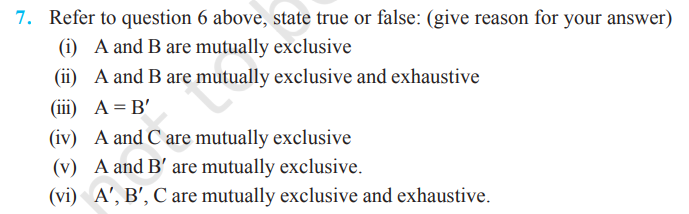
- $A$: even number on the first die. $A = \{ (x, y) \mid x \in \{2, 4, 6\} \}$. ($18$ outcomes)
- $B$: odd number on the first die. $B = \{ (x, y) \mid x \in \{1, 3, 5\} \}$. ($18$ outcomes)
- $C$: sum of the numbers $\le 5$.$$C = \{(1, 1), (1, 2), (1, 3), (1, 4), (2, 1), (2, 2), (2, 3), (3, 1), (3, 2), (4, 1)\}$$ (10 outcomes)
Combined Events:
- (i) $A’$: The complement of $A$ (first die is not even) $\implies$ first die is odd.$$\mathbf{A’ = B}$$
- (ii) not $B$ ($B’$): The complement of $B$ (first die is not odd) $\implies$ first die is even.$$\mathbf{B’ = A}$$
- (iii) $A$ or $B$ ($A \cup B$): The first die is either even or odd.$$\mathbf{A \cup B = S}$$ (Certain event)
- (iv) $A$ and $B$ ($A \cap B$): The first die is both even and odd.$$\mathbf{A \cap B = \emptyset}$$ (Impossible event)
- (v) $A$ but not $C$ ($A – C$ or $A \cap C’$): First die is even AND sum is $> 5$.$$A – C = A – \{(2, 1), (2, 2), (2, 3), (4, 1)\} = \mathbf{A \setminus \{(2, 1), (2, 2), (2, 3), (4, 1)\}}$$ (18 – 4 = 14 outcomes)
- (vi) $B$ or $C$ ($B \cup C$): First die is odd OR sum is $\le 5$.$$B \cup C = B \cup \{(1, 1), (1, 2), (1, 3), (1, 4), (2, 1), (2, 2), (2, 3), (3, 1), (3, 2), (4, 1)\}$$Since $B$ already contains $\{(1, y), (3, y), (5, y)\}$, we only add elements from $C$ not in $B$: $\{(2, 1), (2, 2), (2, 3), (4, 1)\}$.$$\mathbf{B \cup C = B \cup \{(2, 1), (2, 2), (2, 3), (4, 1)\}}$$ (18 + 4 = 22 outcomes)
- (vii) $B$ and $C$ ($B \cap C$): First die is odd AND sum is $\le 5$.$$B \cap C = \{(1, 1), (1, 2), (1, 3), (1, 4), (3, 1), (3, 2)\}$$ (6 outcomes)
- (viii) $A \cap B’ \cap C’$: Since $B’ = A$, this is $A \cap A \cap C’ = A \cap C’$.$$A \cap C’ = A – C$$$$\mathbf{A \cap B’ \cap C’ = A – C}$$ (Same as (v))
7. True or False Statements (Two Dice)
Events $A, B, C$ are defined in Q.6.
- (i) $A$ and $B$ are mutually exclusive.True. $A \cap B = \emptyset$ (First die cannot be both even and odd).
- (ii) $A$ and $B$ are mutually exclusive and exhaustive.True. They are mutually exclusive (i), and $A \cup B = S$ (The first die must be even or odd, covering all outcomes).
- (iii) $A = B’$True. $B’$ is the event that the first die is not odd, which means the first die is even. This is the definition of $A$.
- (iv) $A$ and $C$ are mutually exclusive.False. $A$ (first die even) and $C$ (sum $\le 5$) share outcomes like $(2, 1), (2, 2), (2, 3), (4, 1)$. Since $A \cap C \neq \emptyset$.
- (v) $A$ and $B’$ are mutually exclusive.False. Since $B’=A$, the events are $A$ and $A$. $A \cap A = A$. Since $A \neq \emptyset$, they are not mutually exclusive.
- (vi) $A’, B’, C$ are mutually exclusive and exhaustive.False.
- Mutually Exclusive Check: $A’ = B$ and $B’ = A$. We check $A’, B’$ and $C$.
- $A’ \cap B’ = B \cap A = \emptyset$ (Mutually exclusive).
- $A’ \cap C = B \cap C = \{(1, 1), (1, 2), (1, 3), (1, 4), (3, 1), (3, 2)\} \neq \emptyset$.Since $A’ \cap C \neq \emptyset$, they are not mutually exclusive. (No need to check exhaustive property).
- Mutually Exclusive Check: $A’ = B$ and $B’ = A$. We check $A’, B’$ and $C$.