

Get detailed, step-by-step solutions for NCERT Class 11 Maths Chapter 14 Exercise 14.2. Master the classical definition of probability and the conditions for a valid probability distribution (Q.1). Calculate probabilities for various experiments like coin tosses and dice rolls (Q.2-8). Learn to apply the Addition Rule of Probability ($P(A \cup B) = P(A) + P(B) – P(A \cap B)$) and the complement rule ($P(A’) = 1 – P(A)$). Practice solving problems involving committees, lottery combinations (Q.11), and checking for consistency in probability definitions (Q.12)

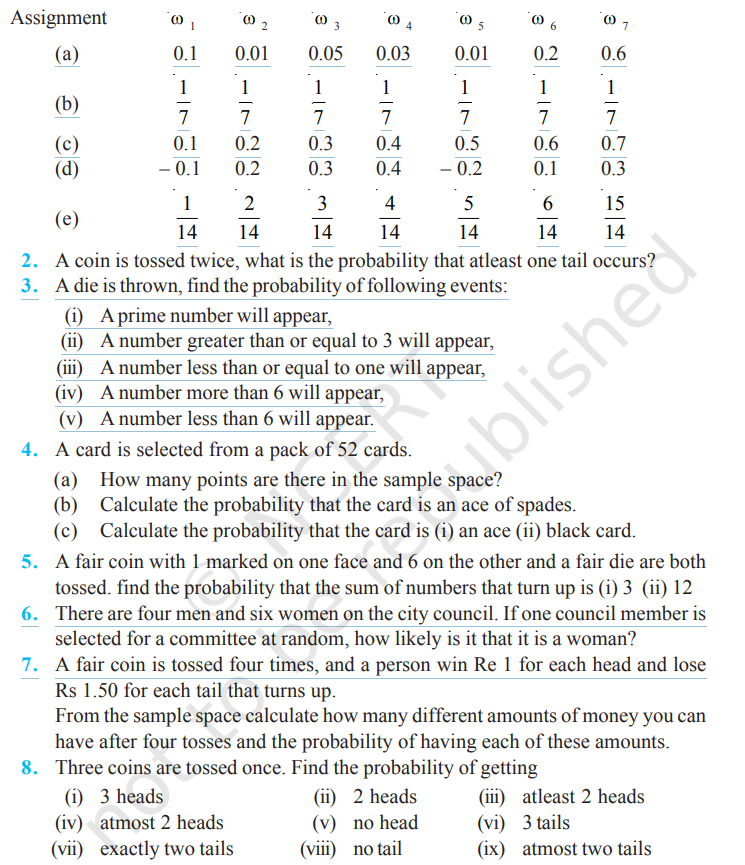

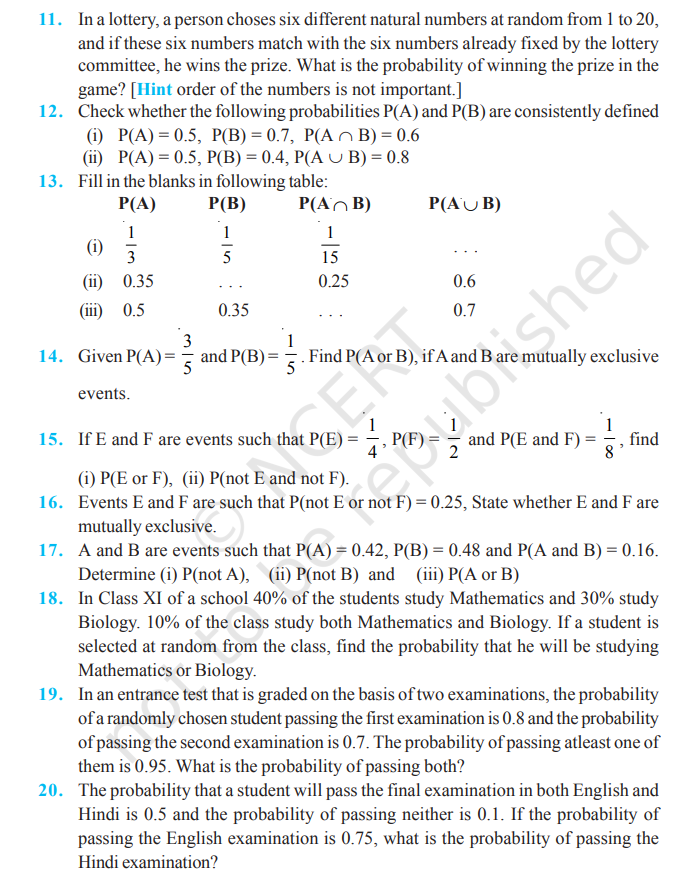

This exercise covers the fundamental rules of probability, including valid probability assignments, calculating probabilities for single and combined events, and using the addition rule.
1. Valid Probability Assignments
For a valid probability assignment on a sample space $S = \{\omega_1, \dots, \omega_7\}$, two conditions must be met:
- Non-negativity: $0 \le P(\omega_i) \le 1$ for every outcome $\omega_i$.
- Summation: $\sum_{i=1}^7 P(\omega_i) = 1$.
| Assignment | ω1 | ω2 | ω3 | ω4 | ω5 | ω6 | ω7 | Sum (∑P(ωi)) | Valid? | Reason |
| (a) | 0.1 | 0.01 | 0.05 | 0.03 | 0.01 | 0.2 | 0.6 | 1.00 | Yes | $0 \le P(\omega_i) \le 1$ and Sum = 1. |
| (b) | $1/7$ | $1/7$ | $1/7$ | $1/7$ | $1/7$ | $1/7$ | $1/7$ | $7 \times (1/7) = 1$ | Yes | $0 \le P(\omega_i) \le 1$ and Sum = 1. |
| (c) | 0.1 | 0.2 | 0.3 | 0.4 | 0.5 | 0.6 | 0.7 | 2.8 | No | Sum is greater than 1. |
| (d) | -0.1 | 0.2 | 0.3 | 0.4 | -0.2 | 0.1 | 0.3 | 1.0 | No | $P(\omega_1) = -0.1$ and $P(\omega_5) = -0.2$ (Probabilities cannot be negative). |
| (e) | $1/14$ | $2/14$ | $3/14$ | $4/14$ | $5/14$ | $6/14$ | $15/14$ | $36/14 \approx 2.57$ | No | $P(\omega_7) = 15/14 > 1$ and Sum is greater than 1. |
The assignments that cannot be valid are (c), (d), and (e).
2. Coin Tossed Twice
Experiment: Tossing a coin twice.
Sample Space ($S$): $S = \{HH, HT, TH, TT\}$. $n(S)=4$.
Event $E$: “at least one tail occurs” $\implies E = \{HT, TH, TT\}$. $n(E)=3$.
$$P(E) = \frac{n(E)}{n(S)} = \mathbf{\frac{3}{4}}$$
Alternatively, using the complement rule: $E’ = \{HH\}$ (no tails).
$$P(E) = 1 – P(E’) = 1 – \frac{1}{4} = \mathbf{\frac{3}{4}}$$
3. Die Thrown (Single Die)
Sample Space ($S$): $S = \{1, 2, 3, 4, 5, 6\}$. $n(S)=6$.
- (i) A prime number will appear: $E_1 = \{2, 3, 5\}$. $n(E_1)=3$.$$P(E_1) = \frac{3}{6} = \mathbf{\frac{1}{2}}$$
- (ii) A number greater than or equal to 3 will appear: $E_2 = \{3, 4, 5, 6\}$. $n(E_2)=4$.$$P(E_2) = \frac{4}{6} = \mathbf{\frac{2}{3}}$$
- (iii) A number less than or equal to one will appear: $E_3 = \{1\}$. $n(E_3)=1$.$$P(E_3) = \mathbf{\frac{1}{6}}$$
- (iv) A number more than 6 will appear: $E_4 = \{\}$. $n(E_4)=0$. (Impossible event)$$P(E_4) = \frac{0}{6} = \mathbf{0}$$
- (v) A number less than 6 will appear: $E_5 = \{1, 2, 3, 4, 5\}$. $n(E_5)=5$.$$P(E_5) = \mathbf{\frac{5}{6}}$$
4. Card Selected from a Pack
Experiment: Selecting one card from a standard deck.
- (a) How many points are there in the sample space?There are $\mathbf{52}$ points (cards) in the sample space.
- (b) Probability that the card is an ace of spades.Event $E$: The card is the Ace of Spades. $n(E)=1$.$$P(E) = \frac{1}{52}$$
- (c) Calculate the probability that the card is (i) an ace (ii) black card.(i) An ace: There are 4 aces (one in each suit). $n(E_{ace})=4$.$$P(\text{ace}) = \frac{4}{52} = \mathbf{\frac{1}{13}}$$(ii) Black card: There are 2 suits that are black (Clubs and Spades), $13+13=26$ cards. $n(E_{black})=26$.$$P(\text{black card}) = \frac{26}{52} = \mathbf{\frac{1}{2}}$$
5. Coin (1, 6) and Die Tossed
Experiment: Tossing a coin marked (1, 6) and a standard die (1 to 6).
Sample Space ($S$): The outcome is a pair $(c, d)$, where $c \in \{1, 6\}$ and $d \in \{1, 2, 3, 4, 5, 6\}$.
$S = \{(1, 1), (1, 2), \dots, (1, 6), (6, 1), (6, 2), \dots, (6, 6)\}$. $n(S) = 2 \times 6 = 12$.
- (i) Sum of numbers is 3:Event $E_1$: Sum = 3. Only the outcome $(1, 2)$ works. $n(E_1)=1$.$$P(E_1) = \mathbf{\frac{1}{12}}$$
- (ii) Sum of numbers is 12:Event $E_2$: Sum = 12. Only the outcome $(6, 6)$ works. $n(E_2)=1$.$$P(E_2) = \mathbf{\frac{1}{12}}$$
6. Committee Member Selection
Experiment: Selecting one council member at random.
Total Members ($n(S)$): 4 men + 6 women = 10.
Event $E$: The member selected is a woman. $n(E)=6$.
$$P(\text{woman}) = \frac{n(E)}{n(S)} = \frac{6}{10} = \mathbf{\frac{3}{5}}$$
7. Coin Tossed Four Times (Winnings)
Experiment: Tossing a fair coin four times. $n(S)=2^4=16$.
Winnings: + Re 1 for H, – Rs 1.50 for T. Let $x$ be the number of Heads. Winnings $W = x \cdot (1) + (4-x) \cdot (-1.50)$.
| Number of Heads (x) | Outcomes (n) | Amount of Money (W) | Probability (P) |
| 4 | 1 (HHHH) | $4(1) + 0(-1.5) = \mathbf{4.00}$ | $1/16$ |
| 3 | 4 (HHHT, HHTH, HT HH, THHH) | $3(1) + 1(-1.5) = \mathbf{1.50}$ | $4/16 = 1/4$ |
| 2 | 6 | $2(1) + 2(-1.5) = \mathbf{-1.00}$ | $6/16 = 3/8$ |
| 1 | 4 | $1(1) + 3(-1.5) = \mathbf{-3.50}$ | $4/16 = 1/4$ |
| 0 | 1 (TTTT) | $0(1) + 4(-1.5) = \mathbf{-6.00}$ | $1/16$ |
- Different amounts of money: $\mathbf{5}$ different amounts: Rs 4.00, Rs 1.50, -Rs 1.00, -Rs 3.50, -Rs 6.00.
- Probabilities: $\mathbf{1/16, 4/16, 6/16, 4/16, 1/16}$ respectively.
8. Three Coins Tossed Once
Sample Space ($S$): $S = \{HHH, HHT, HTH, THH, HTT, THT, TTH, TTT\}$. $n(S)=8$.
| Event | Description | Outcomes (n(E)) | Probability (P(E)) |
| (i) 3 heads | HHH | 1 | $\mathbf{1/8}$ |
| (ii) 2 heads | HHT, HTH, THH | 3 | $\mathbf{3/8}$ |
| (iii) atleast 2 heads | 2 heads or 3 heads | $3+1=4$ | $4/8 = \mathbf{1/2}$ |
| (iv) atmost 2 heads | 0, 1, or 2 heads (Complement of 3 heads) | $8-1=7$ | $\mathbf{7/8}$ |
| (v) no head | TTT | 1 | $\mathbf{1/8}$ |
| (vi) 3 tails | TTT | 1 | $\mathbf{1/8}$ |
| (vii) exactly two tails | HTT, THT, TTH | 3 | $\mathbf{3/8}$ |
| (viii) no tail | HHH | 1 | $\mathbf{1/8}$ |
| (ix) atmost two tails | 0, 1, or 2 tails (Complement of 3 tails) | $8-1=7$ | $\mathbf{7/8}$ |
9. Probability of Complement
Given $P(A) = 2/11$. The probability of the event ‘not A’ ($P(A’)$) is found using the complement rule:
$$P(A’) = 1 – P(A) = 1 – \frac{2}{11} = \mathbf{\frac{9}{11}}$$
10. Letter Chosen from ‘ASSASSINATION’
Total letters ($n(S)$): 13.
Vowels (V): A (3 times), I (2 times), O (1 time). $n(V)=6$.
Consonants (C): S (4 times), N (2 times), T (1 time). $n(C)=7$.
- (i) Probability that the letter is a vowel:$$P(\text{vowel}) = \frac{n(V)}{n(S)} = \mathbf{\frac{6}{13}}$$
- (ii) Probability that the letter is a consonant:$$P(\text{consonant}) = \frac{n(C)}{n(S)} = \mathbf{\frac{7}{13}}$$
11. Winning a Lottery
Experiment: Choosing 6 different natural numbers from 1 to 20.
Total possible combinations ($n(S)$): The number of ways to choose 6 numbers from 20 is given by the combination formula $C(n, k) = \frac{n!}{k!(n-k)!}$.
$$n(S) = \binom{20}{6} = \frac{20!}{6!(14!)} = \frac{20 \times 19 \times 18 \times 17 \times 16 \times 15}{6 \times 5 \times 4 \times 3 \times 2 \times 1} = 38760$$
Event $E$: The chosen 6 numbers match the fixed 6 numbers. $n(E)=1$.
$$P(\text{winning the prize}) = \frac{n(E)}{n(S)} = \mathbf{\frac{1}{38760}}$$
12. Consistently Defined Probabilities
Probabilities $P(A)$ and $P(B)$ are consistently defined if they satisfy two conditions:
- Non-negativity: $0 \le P(A), P(B), P(A \cap B), P(A \cup B) \le 1$.
- Addition Rule: $P(A \cup B) = P(A) + P(B) – P(A \cap B)$.
- (i) $P(A) = 0.5, P(B) = 0.7, P(A \cap B) = 0.6$.Condition 1 is satisfied. Check Addition Rule:$P(A) + P(B) – P(A \cap B) = 0.5 + 0.7 – 0.6 = 1.2 – 0.6 = 0.6$.Since $P(A \cap B)$ must be $\le \min(P(A), P(B))$ and $0.6 > 0.5$, this is already a contradiction.Also, $P(A \cup B)$ must be $\le 1$. From the Addition Rule, $P(A \cup B) = 0.5 + 0.7 – 0.6 = 0.6$.However, for any two events, $P(A \cap B)$ must be $\ge P(A) + P(B) – 1$.$P(A \cap B) \ge 0.5 + 0.7 – 1 = 0.2$.The condition that $P(A \cup B) = 0.6$ is too low since $P(A \cap B)$ is given as $0.6$.Using the Addition Rule: $P(A \cup B) = 0.5 + 0.7 – 0.6 = 0.6$.But $P(A) = 0.5$ must be $\le P(A \cup B) = 0.6$. $P(B)=0.7$ must be $\le P(A \cup B)=0.6$. This is FALSE.The probabilities are NOT consistently defined because $P(B) > P(A \cup B)$.
- (ii) $P(A) = 0.5, P(B) = 0.4, P(A \cup B) = 0.8$.Condition 1 is satisfied. Check Addition Rule:$P(A \cap B) = P(A) + P(B) – P(A \cup B) = 0.5 + 0.4 – 0.8 = 0.1$.Since $P(A \cap B) = 0.1$ satisfies $0 \le P(A \cap B) \le \min(P(A), P(B))$, the probabilities are consistently defined.
13. Filling in the Blanks (Addition Rule)
Use the Addition Rule: $P(A \cup B) = P(A) + P(B) – P(A \cap B)$.
| P(A) | P(B) | P(A ∩ B) | P(A ∪ B) | Calculation |
| (i) $1/3$ | $1/5$ | $1/15$ | $\mathbf{7/15}$ | $1/3 + 1/5 – 1/15 = 5/15 + 3/15 – 1/15 = 7/15$ |
| (ii) 0.35 | 0.50 | 0.25 | 0.6 | $0.6 = 0.35 + P(B) – 0.25 \implies P(B) = 0.6 – 0.10 = 0.50$ |
| (iii) 0.5 | 0.35 | 0.15 | 0.7 | $0.7 = 0.5 + 0.35 – P(A \cap B) \implies P(A \cap B) = 0.85 – 0.7 = 0.15$ |
14. Mutually Exclusive Events
Given $P(A) = 3/5$ and $P(B) = 1/5$. $A$ and $B$ are mutually exclusive, meaning $P(A \cap B) = 0$.
$$P(A \text{ or } B) = P(A \cup B) = P(A) + P(B) – P(A \cap B)$$
$$P(A \cup B) = \frac{3}{5} + \frac{1}{5} – 0 = \mathbf{\frac{4}{5}}$$
15. Addition Rule and De Morgan’s Law
Given $P(E) = 1/4$, $P(F) = 1/2$, $P(E \cap F) = 1/8$.
- (i) $P(E \text{ or } F)$ ($P(E \cup F)$):$$P(E \cup F) = P(E) + P(F) – P(E \cap F) = \frac{1}{4} + \frac{1}{2} – \frac{1}{8}$$$$P(E \cup F) = \frac{2}{8} + \frac{4}{8} – \frac{1}{8} = \mathbf{\frac{5}{8}}$$
- (ii) $P(\text{not } E \text{ and not } F)$ ($P(E’ \cap F’)$):By De Morgan’s Law, $E’ \cap F’ = (E \cup F)’$.$$P(E’ \cap F’) = P((E \cup F)’) = 1 – P(E \cup F) = 1 – \frac{5}{8} = \mathbf{\frac{3}{8}}$$
16. Mutually Exclusive Check
Given $P(\text{not } E \text{ or not } F) = P(E’ \cup F’) = 0.25$.
By De Morgan’s Law, $E’ \cup F’ = (E \cap F)’$.
$$P((E \cap F)’) = 1 – P(E \cap F)$$
$$0.25 = 1 – P(E \cap F)$$
$$P(E \cap F) = 1 – 0.25 = 0.75$$
For $E$ and $F$ to be mutually exclusive, $P(E \cap F)$ must be $0$.
Since $P(E \cap F) = 0.75 \neq 0$, the events $E$ and $F$ are not mutually exclusive.
17. Complement and Addition Rule
Given $P(A) = 0.42, P(B) = 0.48, P(A \cap B) = 0.16$.
- (i) $P(\text{not } A)$ ($P(A’)$):$$P(A’) = 1 – P(A) = 1 – 0.42 = \mathbf{0.58}$$
- (ii) $P(\text{not } B)$ ($P(B’)$):$$P(B’) = 1 – P(B) = 1 – 0.48 = \mathbf{0.52}$$
- (iii) $P(A \text{ or } B)$ ($P(A \cup B)$):$$P(A \cup B) = P(A) + P(B) – P(A \cap B)$$$$P(A \cup B) = 0.42 + 0.48 – 0.16 = 0.90 – 0.16 = \mathbf{0.74}$$
18. Mathematics or Biology
Let $M$ be the event of studying Mathematics and $B$ be the event of studying Biology.
Given: $P(M) = 0.40, P(B) = 0.30, P(M \cap B) = 0.10$.
Find $P(M \text{ or } B) = P(M \cup B)$.
$$P(M \cup B) = P(M) + P(B) – P(M \cap B)$$
$$P(M \cup B) = 0.40 + 0.30 – 0.10 = 0.70 – 0.10 = \mathbf{0.60}$$
19. Probability of Passing Both Exams
Let $E_1$ be passing the first exam and $E_2$ be passing the second exam.
Given: $P(E_1) = 0.8, P(E_2) = 0.7$.
$P(\text{at least one}) = P(E_1 \cup E_2) = 0.95$.
Find $P(\text{passing both}) = P(E_1 \cap E_2)$.
$$P(E_1 \cap E_2) = P(E_1) + P(E_2) – P(E_1 \cup E_2)$$
$$P(E_1 \cap E_2) = 0.8 + 0.7 – 0.95 = 1.5 – 0.95 = \mathbf{0.55}$$
20. Probability of Passing Hindi Exam
Let $E$ be passing English and $H$ be passing Hindi.
Given: $P(E \cap H) = 0.5$, $P((E \cup H)’) = 0.1$, $P(E) = 0.75$.
Find $P(H)$.
- Find $P(E \cup H)$:$$P(E \cup H) = 1 – P((E \cup H)’) = 1 – 0.1 = 0.9$$
- Use the Addition Rule to find $P(H)$:$$P(E \cup H) = P(E) + P(H) – P(E \cap H)$$$$0.9 = 0.75 + P(H) – 0.5$$$$0.9 = 0.25 + P(H)$$$$P(H) = 0.9 – 0.25 = \mathbf{0.65}$$
21. NCC and NSS Students
Total students ($n(S)$): 60.
Let $N$ be the set of students who opted for NCC, and $S$ be the set of students who opted for NSS.
$n(N)=30, n(S)=32, n(N \cap S)=24$.
We use probabilities: $P(N) = 30/60 = 0.5$, $P(S) = 32/60 = 8/15$, $P(N \cap S) = 24/60 = 2/5 = 0.4$.
- (i) The student opted for NCC or NSS ($P(N \cup S)$):$$P(N \cup S) = P(N) + P(S) – P(N \cap S)$$$$P(N \cup S) = \frac{30}{60} + \frac{32}{60} – \frac{24}{60} = \frac{30 + 32 – 24}{60} = \frac{38}{60} = \mathbf{\frac{19}{30}}$$
- (ii) The student has opted neither NCC nor NSS ($P((N \cup S)’)$):$$P((N \cup S)’) = 1 – P(N \cup S) = 1 – \frac{38}{60} = \frac{22}{60} = \mathbf{\frac{11}{30}}$$
- (iii) The student has opted NSS but not NCC ($P(S \cap N’)$):$$P(S \cap N’) = P(S) – P(N \cap S)$$$$P(S \cap N’) = \frac{32}{60} – \frac{24}{60} = \frac{8}{60} = \mathbf{\frac{2}{15}}$$(This is the probability of choosing a student in NSS only).