
Get detailed, step-by-step solutions for the NCERT Class 11 Maths Chapter 14 Miscellaneous Exercise
Solve complex probability problems using combinations ($\binom{n}{k}$), permutations ($P(n, k)$), and the complement rule to find probabilities for drawing marbles, selecting cards, and lottery tickets (Q.1-4). Apply the Principle of Inclusion-Exclusion to solve derangement problems (Q.6). Use the Addition Rule and De Morgan’s Law to evaluate combined events (Q.7-8). Practice calculating probabilities for number formation with and without digit repetition (Q.9-10). Essential preparation for final exams and advanced statistics topics.
This exercise covers various probability scenarios, including combinations, complementary events, the addition theorem, and permutations.
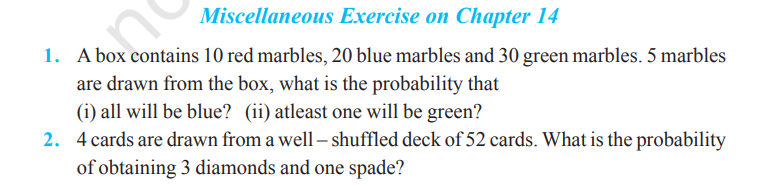

1. Drawing Marbles from a Box
Total Marbles: $10 \text{ Red} + 20 \text{ Blue} + 30 \text{ Green} = 60$.
Experiment: Drawing 5 marbles.
Total Possible Outcomes ($n(S)$): The number of ways to choose 5 marbles from 60.
$$n(S) = \binom{60}{5} = \frac{60 \times 59 \times 58 \times 57 \times 56}{5 \times 4 \times 3 \times 2 \times 1} = 5,461,512$$
- (i) All will be blue ($E_1$): 5 marbles drawn are from the 20 blue marbles.$$n(E_1) = \binom{20}{5} = \frac{20 \times 19 \times 18 \times 17 \times 16}{5 \times 4 \times 3 \times 2 \times 1} = 15,504$$$$P(E_1) = \frac{n(E_1)}{n(S)} = \frac{15,504}{5,461,512} \approx \mathbf{0.00284}$$
- (ii) At least one will be green ($E_2$): Use the complement rule. The complement $E_2’$ is “none of the 5 marbles are green.”Marbles that are not green = $10 \text{ Red} + 20 \text{ Blue} = 30$.$$n(E_2′) = \binom{30}{5} = \frac{30 \times 29 \times 28 \times 27 \times 26}{5 \times 4 \times 3 \times 2 \times 1} = 142,506$$$$P(E_2′) = \frac{142,506}{5,461,512} \approx 0.0261$$$$P(E_2) = 1 – P(E_2′) = 1 – 0.0261 \approx \mathbf{0.9739}$$
2. Drawing Cards
Experiment: Drawing 4 cards from 52.
Total Possible Outcomes ($n(S)$):
$$n(S) = \binom{52}{4} = \frac{52 \times 51 \times 50 \times 49}{4 \times 3 \times 2 \times 1} = 270,725$$
Event $E$: Obtaining 3 diamonds and 1 spade.
- Number of diamonds: 13. Choose 3: $\binom{13}{3} = \frac{13 \times 12 \times 11}{3 \times 2 \times 1} = 286$.
- Number of spades: 13. Choose 1: $\binom{13}{1} = 13$.$$n(E) = \binom{13}{3} \times \binom{13}{1} = 286 \times 13 = 3,718$$$$P(E) = \frac{n(E)}{n(S)} = \frac{3,718}{270,725} \approx \mathbf{0.0137}$$
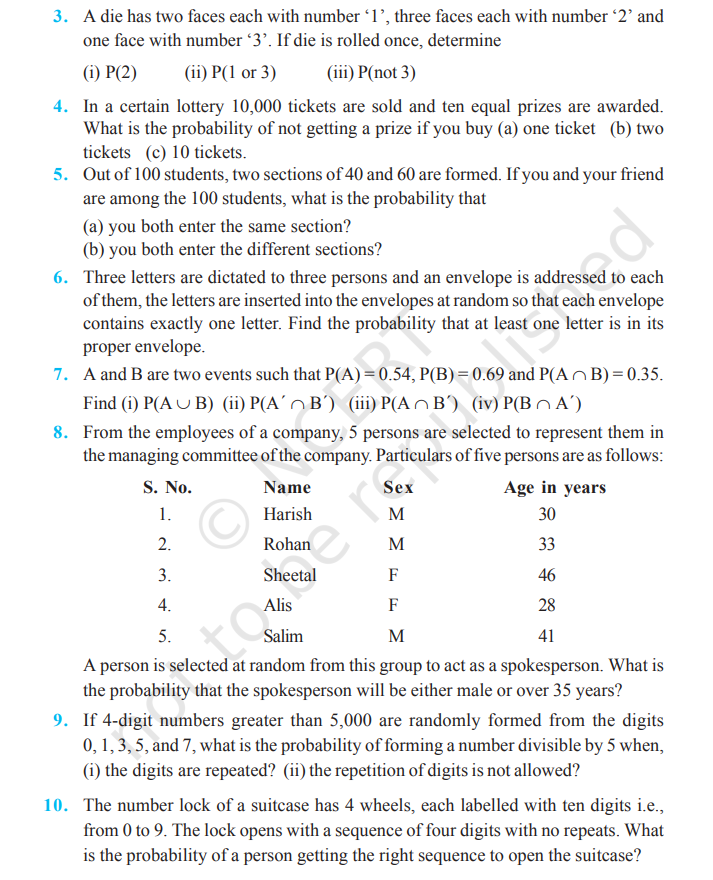
3. Probability for a Custom Die
Sample Space ($S$): A die with faces $\{1, 1, 2, 2, 2, 3\}$. Total faces ($n(S)$): 6.
- (i) $P(2)$: Number of faces with ‘2’ is 3.$$P(2) = \frac{3}{6} = \mathbf{\frac{1}{2}}$$
- (ii) $P(1 \text{ or } 3)$: Number of faces with ‘1’ is 2. Number of faces with ‘3’ is 1.$$P(1 \text{ or } 3) = P(1) + P(3) = \frac{2}{6} + \frac{1}{6} = \frac{3}{6} = \mathbf{\frac{1}{2}}$$
- (iii) $P(\text{not } 3)$: Use the complement rule: $P(\text{not } 3) = 1 – P(3)$.$$P(\text{not } 3) = 1 – \frac{1}{6} = \mathbf{\frac{5}{6}}$$(Or, $P(1 \text{ or } 2) = P(1) + P(2) = 2/6 + 3/6 = 5/6$).
4. Lottery Tickets
Total tickets: 10,000. Prizes awarded: 10.
Probability of winning a prize ($P(W)$): $10/10,000 = 1/1,000$.
Probability of not getting a prize ($P(W’)$): $1 – 1/1,000 = 9,990/10,000$.
The number of non-winning tickets is $10,000 – 10 = 9,990$.
- (a) Buy one ticket:$$P(\text{not getting prize}) = \frac{\text{No. of non-winning tickets}}{\text{Total tickets}} = \frac{9,990}{10,000} = \mathbf{0.999}$$
- (b) Buy two tickets:Total ways to choose 2 tickets: $\binom{10000}{2}$.Ways to choose 2 non-winning tickets: $\binom{9990}{2}$.$$P(\text{not getting prize}) = \frac{\binom{9990}{2}}{\binom{10000}{2}} = \frac{9990 \times 9989 / 2}{10000 \times 9999 / 2} = \frac{9990 \times 9989}{10000 \times 9999} \approx \mathbf{0.998}$$
- (c) Buy 10 tickets:Total ways to choose 10 tickets: $\binom{10000}{10}$.Ways to choose 10 non-winning tickets: $\binom{9990}{10}$.$$P(\text{not getting prize}) = \frac{\binom{9990}{10}}{\binom{10000}{10}}$$$$P(\text{not getting prize}) = \frac{9990 \times 9989 \times \dots \times 9981}{10000 \times 9999 \times \dots \times 9991} \approx \mathbf{0.990}$$
5. Students in Two Sections
Total Students: 100. Sections: Section $A$ (40 students) and Section $B$ (60 students).
Experiment: Choosing 2 students (you and your friend) and assigning them to sections.
Total Possible Outcomes ($n(S)$): The total number of ways to divide 100 students into a group of 40 and a group of 60.
$$n(S) = \binom{100}{40} \times \binom{60}{60} = \binom{100}{40}$$
- (a) You both enter the same section ($E_{same}$):This means either both are in $A$ or both are in $B$.
- Case 1 (Both in A): Choose 2 from 40, and the remaining 38 from the other 98 students. The remaining $100-2=98$ students are divided into $38$ for $A$ and $60$ for $B$.$$n(E_{A}) = \binom{40}{2} \times \binom{60}{60} \text{ (Total ways to form the sections with 2 fixed spots in A)}$$Simpler approach (using the principle of combinations for the other 98 students):
- Choose 2 spots in A for you and your friend: $\binom{40}{2}$.
- The remaining $40-2=38$ spots in A must be filled by the remaining $100-2=98$ students.
- The remaining $60$ spots in B are filled by the leftover $98-38=60$ students.$$n(E_A) = \binom{40}{2} \times \binom{60}{60}$$$$n(E_B) = \binom{60}{2} \times \binom{40}{40}$$Probability (Simpler combination approach):$$P(E_{A}) = \frac{\binom{40}{2}}{\binom{100}{2}} \text{ (Prob. that 2 chosen spots out of 100 are in A’s 40 spots)}$$$$P(E_{B}) = \frac{\binom{60}{2}}{\binom{100}{2}}$$$$P(E_{same}) = P(E_{A}) + P(E_{B}) = \frac{\binom{40}{2} + \binom{60}{2}}{\binom{100}{2}}$$$$P(E_{same}) = \frac{\frac{40 \times 39}{2} + \frac{60 \times 59}{2}}{\frac{100 \times 99}{2}} = \frac{40 \times 39 + 60 \times 59}{100 \times 99} = \frac{1560 + 3540}{9900} = \frac{5100}{9900} = \mathbf{\frac{17}{33}}$$
- Case 1 (Both in A): Choose 2 from 40, and the remaining 38 from the other 98 students. The remaining $100-2=98$ students are divided into $38$ for $A$ and $60$ for $B$.$$n(E_{A}) = \binom{40}{2} \times \binom{60}{60} \text{ (Total ways to form the sections with 2 fixed spots in A)}$$Simpler approach (using the principle of combinations for the other 98 students):
- (b) You both enter different sections ($E_{diff}$):Use the complement rule: $P(E_{diff}) = 1 – P(E_{same})$.$$P(E_{diff}) = 1 – \frac{17}{33} = \mathbf{\frac{16}{33}}$$(Alternatively: You are in A (40/100) and friend is in B (60/99) OR You are in B (60/100) and friend is in A (40/99). $P(E_{diff}) = \frac{40}{100} \cdot \frac{60}{99} + \frac{60}{100} \cdot \frac{40}{99} = \frac{2400+2400}{9900} = \frac{4800}{9900} = \frac{16}{33}$)
6. Letters in Proper Envelopes
Experiment: 3 letters are randomly inserted into 3 addressed envelopes.
Total Possible Outcomes ($n(S)$): The number of ways to arrange 3 letters in 3 envelopes (Permutations of 3).
$$n(S) = 3! = 6$$
$S = \{L_1 E_1 L_2 E_2 L_3 E_3 \text{ (All correct)}, L_1 E_1 L_3 E_2 L_2 E_3, L_2 E_1 L_1 E_2 L_3 E_3, L_2 E_1 L_3 E_2 L_1 E_3, L_3 E_1 L_1 E_2 L_2 E_3, L_3 E_1 L_2 E_2 L_1 E_3 \text{ (All wrong)}\}$
Event $E$: At least one letter is in its proper envelope.
Let $A_i$ be the event that letter $i$ is in its proper envelope.
We need $P(A_1 \cup A_2 \cup A_3)$. Use the Principle of Inclusion-Exclusion for 3 events:
$$P(A_1 \cup A_2 \cup A_3) = \sum P(A_i) – \sum P(A_i \cap A_j) + P(A_1 \cap A_2 \cap A_3)$$
- $P(A_i)$: Letter $i$ is correct. The other two can be arranged in $2!$ ways. $P(A_1) = \frac{2!}{3!} = 1/3$. $\sum P(A_i) = 3 \times (1/3) = 1$.
- $P(A_i \cap A_j)$: Letters $i$ and $j$ are correct. The third must be correct. $P(A_1 \cap A_2) = \frac{1!}{3!} = 1/6$. $\sum P(A_i \cap A_j) = 3 \times (1/6) = 1/2$.
- $P(A_1 \cap A_2 \cap A_3)$: All 3 are correct. $P(A_1 \cap A_2 \cap A_3) = \frac{0!}{3!} = 1/6$.
$$P(E) = 1 – \frac{1}{2} + \frac{1}{6} = \frac{6 – 3 + 1}{6} = \frac{4}{6} = \mathbf{\frac{2}{3}}$$
7. Addition Rule and De Morgan’s Law
Given: $P(A) = 0.54, P(B) = 0.69, P(A \cap B) = 0.35$.
- (i) $P(A \cup B)$:$$P(A \cup B) = P(A) + P(B) – P(A \cap B)$$$$P(A \cup B) = 0.54 + 0.69 – 0.35 = 1.23 – 0.35 = \mathbf{0.88}$$
- (ii) $P(A’ \cap B’)$: (Neither A nor B occurs)By De Morgan’s Law, $A’ \cap B’ = (A \cup B)’$.$$P(A’ \cap B’) = 1 – P(A \cup B) = 1 – 0.88 = \mathbf{0.12}$$
- (iii) $P(A \cap B’)$: (A occurs but B does not)$$P(A \cap B’) = P(A) – P(A \cap B) = 0.54 – 0.35 = \mathbf{0.19}$$
- (iv) $P(B \cap A’)$: (B occurs but A does not)$$P(B \cap A’) = P(B) – P(A \cap B) = 0.69 – 0.35 = \mathbf{0.34}$$
8. Spokesperson Selection
Total Persons ($n(S)$): 5.
Events: $M$ (Male), $O$ (Over 35 years).
| S. No. | Name | Sex (M) | Age (O) |
| 1. | Harish | M | 30 |
| 2. | Rohan | M | 33 |
| 3. | Sheetal | F | 46 (O) |
| 4. | Alis | F | 28 |
| 5. | Salim | M | 41 (O) |
- $n(M)$ (Male): 3 (Harish, Rohan, Salim) $\implies P(M) = 3/5$.
- $n(O)$ (Over 35): 2 (Sheetal, Salim) $\implies P(O) = 2/5$.
- $n(M \cap O)$ (Male and Over 35): 1 (Salim) $\implies P(M \cap O) = 1/5$.
Event $E$: Spokesperson is either male or over 35 years ($P(M \cup O)$).
$$P(M \cup O) = P(M) + P(O) – P(M \cap O)$$
$$P(M \cup O) = \frac{3}{5} + \frac{2}{5} – \frac{1}{5} = \frac{4}{5}$$
The probability is $\mathbf{4/5}$ or $\mathbf{0.8}$.
9. 4-Digit Numbers Greater than 5,000
Digits available: $\{0, 1, 3, 5, 7\}$.
Condition 1: 4-digit number.
Condition 2: Greater than 5,000 $\implies$ The first digit must be 5 or 7.
Condition 3: Divisible by 5 $\implies$ The last digit must be 0 or 5.
- (i) Repetition is allowed:Total Outcomes ($n(S)$):
- Digit 1: $\{5, 7\}$ (2 choices)
- Digit 2: $\{0, 1, 3, 5, 7\}$ (5 choices)
- Digit 3: $\{0, 1, 3, 5, 7\}$ (5 choices)
- Digit 4: $\{0, 1, 3, 5, 7\}$ (5 choices)$$n(S) = 2 \times 5 \times 5 \times 5 = 250$$Favorable Outcomes ($n(E)$ – Divisible by 5):
- Digit 1: $\{5, 7\}$ (2 choices)
- Digit 2: 5 choices
- Digit 3: 5 choices
- Digit 4: $\{0, 5\}$ (2 choices)$$n(E) = 2 \times 5 \times 5 \times 2 = 100$$$$P(E) = \frac{n(E)}{n(S)} = \frac{100}{250} = \mathbf{\frac{2}{5}}$$
- (ii) Repetition is not allowed:Total Outcomes ($n(S)$):
- Digit 1: $\{5, 7\}$ (2 choices)
- Digit 2: 4 remaining choices
- Digit 3: 3 remaining choices
- Digit 4: 2 remaining choices$$n(S) = 2 \times 4 \times 3 \times 2 = 48$$Favorable Outcomes ($n(E)$ – Divisible by 5): (Must consider two cases based on the last digit)
- Case A (Last digit is 0): $\_ \_ \_ 0$
- Digit 4: $\{0\}$ (1 choice)
- Digit 1: $\{5, 7\}$ (2 choices)
- Digit 2: 3 remaining choices
- Digit 3: 2 remaining choices$$n(E_A) = 2 \times 3 \times 2 \times 1 = 12$$
- Case B (Last digit is 5): $\_ \_ \_ 5$
- Digit 4: $\{5\}$ (1 choice)
- Digit 1: $\{7\}$ (Since 5 is used) (1 choice)
- Digit 2: 3 remaining choices
- Digit 3: 2 remaining choices$$n(E_B) = 1 \times 3 \times 2 \times 1 = 6$$$$n(E) = 12 + 6 = 18$$$$P(E) = \frac{n(E)}{n(S)} = \frac{18}{48} = \mathbf{\frac{3}{8}}$$
10. Suitcase Lock
Lock: 4 wheels, digits 0-9. Sequence: 4 digits with no repeats.
Total Possible Outcomes ($n(S)$): The number of 4-digit sequences without repetition from 10 digits ($P(10, 4)$).
$$n(S) = P(10, 4) = 10 \times 9 \times 8 \times 7 = 5,040$$
Event $E$: Getting the right sequence. The right sequence is unique.
$$n(E) = 1$$
$$P(E) = \frac{1}{5,040}$$