
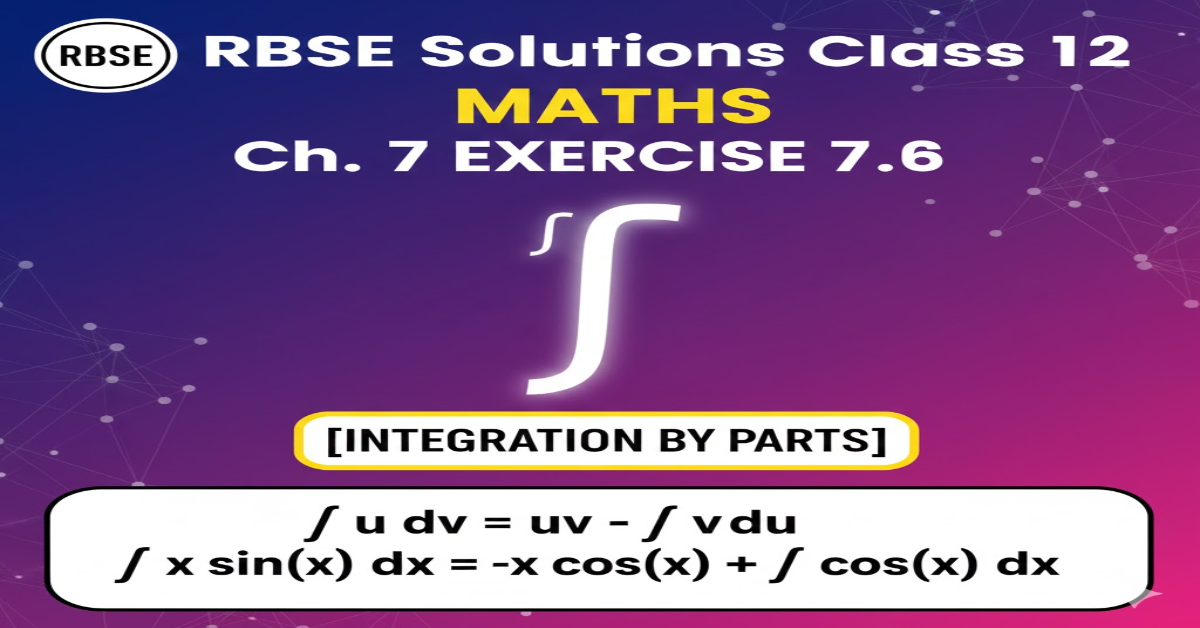
Comprehensive solutions for Class 12 Maths (NCERT) Exercise 7.6 on Integrals. Master the Integration by Parts (ILATE) rule for product functions. Covers various types, including inverse/logarithmic functions ($\int x \tan^{-1} x dx$), powers ($\int x^2 e^x dx$), and integrals of the form $\int e^x [f(x) + f'(x)] dx$.
This exercise focuses on the integration technique known as Integration by Parts (ILATE Rule).
The formula for Integration by Parts is:
$$\int u \cdot v dx = u \int v dx – \int \left( \frac{du}{dx} \int v dx \right) dx$$
The ILATE rule helps select the first function ($u$) and the second function ($v$):
Inverse trigonometric $\rightarrow$ Logarithmic $\rightarrow$ Algebraic $\rightarrow$ Trigonometric $\rightarrow$ Exponential.
Table of Contents


Part 1: Direct Integration by Parts (1-15)
1. $\int x \sin x dx$
$u = x$ (Algebraic), $v = \sin x$ (Trigonometric).
$$\int x \sin x dx = x (-\cos x) – \int (1) (-\cos x) dx$$
$$= -x \cos x + \int \cos x dx$$
$$= \mathbf{-x \cos x + \sin x + C}$$
2. $\int x \sin 3x dx$
$u = x$, $v = \sin 3x$.
$$\int x \sin 3x dx = x \left(-\frac{\cos 3x}{3}\right) – \int (1) \left(-\frac{\cos 3x}{3}\right) dx$$
$$= -\frac{x \cos 3x}{3} + \frac{1}{3} \int \cos 3x dx$$
$$= -\frac{x \cos 3x}{3} + \frac{1}{3} \left(\frac{\sin 3x}{3}\right) + C$$
$$= \mathbf{-\frac{x \cos 3x}{3} + \frac{\sin 3x}{9} + C}$$
3. $\int x^2 e^x dx$
$u = x^2$ (Algebraic), $v = e^x$ (Exponential). Apply integration by parts twice.
$$\int x^2 e^x dx = x^2 e^x – \int (2x) e^x dx$$
Now apply integration by parts to $\int 2x e^x dx$, with $u = 2x$, $v = e^x$:
$$\int 2x e^x dx = 2x e^x – \int (2) e^x dx = 2x e^x – 2e^x$$
Substituting back:
$$x^2 e^x – (2x e^x – 2e^x) + C$$
$$= \mathbf{e^x (x^2 – 2x + 2) + C}$$
4. $\int x \log x dx$
$u = \log x$ (Logarithmic), $v = x$ (Algebraic).
$$\int x \log x dx = \log x \left(\frac{x^2}{2}\right) – \int \left(\frac{1}{x}\right) \left(\frac{x^2}{2}\right) dx$$
$$= \frac{x^2}{2} \log x – \frac{1}{2} \int x dx$$
$$= \frac{x^2}{2} \log x – \frac{1}{2} \left(\frac{x^2}{2}\right) + C$$
$$= \mathbf{\frac{x^2}{2} \log x – \frac{x^2}{4} + C}$$
5. $\int x \log 2x dx$
$u = \log 2x$, $v = x$.
$$\int x \log 2x dx = \log 2x \left(\frac{x^2}{2}\right) – \int \left(\frac{1}{2x} \cdot 2\right) \left(\frac{x^2}{2}\right) dx$$
$$= \frac{x^2}{2} \log 2x – \frac{1}{2} \int x dx$$
$$= \mathbf{\frac{x^2}{2} \log 2x – \frac{x^2}{4} + C}$$
6. $\int x^2 \log x dx$
$u = \log x$, $v = x^2$.
$$\int x^2 \log x dx = \log x \left(\frac{x^3}{3}\right) – \int \left(\frac{1}{x}\right) \left(\frac{x^3}{3}\right) dx$$
$$= \frac{x^3}{3} \log x – \frac{1}{3} \int x^2 dx$$
$$= \frac{x^3}{3} \log x – \frac{1}{3} \left(\frac{x^3}{3}\right) + C$$
$$= \mathbf{\frac{x^3}{3} \log x – \frac{x^3}{9} + C}$$
7. $\int x \sin^{-1} x dx$
$u = \sin^{-1} x$ (Inverse), $v = x$ (Algebraic).
$$\int x \sin^{-1} x dx = \sin^{-1} x \left(\frac{x^2}{2}\right) – \int \left(\frac{1}{\sqrt{1 – x^2}}\right) \left(\frac{x^2}{2}\right) dx$$
For the second integral: $\int \frac{x^2}{\sqrt{1 – x^2}} dx$. Substitute $x = \sin \theta$.
$$\frac{x^2}{2} \sin^{-1} x – \frac{1}{2} \int \frac{1 – (1 – x^2)}{\sqrt{1 – x^2}} dx$$
$$\frac{x^2}{2} \sin^{-1} x – \frac{1}{2} \int \left( \frac{1}{\sqrt{1 – x^2}} – \sqrt{1 – x^2} \right) dx$$
$$\frac{x^2}{2} \sin^{-1} x – \frac{1}{2} \left[ \sin^{-1} x – \left( \frac{x}{2} \sqrt{1 – x^2} + \frac{1}{2} \sin^{-1} x \right) \right] + C$$
$$= \mathbf{\frac{1}{4} \left[ (2x^2 – 1) \sin^{-1} x + x \sqrt{1 – x^2} \right] + C}$$
8. $\int x \tan^{-1} x dx$
$u = \tan^{-1} x$, $v = x$.
$$\int x \tan^{-1} x dx = \tan^{-1} x \left(\frac{x^2}{2}\right) – \int \left(\frac{1}{1 + x^2}\right) \left(\frac{x^2}{2}\right) dx$$
$$= \frac{x^2}{2} \tan^{-1} x – \frac{1}{2} \int \frac{x^2}{1 + x^2} dx$$
For the second integral: $\int \frac{x^2}{1 + x^2} dx = \int \frac{(1 + x^2) – 1}{1 + x^2} dx = \int \left(1 – \frac{1}{1 + x^2}\right) dx = x – \tan^{-1} x$.
$$= \frac{x^2}{2} \tan^{-1} x – \frac{1}{2} (x – \tan^{-1} x) + C$$
$$= \mathbf{\frac{1}{2} (x^2 + 1) \tan^{-1} x – \frac{x}{2} + C}$$
9. $\int x \cos^{-1} x dx$
$u = \cos^{-1} x$, $v = x$.
$$\int x \cos^{-1} x dx = \cos^{-1} x \left(\frac{x^2}{2}\right) – \int \left(-\frac{1}{\sqrt{1 – x^2}}\right) \left(\frac{x^2}{2}\right) dx$$
$$= \frac{x^2}{2} \cos^{-1} x + \frac{1}{2} \int \frac{x^2}{\sqrt{1 – x^2}} dx$$
(Using the result for $\int \frac{x^2}{\sqrt{1 – x^2}} dx$ from Q7)
$$\frac{x^2}{2} \cos^{-1} x + \frac{1}{2} \left[ \frac{1}{2} \sin^{-1} x – \frac{x}{2} \sqrt{1 – x^2} \right] + C$$
$$= \mathbf{\frac{1}{4} \left[ (2x^2 – 1) \cos^{-1} x – x \sqrt{1 – x^2} \right] + C}$$
10. $\int (\sin^{-1} x)^2 dx$
$u = (\sin^{-1} x)^2$, $v = 1$. Let $t = \sin^{-1} x \implies x = \sin t, dx = \cos t dt$.
$$\int t^2 \cos t dt$$
Apply integration by parts twice:
$$t^2 \sin t – \int 2t \sin t dt = t^2 \sin t – 2 \left[ t (-\cos t) – \int (1) (-\cos t) dt \right]$$
$$= t^2 \sin t – 2 (-t \cos t + \sin t) + C = t^2 \sin t + 2t \cos t – 2 \sin t + C$$
Substitute back: $\sin t = x$. $\cos t = \sqrt{1 – x^2}$. $t = \sin^{-1} x$.
$$= \mathbf{x (\sin^{-1} x)^2 + 2 \sqrt{1 – x^2} \sin^{-1} x – 2x + C}$$
11. $\int x \cos^{-1} \left(\frac{1 – x^2}{1 + x^2}\right) dx$
Use the identity $\cos^{-1} \left(\frac{1 – x^2}{1 + x^2}\right) = 2 \tan^{-1} x$.
$$\int x (2 \tan^{-1} x) dx = 2 \int x \tan^{-1} x dx$$
Using the result from Q8:
$$2 \left[ \frac{1}{2} (x^2 + 1) \tan^{-1} x – \frac{x}{2} \right] + C$$
$$= \mathbf{(x^2 + 1) \tan^{-1} x – x + C}$$
12. $\int x \sec^2 x dx$
$u = x$, $v = \sec^2 x$.
$$\int x \sec^2 x dx = x (\tan x) – \int (1) (\tan x) dx$$
$$= x \tan x – \log|\sec x| + C$$
$$= \mathbf{x \tan x + \log|\cos x| + C}$$
13. $\int \tan^{-1} x dx = \int 1 \cdot \tan^{-1} x dx$
$u = \tan^{-1} x$, $v = 1$.
$$\int \tan^{-1} x dx = \tan^{-1} x (x) – \int \left(\frac{1}{1 + x^2}\right) (x) dx$$
$$= x \tan^{-1} x – \int \frac{x}{1 + x^2} dx$$
For the second integral, let $t = 1 + x^2, dt = 2x dx$.
$$= x \tan^{-1} x – \frac{1}{2} \int \frac{dt}{t} = x \tan^{-1} x – \frac{1}{2} \log|1 + x^2| + C$$
$$= \mathbf{x \tan^{-1} x – \frac{1}{2} \log(1 + x^2) + C}$$
14. $\int x (\log x)^2 dx$
$u = (\log x)^2$, $v = x$. Apply integration by parts twice.
$$\int x (\log x)^2 dx = (\log x)^2 \left(\frac{x^2}{2}\right) – \int \left(2 \log x \cdot \frac{1}{x}\right) \left(\frac{x^2}{2}\right) dx$$
$$= \frac{x^2}{2} (\log x)^2 – \int x \log x dx$$
Using the result for $\int x \log x dx$ from Q4:
$$= \frac{x^2}{2} (\log x)^2 – \left( \frac{x^2}{2} \log x – \frac{x^2}{4} \right) + C$$
$$= \mathbf{\frac{x^2}{2} (\log x)^2 – \frac{x^2}{2} \log x + \frac{x^2}{4} + C}$$
15. $\int (x^2 + 1) \log x dx$
$u = \log x$, $v = x^2 + 1$.
$$\int (x^2 + 1) \log x dx = \log x \left(\frac{x^3}{3} + x\right) – \int \left(\frac{1}{x}\right) \left(\frac{x^3}{3} + x\right) dx$$
$$= \left(\frac{x^3}{3} + x\right) \log x – \int \left(\frac{x^2}{3} + 1\right) dx$$
$$= \left(\frac{x^3}{3} + x\right) \log x – \left(\frac{x^3}{9} + x\right) + C$$
$$= \mathbf{\left(\frac{x^3}{3} + x\right) \log x – \frac{x^3}{9} – x + C}$$
Part 2: Integrals of the Form $\int e^x [f(x) + f'(x)] dx$ (16-20)
The standard formula is:
$$\int e^x [f(x) + f'(x)] dx = e^x f(x) + C$$
16. $\int e^x (\sin x + \cos x) dx$
Here, $f(x) = \sin x$ and $f'(x) = \cos x$.
$$= \mathbf{e^x \sin x + C}$$
17. $\int \frac{x e^x}{(1 + x)^2} dx$
Rewrite the numerator: $x = (1 + x) – 1$.
$$\int e^x \frac{(1 + x) – 1}{(1 + x)^2} dx = \int e^x \left[ \frac{1 + x}{(1 + x)^2} – \frac{1}{(1 + x)^2} \right] dx$$
$$\int e^x \left[ \frac{1}{1 + x} + \frac{-1}{(1 + x)^2} \right] dx$$
Here, $f(x) = \frac{1}{1 + x}$ and $f'(x) = \frac{-1}{(1 + x)^2}$.
$$= \mathbf{\frac{e^x}{1 + x} + C}$$
18. $\int e^x \left(\frac{1 + \sin x}{1 + \cos x}\right) dx$
Simplify the fraction using half-angle identities:
$$\frac{1 + \sin x}{1 + \cos x} = \frac{1 + 2 \sin(x/2) \cos(x/2)}{2 \cos^2(x/2)}$$
$$= \frac{1}{2 \cos^2(x/2)} + \frac{2 \sin(x/2) \cos(x/2)}{2 \cos^2(x/2)}$$
$$= \frac{1}{2} \sec^2(x/2) + \tan(x/2)$$
The integral is $\int e^x \left[ \tan(x/2) + \frac{1}{2} \sec^2(x/2) \right] dx$.
Here, $f(x) = \tan(x/2)$ and $f'(x) = \sec^2(x/2) \cdot \frac{1}{2}$.
$$= \mathbf{e^x \tan(x/2) + C}$$
19. $\int e^x \left(\frac{1}{x} – \frac{1}{x^2}\right) dx$
Here, $f(x) = \frac{1}{x}$ and $f'(x) = -\frac{1}{x^2}$.
$$= \mathbf{\frac{e^x}{x} + C}$$
20. $\int \frac{(x – 3) e^x}{(x – 1)^3} dx$
Rewrite the numerator: $x – 3 = (x – 1) – 2$.
$$\int e^x \frac{(x – 1) – 2}{(x – 1)^3} dx = \int e^x \left[ \frac{x – 1}{(x – 1)^3} – \frac{2}{(x – 1)^3} \right] dx$$
$$\int e^x \left[ \frac{1}{(x – 1)^2} + \frac{-2}{(x – 1)^3} \right] dx$$
Here, $f(x) = \frac{1}{(x – 1)^2} = (x – 1)^{-2}$.
$f'(x) = -2(x – 1)^{-3} \cdot 1 = \frac{-2}{(x – 1)^3}$.
$$= \mathbf{\frac{e^x}{(x – 1)^2} + C}$$
Part 3: Cyclic Integrals and Substitution (21-22)
21. $\int e^{2x} \sin x dx$
This is a cyclic integral. Let $I = \int e^{2x} \sin x dx$. Apply integration by parts twice.
$u = \sin x$, $v = e^{2x}$.
$$I = \sin x \left(\frac{e^{2x}}{2}\right) – \int (\cos x) \left(\frac{e^{2x}}{2}\right) dx$$
$$I = \frac{1}{2} e^{2x} \sin x – \frac{1}{2} \int e^{2x} \cos x dx$$
Apply integration by parts to the second integral $I_2 = \int e^{2x} \cos x dx$.
$u = \cos x$, $v = e^{2x}$.
$$I_2 = \cos x \left(\frac{e^{2x}}{2}\right) – \int (-\sin x) \left(\frac{e^{2x}}{2}\right) dx$$
$$I_2 = \frac{1}{2} e^{2x} \cos x + \frac{1}{2} \int e^{2x} \sin x dx = \frac{1}{2} e^{2x} \cos x + \frac{1}{2} I$$
Substitute $I_2$ back into the equation for $I$:
$$I = \frac{1}{2} e^{2x} \sin x – \frac{1}{2} \left( \frac{1}{2} e^{2x} \cos x + \frac{1}{2} I \right)$$
$$I = \frac{1}{2} e^{2x} \sin x – \frac{1}{4} e^{2x} \cos x – \frac{1}{4} I$$
$$\frac{5}{4} I = \frac{1}{4} e^{2x} (2 \sin x – \cos x)$$
$$I = \frac{4}{5} \cdot \frac{1}{4} e^{2x} (2 \sin x – \cos x) + C$$
$$= \mathbf{\frac{e^{2x}}{5} (2 \sin x – \cos x) + C}$$
22. $\int \sin^{-1} \left(\frac{2x}{1 + x^2}\right) dx$
Use the identity $\sin^{-1} \left(\frac{2x}{1 + x^2}\right) = 2 \tan^{-1} x$.
$$\int 2 \tan^{-1} x dx = 2 \int 1 \cdot \tan^{-1} x dx$$
Using the result from Q13:
$$2 \left[ x \tan^{-1} x – \frac{1}{2} \log(1 + x^2) \right] + C$$
$$= \mathbf{2x \tan^{-1} x – \log(1 + x^2) + C}$$
Part 4: Multiple Choice Questions
23. $\int x^2 e^{x^3} dx$
Let $t = x^3$. Then $dt = 3x^2 dx$, so $x^2 dx = \frac{1}{3} dt$.
$$\int e^t \frac{1}{3} dt = \frac{1}{3} e^t + C = \mathbf{\frac{1}{3} e^{x^3} + C}$$
The correct answer is (A) $\frac{1}{3} e^{x^3} + C$.
24. $\int e^x (\sec x (1 + \tan x)) dx$
Distribute $e^x$: $\int e^x (\sec x + \sec x \tan x) dx$.
This is in the form $\int e^x [f(x) + f'(x)] dx$.
Here, $f(x) = \sec x$ and $f'(x) = \sec x \tan x$.
$$= e^x f(x) + C = \mathbf{e^x \sec x + C}$$
The correct answer is (B) $e^x \sec x + C$.