
Get step-by-step solutions for NCERT Class 10 Maths Chapter 1 Exercise 1.2. Learn the proof by contradiction method to establish the irrationality of numbers. Solutions cover proving that $\sqrt{5}$ is irrational (Q.1) and that linear combinations like $3 + 2\sqrt{5}$ and $6 + \sqrt{2}$ are irrational (Q.2-3). Master proofs for $1/\sqrt{2}$ and $7\sqrt{5}$ based on the property that a rational number combined with an irrational number is irrational. Essential for Board Exam proofs.

This exercise focuses on proving the irrationality of numbers, primarily using the method of proof by contradiction and the established fact that $\sqrt{2}$, $\sqrt{3}$, and $\sqrt{5}$ are irrational.
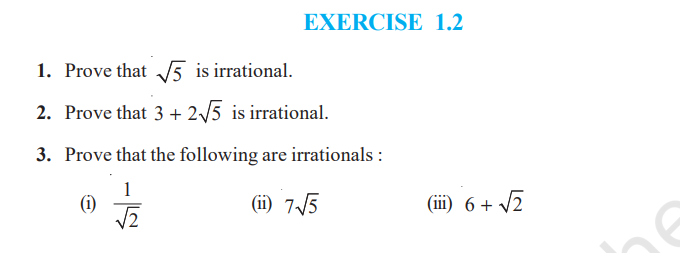
1. Prove that $\mathbf{\sqrt{5}}$ is irrational.
We will use the method of proof by contradiction.
Assumption: Assume, for the sake of contradiction, that $\sqrt{5}$ is a rational number.
- If $\sqrt{5}$ is rational, it can be expressed as a fraction $a/b$, where $a$ and $b$ are co-prime integers (i.e., $\text{HCF}(a, b) = 1$) and $b \neq 0$.$$\sqrt{5} = \frac{a}{b}$$
- Square both sides:$$5 = \frac{a^2}{b^2}$$$$5b^2 = a^2 \quad \dots (I)$$
- Since $a^2 = 5b^2$, $a^2$ is divisible by 5. By the theorem: If a prime number $p$ divides $a^2$, then $p$ divides $a$.Therefore, $a$ is divisible by 5.
- Since $a$ is divisible by 5, we can write $a = 5c$ for some integer $c$.
- Substitute $a = 5c$ into equation (I):$$5b^2 = (5c)^2$$$$5b^2 = 25c^2$$$$b^2 = 5c^2 \quad \dots (II)$$
- Since $b^2 = 5c^2$, $b^2$ is divisible by 5.Therefore, $b$ is divisible by 5.
- From steps 3 and 6, both $a$ and $b$ are divisible by 5. This means that 5 is a common factor of $a$ and $b$.
- Contradiction: This contradicts our initial assumption that $a$ and $b$ are co-prime (i.e., their HCF is 1).
- Conclusion: Our assumption that $\sqrt{5}$ is rational is false.Hence, $\sqrt{5}$ is irrational.
2. Prove that $\mathbf{3 + 2\sqrt{5}}$ is irrational.
Assumption: Assume, for the sake of contradiction, that $3 + 2\sqrt{5}$ is a rational number.
- If $3 + 2\sqrt{5}$ is rational, it can be written as $a/b$, where $a$ and $b$ are co-prime integers and $b \neq 0$.$$3 + 2\sqrt{5} = \frac{a}{b}$$
- Isolate the irrational part ($\sqrt{5}$):$$2\sqrt{5} = \frac{a}{b} – 3$$$$2\sqrt{5} = \frac{a – 3b}{b}$$$$\sqrt{5} = \frac{a – 3b}{2b}$$
- Analysis:
- Since $a, b,$ and $3$ are integers, the numerator $(a – 3b)$ is an integer.
- Since $b$ and $2$ are non-zero integers, the denominator $(2b)$ is a non-zero integer.
- Therefore, the right-hand side, $\frac{a – 3b}{2b}$, is a rational number.
- Contradiction: This means $\sqrt{5}$ must be rational. However, we know that $\sqrt{5}$ is irrational (as proved in Q.1).
- Conclusion: The statement “$\sqrt{5}$ is rational” is false.Our assumption that $3 + 2\sqrt{5}$ is rational is false.Hence, $3 + 2\sqrt{5}$ is irrational.
3. Prove that the following are irrationals:
(i) $\mathbf{1/\sqrt{2}}$
Assumption: Assume, for the sake of contradiction, that $1/\sqrt{2}$ is rational.
- $$\frac{1}{\sqrt{2}} = \frac{a}{b}$$where $a$ and $b$ are co-prime integers, $a \neq 0, b \neq 0$.
- Rearrange the equation to isolate $\sqrt{2}$:$$\sqrt{2} = \frac{b}{a}$$
- Analysis: Since $a$ and $b$ are non-zero integers, $b/a$ is a rational number.
- Contradiction: This implies that $\sqrt{2}$ is rational. However, $\sqrt{2}$ is known to be irrational.
- Conclusion: Our assumption is false. Hence, $1/\sqrt{2}$ is irrational.
(ii) $\mathbf{7\sqrt{5}}$
Assumption: Assume, for the sake of contradiction, that $7\sqrt{5}$ is rational.
- $$7\sqrt{5} = \frac{a}{b}$$where $a$ and $b$ are co-prime integers and $b \neq 0$.
- Isolate $\sqrt{5}$:$$\sqrt{5} = \frac{a}{7b}$$
- Analysis: Since $a, b,$ and $7$ are integers, $\frac{a}{7b}$ is a rational number.
- Contradiction: This implies that $\sqrt{5}$ is rational, which is false.
- Conclusion: Our assumption is false. Hence, $7\sqrt{5}$ is irrational.(A rational number multiplied by a non-zero irrational number is always irrational).
(iii) $\mathbf{6 + \sqrt{2}}$
Assumption: Assume, for the sake of contradiction, that $6 + \sqrt{2}$ is rational.
- $$6 + \sqrt{2} = \frac{a}{b}$$where $a$ and $b$ are co-prime integers and $b \neq 0$.
- Isolate $\sqrt{2}$:$$\sqrt{2} = \frac{a}{b} – 6$$$$\sqrt{2} = \frac{a – 6b}{b}$$
- Analysis: Since $a, b,$ and $6$ are integers, $\frac{a – 6b}{b}$ is a rational number.
- Contradiction: This implies that $\sqrt{2}$ is rational, which is false.
- Conclusion: Our assumption is false. Hence, $6 + \sqrt{2}$ is irrational.(The sum of a rational number and an irrational number is always irrational).