
Get complete, step-by-step solutions for NCERT Class 10 Maths Chapter 8 Exercise 8.1 on Introduction to Trigonometry.
Learn to calculate all six trigonometric ratios ($\sin, \cos, \tan, \csc, \sec, \cot$) using the sides of a right-angled triangle and the Pythagorean theorem (Q.1, Q.3, Q.4, Q.5). Solutions include problems simplifying complex trigonometric expressions (Q.7), verifying identities (Q.8), and proving geometric properties using ratios (Q.6). Practice solving contextual problems where side lengths are related (Q.10). Also includes justifications for True/False statements on the range and definitions of trigonometric ratios (Q.11). Essential for mastering the foundations of trigonometry.
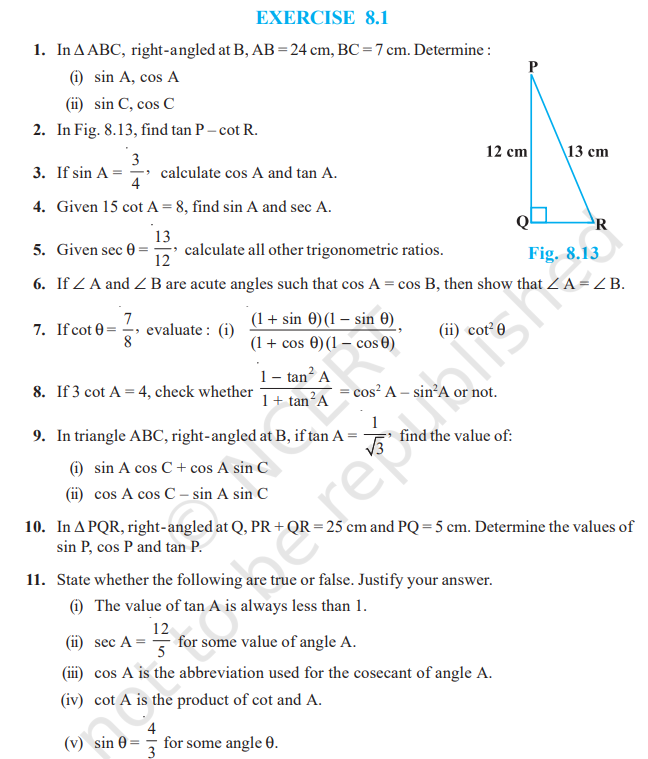

This exercise uses the definitions of trigonometric ratios in a right-angled triangle (SOH CAH TOA) and the Pythagorean theorem ($a^2 + b^2 = c^2$).
Shutterstock
Explore
- $\sin(\theta) = \frac{\text{Opposite}}{\text{Hypotenuse}}$
- $\cos(\theta) = \frac{\text{Adjacent}}{\text{Hypotenuse}}$
- $\tan(\theta) = \frac{\text{Opposite}}{\text{Adjacent}}$
- $\csc(\theta) = \frac{1}{\sin(\theta)}$
- $\sec(\theta) = \frac{1}{\cos(\theta)}$
- $\cot(\theta) = \frac{1}{\tan(\theta)}$
1. In $\triangle ABC$, right-angled at $B$, $AB = 24 \text{ cm}$, $BC = 7 \text{ cm}$.
First, find the hypotenuse ($AC$) using the Pythagorean theorem:
$$AC^2 = AB^2 + BC^2 = 24^2 + 7^2 = 576 + 49 = 625$$
$$AC = \sqrt{625} = 25 \text{ cm}$$
(i) $\sin A, \cos A$
Relative to angle $A$: Opposite side is $BC=7$, Adjacent side is $AB=24$, Hypotenuse is $AC=25$.
$$\sin A = \frac{\text{Opposite}}{\text{Hypotenuse}} = \frac{BC}{AC} = \mathbf{\frac{7}{25}}$$
$$\cos A = \frac{\text{Adjacent}}{\text{Hypotenuse}} = \frac{AB}{AC} = \mathbf{\frac{24}{25}}$$
(ii) $\sin C, \cos C$
Relative to angle $C$: Opposite side is $AB=24$, Adjacent side is $BC=7$, Hypotenuse is $AC=25$.
$$\sin C = \frac{\text{Opposite}}{\text{Hypotenuse}} = \frac{AB}{AC} = \mathbf{\frac{24}{25}}$$
$$\cos C = \frac{\text{Adjacent}}{\text{Hypotenuse}} = \frac{BC}{AC} = \mathbf{\frac{7}{25}}$$
2. In Fig. 8.13, find $\tan P – \cot R$.
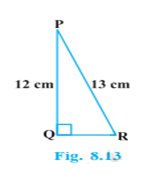
The figure is a right-angled triangle $\triangle PQR$ with $PQ = 12 \text{ cm}$, $PR = 13 \text{ cm}$.
First, find the missing side ($QR$) using the Pythagorean theorem:
$$QR^2 + PQ^2 = PR^2$$
$$QR^2 + 12^2 = 13^2 \implies QR^2 + 144 = 169$$
$$QR^2 = 169 – 144 = 25 \implies QR = 5 \text{ cm}$$
- Find $\tan P$: (Opposite is $QR=5$, Adjacent is $PQ=12$)$$\tan P = \frac{QR}{PQ} = \frac{5}{12}$$
- Find $\cot R$: (Opposite is $PQ=12$, Adjacent is $QR=5$)$$\cot R = \frac{\text{Adjacent}}{\text{Opposite}} = \frac{QR}{PQ} = \frac{5}{12}$$
- Calculate $\tan P – \cot R$:$$\tan P – \cot R = \frac{5}{12} – \frac{5}{12} = \mathbf{0}$$
3. If $\sin A = 3/4$, calculate $\cos A$ and $\tan A$.
In a right triangle, $\sin A = \frac{\text{Opposite}}{\text{Hypotenuse}} = \frac{3}{4}$.
Let Opposite side $= 3k$, Hypotenuse $= 4k$.
Find the Adjacent side ($x$) using the Pythagorean theorem:
$$x^2 + (3k)^2 = (4k)^2 \implies x^2 + 9k^2 = 16k^2$$
$$x^2 = 7k^2 \implies x = k\sqrt{7}$$
Now calculate $\cos A$ and $\tan A$:
$$\cos A = \frac{\text{Adjacent}}{\text{Hypotenuse}} = \frac{k\sqrt{7}}{4k} = \mathbf{\frac{\sqrt{7}}{4}}$$
$$\tan A = \frac{\text{Opposite}}{\text{Adjacent}} = \frac{3k}{k\sqrt{7}} = \frac{3}{\sqrt{7}} = \mathbf{\frac{3\sqrt{7}}{7}}$$
4. Given $15 \cot A = 8$, find $\sin A$ and $\sec A$.
$$\cot A = \frac{8}{15}$$
In a right triangle, $\cot A = \frac{\text{Adjacent}}{\text{Opposite}} = \frac{8}{15}$.
Let Adjacent side $= 8k$, Opposite side $= 15k$.
Find the Hypotenuse ($h$) using the Pythagorean theorem:
$$h^2 = (8k)^2 + (15k)^2 = 64k^2 + 225k^2 = 289k^2$$
$$h = \sqrt{289k^2} = 17k$$
Now find $\sin A$ and $\sec A$:
$$\sin A = \frac{\text{Opposite}}{\text{Hypotenuse}} = \frac{15k}{17k} = \mathbf{\frac{15}{17}}$$
$$\sec A = \frac{\text{Hypotenuse}}{\text{Adjacent}} = \frac{17k}{8k} = \mathbf{\frac{17}{8}}$$
5. Given $\sec \theta = 13/12$, calculate all other trigonometric ratios.
In a right triangle, $\sec \theta = \frac{\text{Hypotenuse}}{\text{Adjacent}} = \frac{13}{12}$.
Let Hypotenuse $= 13k$, Adjacent side $= 12k$.
Find the Opposite side ($x$) using the Pythagorean theorem:
$$x^2 + (12k)^2 = (13k)^2 \implies x^2 + 144k^2 = 169k^2$$
$$x^2 = 169k^2 – 144k^2 = 25k^2 \implies x = 5k$$
The ratios are:
- $\cos \theta = \frac{1}{\sec \theta} = \mathbf{\frac{12}{13}}$
- $\sin \theta = \frac{\text{Opposite}}{\text{Hypotenuse}} = \frac{5k}{13k} = \mathbf{\frac{5}{13}}$
- $\tan \theta = \frac{\text{Opposite}}{\text{Adjacent}} = \frac{5k}{12k} = \mathbf{\frac{5}{12}}$
- $\csc \theta = \frac{1}{\sin \theta} = \mathbf{\frac{13}{5}}$
- $\cot \theta = \frac{1}{\tan \theta} = \mathbf{\frac{12}{5}}$
6. If $\angle A$ and $\angle B$ are acute angles such that $\cos A = \cos B$, then show that $\angle A = \angle B$.
Consider a right-angled triangle $\triangle ABC$ where $\angle C = 90^\circ$.
$$\cos A = \frac{\text{Adjacent to } A}{\text{Hypotenuse}} = \frac{AC}{AB}$$
$$\cos B = \frac{\text{Adjacent to } B}{\text{Hypotenuse}} = \frac{BC}{AB}$$
Given $\cos A = \cos B$:
$$\frac{AC}{AB} = \frac{BC}{AB}$$
$$AC = BC$$
Since the sides opposite to $\angle A$ and $\angle B$ are equal, the angles themselves must be equal (angles opposite to equal sides are equal).
$$\angle A = \angle B$$
Alternatively, consider a general acute-angled triangle $ABC$. Draw a perpendicular $CD$ to $AB$.
In $\triangle ADC$, $\cos A = \frac{AD}{AC}$. In $\triangle BDC$, $\cos B = \frac{BD}{BC}$.
If $\cos A = \cos B$, then the angle $A$ must equal angle $B$ because the cosine function is one-to-one for acute angles (i.e., if $0^\circ < A, B < 90^\circ$ and $\cos A = \cos B$, then $A = B$).
7. If $\cot \theta = 7/8$, evaluate:
Since $\cot \theta = \frac{\cos \theta}{\sin \theta}$, we can simplify the expression without finding the sides of the triangle.
(i) $\frac{(1 + \sin \theta)(1 – \sin \theta)}{(1 + \cos \theta)(1 – \cos \theta)}$
Using the identity $(a+b)(a-b) = a^2 – b^2$:
$$\text{Expression} = \frac{1 – \sin^2 \theta}{1 – \cos^2 \theta}$$
Using the Pythagorean identities: $1 – \sin^2 \theta = \cos^2 \theta$ and $1 – \cos^2 \theta = \sin^2 \theta$.
$$\text{Expression} = \frac{\cos^2 \theta}{\sin^2 \theta} = \left(\frac{\cos \theta}{\sin \theta}\right)^2 = (\cot \theta)^2$$
Since $\cot \theta = 7/8$:
$$\text{Value} = \left(\frac{7}{8}\right)^2 = \mathbf{\frac{49}{64}}$$
(ii) $\cot^2 \theta$
$$\cot^2 \theta = (\cot \theta)^2 = \left(\frac{7}{8}\right)^2 = \mathbf{\frac{49}{64}}$$
8. If $3 \cot A = 4$, check whether $\frac{1 – \tan^2 A}{1 + \tan^2 A} = \cos^2 A – \sin^2 A$ or not.
Given $\cot A = 4/3$.
- Find $\tan A$:$$\tan A = \frac{1}{\cot A} = \frac{3}{4}$$
- Find $\sin A$ and $\cos A$:$\cot A = 4/3 = \text{Adjacent}/\text{Opposite}$. Let $Adj=4k, Opp=3k$.Hypotenuse $h = \sqrt{(4k)^2 + (3k)^2} = \sqrt{16k^2 + 9k^2} = \sqrt{25k^2} = 5k$.$$\sin A = \frac{3k}{5k} = \frac{3}{5} \quad ; \quad \cos A = \frac{4k}{5k} = \frac{4}{5}$$
- Evaluate LHS ($\frac{1 – \tan^2 A}{1 + \tan^2 A}$):$$\text{LHS} = \frac{1 – (3/4)^2}{1 + (3/4)^2} = \frac{1 – 9/16}{1 + 9/16} = \frac{(16 – 9)/16}{(16 + 9)/16} = \frac{7/16}{25/16} = \frac{7}{25}$$
- Evaluate RHS ($\cos^2 A – \sin^2 A$):$$\text{RHS} = \left(\frac{4}{5}\right)^2 – \left(\frac{3}{5}\right)^2 = \frac{16}{25} – \frac{9}{25} = \frac{16 – 9}{25} = \frac{7}{25}$$
Since LHS = RHS ($7/25 = 7/25$), the statement is True.
9. In triangle $ABC$, right-angled at $B$, if $\tan A = 1/\sqrt{3}$.
Since $\tan A = 1/\sqrt{3}$, we know $\angle A = 30^\circ$.
Since $\angle B = 90^\circ$, then $\angle C = 180^\circ – 90^\circ – 30^\circ = 60^\circ$.
Also, $\tan A = \frac{\text{Opposite}}{\text{Adjacent}} = \frac{BC}{AB} = \frac{1}{\sqrt{3}}$.
Let $BC=1$ and $AB=\sqrt{3}$.
Hypotenuse $AC = \sqrt{1^2 + (\sqrt{3})^2} = \sqrt{1 + 3} = \sqrt{4} = 2$.
- $\sin A = 1/2$ ; $\cos A = \sqrt{3}/2$
- $\sin C = \sqrt{3}/2$ ; $\cos C = 1/2$
(i) $\sin A \cos C + \cos A \sin C$
$$\text{Value} = \left(\frac{1}{2}\right)\left(\frac{1}{2}\right) + \left(\frac{\sqrt{3}}{2}\right)\left(\frac{\sqrt{3}}{2}\right) = \frac{1}{4} + \frac{3}{4} = \frac{4}{4} = \mathbf{1}$$
(This is the sine addition identity: $\sin(A+C) = \sin(30^\circ + 60^\circ) = \sin(90^\circ) = 1$)
(ii) $\cos A \cos C – \sin A \sin C$
$$\text{Value} = \left(\frac{\sqrt{3}}{2}\right)\left(\frac{1}{2}\right) – \left(\frac{1}{2}\right)\left(\frac{\sqrt{3}}{2}\right) = \frac{\sqrt{3}}{4} – \frac{\sqrt{3}}{4} = \mathbf{0}$$
(This is the cosine addition identity: $\cos(A+C) = \cos(30^\circ + 60^\circ) = \cos(90^\circ) = 0$)
10. In $\triangle PQR$, right-angled at $Q$, $PR + QR = 25 \text{ cm}$ and $PQ = 5 \text{ cm}$.
Let $PR = x$. Then $QR = 25 – x$. $PQ = 5$.
Using the Pythagorean theorem: $PQ^2 + QR^2 = PR^2$
$$5^2 + (25 – x)^2 = x^2$$
$$25 + (625 – 50x + x^2) = x^2$$
$$650 – 50x + x^2 = x^2$$
$$650 = 50x \implies x = \frac{650}{50} = 13$$
The sides are: $\mathbf{PR = 13 \text{ cm}}$ (Hypotenuse), $\mathbf{QR = 25 – 13 = 12 \text{ cm}}$ (Opposite to $P$), $\mathbf{PQ = 5 \text{ cm}}$ (Adjacent to $P$).
Now determine $\sin P, \cos P$, and $\tan P$:
$$\sin P = \frac{QR}{PR} = \mathbf{\frac{12}{13}}$$
$$\cos P = \frac{PQ}{PR} = \mathbf{\frac{5}{13}}$$
$$\tan P = \frac{QR}{PQ} = \mathbf{\frac{12}{5}}$$
11. State whether the following are true or false. Justify your answer.
(i) The value of $\tan A$ is always less than 1.
False. $\tan A = \frac{\text{Opposite}}{\text{Adjacent}}$. If the Opposite side is greater than the Adjacent side (e.g., $A=60^\circ$, $\tan 60^\circ = \sqrt{3} \approx 1.732$), then $\tan A > 1$.
(ii) $\sec A = 12/5$ for some value of angle $A$.
True. $\sec A = \frac{\text{Hypotenuse}}{\text{Adjacent}}$. In a right triangle, the hypotenuse is always the longest side, so $\text{Hypotenuse} > \text{Adjacent}$. Since $12/5 = 2.4 > 1$, this ratio is possible for the sides of a right triangle.
(iii) $\cos A$ is the abbreviation used for the cosecant of angle $A$.
False. $\cos A$ is the abbreviation used for the cosine of angle $A$. The abbreviation for cosecant is $\mathbf{\csc A}$.
(iv) $\cot A$ is the product of $\cot$ and $A$.
False. $\cot A$ means the cotangent of the angle $A$. $\mathbf{\cot}$ is not a standalone numerical value but a function that requires an argument (the angle $A$).
(v) $\sin \theta = 4/3$ for some angle $\theta$.
False. $\sin \theta = \frac{\text{Opposite}}{\text{Hypotenuse}}$. In a right triangle, the Opposite side must be less than the Hypotenuse, so $\sin \theta$ must always be less than 1 (for $0^\circ < \theta < 90^\circ$). Since $4/3 \approx 1.33 > 1$, this is impossible.