
Complete solutions for NCERT Class 12 Maths Exercise 10.1 (Vectors). Learn to represent vectors graphically (like displacement) and classify quantities as scalars (e.g., mass, time, power) or vectors (e.g., velocity, acceleration, force). Identify and distinguish between different types of vectors (coinitial, equal, collinear). Essential foundation for the Vectors chapter.
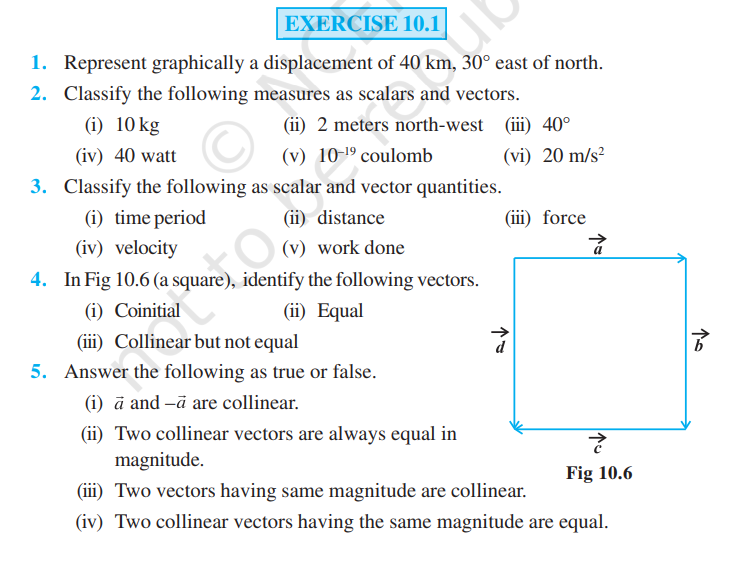
Table of Contents

This exercise introduces the basic concepts of scalars, vectors, and their graphical representation.
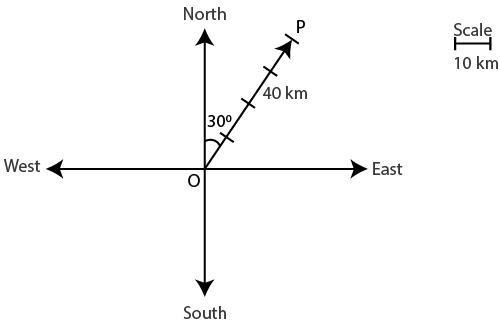
1. Graphical Representation of Displacement
A vector quantity has both magnitude and direction.
The displacement is $\mathbf{40 \text{ km}}$, $\mathbf{30^\circ}$ east of north.
- Draw Axes: Draw a coordinate system representing the four main directions (North, South, East, West).
- Identify Reference Line: The direction is specified “east of north,” so the reference line is the North axis.
- Draw Angle: Draw a ray starting from the origin that makes an angle of $30^\circ$ measured from the North axis towards the East.
- Magnitude: The length of the ray represents the magnitude of 40 km.
2. Classification of Measures (Scalars and Vectors)
Scalar quantities are defined by magnitude only. Vector quantities are defined by magnitude and direction.
| Measure | Classification | Reason |
| (i) 10 kg | Scalar | Represents mass (magnitude only). |
| (ii) 2 meters north-west | Vector | Represents displacement (magnitude and direction). |
| (iii) $40^\circ$ | Scalar | Represents angle/temperature (magnitude only). |
| (iv) 40 watt | Scalar | Represents power (magnitude only). |
| (v) $10^{-19}$ coulomb | Scalar | Represents electric charge (magnitude only). |
| (vi) $20 \text{ m/s}^2$ | Vector | Represents acceleration (magnitude and direction). |
3. Classification of Quantities (Scalars and Vectors)
| Quantity | Classification |
| (i) time period | Scalar |
| (ii) distance | Scalar |
| (iii) force | Vector |
| (iv) velocity | Vector |
| (v) work done | Scalar |
4. Identifying Vectors in a Square
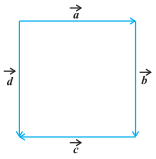
Assuming the figure is a square with vertices A, B, C, D labeled counter-clockwise:
| Vector Property | Identification | Explanation |
| (i) Coinitial | $\vec{A}, \vec{D}$ (e.g., $\vec{AD}, \vec{AB}$) | Vectors starting from the same initial point (e.g., A). |
| (ii) Equal | $\vec{AB}, \vec{DC}$ | Vectors having the same magnitude and the same direction. In a square, $\vec{AB}$ and $\vec{DC}$ are equal. |
| (iii) Collinear but not equal | $\vec{AB}, \vec{CD}$ | Vectors lying on the same line (or parallel lines) but having opposite directions. $\vec{AB}$ and $\vec{CD}$ have the same magnitude but $\vec{CD} = -\vec{AB}$. |
5. True or False
(i) $\vec{a}$ and $-\vec{a}$ are collinear.
- True. Collinear vectors lie on the same line or on parallel lines. Since $\vec{a}$ and $-\vec{a}$ are parallel (they share the same line of action), they are collinear.
(ii) Two collinear vectors are always equal in magnitude.
- False. Collinear vectors only need to be parallel (e.g., $2\vec{a}$ and $\vec{a}$ are collinear but not equal in magnitude).
(iii) Two vectors having same magnitude are collinear.
- False. Vectors $\vec{a}$ and $\vec{b}$ can have the same length but point in entirely different directions (e.g., vectors along adjacent sides of a square).
(iv) Two collinear vectors having the same magnitude are equal.
- False. They must also have the same direction. For example, $\vec{a}$ and $-\vec{a}$ are collinear and have the same magnitude, but they are not equal since their directions are opposite. $\vec{a} \neq -\vec{a}$ (unless $\vec{a} = \vec{0}$).
Would you like to move on to the next exercise which covers components of a vector and unit vectors?