
Find complete solutions for NCERT Class 12 Maths Exercise 10.4 covering the Vector (Cross) Product. Learn to calculate
This exercise focuses on the vector product (or cross product) of two vectors, defined by $\mathbf{\vec{a} \times \vec{b} = |\vec{a}| |\vec{b}| \sin \theta \hat{n}}$ and its applications in geometry (Area of Triangle and Parallelogram).
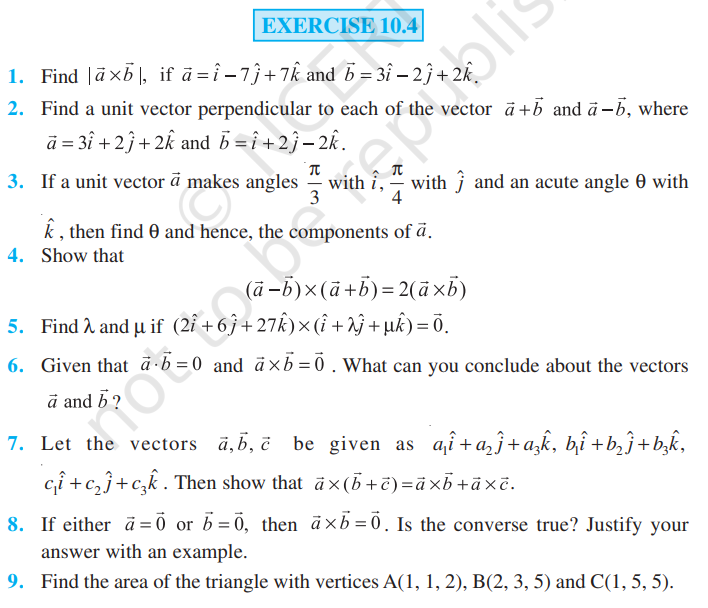

1. Find $|\vec{a} \times \vec{b}|$ where $\vec{a} = \hat{i} – 7\hat{j} + 7\hat{k}$ and $\vec{b} = 3\hat{i} – 2\hat{j} + 2\hat{k}$.
- Calculate the Cross Product $\vec{a} \times \vec{b}$:$$\vec{a} \times \vec{b} = \begin{vmatrix} \hat{i} & \hat{j} & \hat{k} \\ 1 & -7 & 7 \\ 3 & -2 & 2 \end{vmatrix}$$$$\vec{a} \times \vec{b} = \hat{i}[(-7)(2) – (7)(-2)] – \hat{j}[(1)(2) – (7)(3)] + \hat{k}[(1)(-2) – (-7)(3)]$$$$\vec{a} \times \vec{b} = \hat{i}(-14 – (-14)) – \hat{j}(2 – 21) + \hat{k}(-2 – (-21))$$$$\vec{a} \times \vec{b} = \hat{i}(0) – \hat{j}(-19) + \hat{k}(19) = 19\hat{j} + 19\hat{k}$$
- Calculate the Magnitude $|\vec{a} \times \vec{b}|$:$$|\vec{a} \times \vec{b}| = \sqrt{0^2 + (19)^2 + (19)^2} = \sqrt{2 \cdot 19^2} = \mathbf{19\sqrt{2}}$$
2. Find a unit vector perpendicular to each of the vectors $\vec{a} + \vec{b}$ and $\vec{a} – \vec{b}$, where $\vec{a} = 3\hat{i} + 2\hat{j} + 2\hat{k}$ and $\vec{b} = \hat{i} + 2\hat{j} – 2\hat{k}$.
A vector perpendicular to both $\vec{x}$ and $\vec{y}$ is given by their cross product $\vec{x} \times \vec{y}$. The unit vector is $\frac{\vec{x} \times \vec{y}}{|\vec{x} \times \vec{y}|}$.
- Calculate the resultant vectors:$$\vec{x} = \vec{a} + \vec{b} = (3+1)\hat{i} + (2+2)\hat{j} + (2-2)\hat{k} = 4\hat{i} + 4\hat{j} + 0\hat{k}$$$$\vec{y} = \vec{a} – \vec{b} = (3-1)\hat{i} + (2-2)\hat{j} + (2-(-2))\hat{k} = 2\hat{i} + 0\hat{j} + 4\hat{k}$$
- Calculate the Cross Product $\vec{x} \times \vec{y}$:$$\vec{x} \times \vec{y} = \begin{vmatrix} \hat{i} & \hat{j} & \hat{k} \\ 4 & 4 & 0 \\ 2 & 0 & 4 \end{vmatrix}$$$$\vec{x} \times \vec{y} = \hat{i}(16 – 0) – \hat{j}(16 – 0) + \hat{k}(0 – 8) = 16\hat{i} – 16\hat{j} – 8\hat{k}$$
- Find the unit vector:$$|\vec{x} \times \vec{y}| = \sqrt{16^2 + (-16)^2 + (-8)^2} = \sqrt{256 + 256 + 64} = \sqrt{576} = 24$$$$\hat{n} = \frac{16\hat{i} – 16\hat{j} – 8\hat{k}}{24} = \frac{8(2\hat{i} – 2\hat{j} – \hat{k})}{24} = \mathbf{\frac{1}{3}(2\hat{i} – 2\hat{j} – \hat{k})}$$
3. If a unit vector $\vec{a}$ makes angles $\frac{\pi}{3}$ with $\hat{i}$, $\frac{\pi}{4}$ with $\hat{j}$, and an acute angle $\theta$ with $\hat{k}$, then find $\theta$ and hence, the components of $\vec{a}$.
A unit vector $\vec{a}$ has direction cosines $l = \cos \alpha$, $m = \cos \beta$, $n = \cos \gamma$, where $\alpha, \beta, \gamma$ are the angles it makes with the axes. The components of $\vec{a}$ are $\langle l, m, n \rangle$. The identity for direction cosines is $l^2 + m^2 + n^2 = 1$.
- Find direction cosines:$$l = \cos(\pi/3) = 1/2$$$$m = \cos(\pi/4) = 1/\sqrt{2}$$$$n = \cos \theta$$
- Apply the identity:$$l^2 + m^2 + n^2 = 1$$$$\left(\frac{1}{2}\right)^2 + \left(\frac{1}{\sqrt{2}}\right)^2 + \cos^2 \theta = 1$$$$\frac{1}{4} + \frac{1}{2} + \cos^2 \theta = 1$$$$\frac{3}{4} + \cos^2 \theta = 1 \implies \cos^2 \theta = 1 – \frac{3}{4} = \frac{1}{4}$$
- Find $\theta$ and components:$$\cos \theta = \pm \frac{1}{2}$$Since $\theta$ is an acute angle ($0 < \theta < \pi/2$), $\cos \theta$ must be positive.$$\cos \theta = \frac{1}{2} \implies \theta = \mathbf{\pi/3}$$The components of $\vec{a}$ are $\langle l, m, n \rangle = \langle 1/2, 1/\sqrt{2}, 1/2 \rangle$.$$\vec{a} = \mathbf{\frac{1}{2}\hat{i} + \frac{1}{\sqrt{2}}\hat{j} + \frac{1}{2}\hat{k}}$$
4. Show that $(\vec{a} – \vec{b}) \times (\vec{a} + \vec{b}) = 2 (\vec{a} \times \vec{b})$.
Use the distributive property of the cross product:
$$LHS = (\vec{a} – \vec{b}) \times (\vec{a} + \vec{b})$$
$$LHS = \vec{a} \times \vec{a} + \vec{a} \times \vec{b} – \vec{b} \times \vec{a} – \vec{b} \times \vec{b}$$
We know that:
- The cross product of a vector with itself is the zero vector: $\vec{a} \times \vec{a} = \vec{0}$ and $\vec{b} \times \vec{b} = \vec{0}$.
- The cross product is anti-commutative: $\vec{b} \times \vec{a} = -(\vec{a} \times \vec{b})$.
$$LHS = \vec{0} + \vec{a} \times \vec{b} – (-\vec{a} \times \vec{b}) – \vec{0}$$
$$LHS = \vec{a} \times \vec{b} + \vec{a} \times \vec{b} = 2 (\vec{a} \times \vec{b})$$
Shown. (This formula is used to derive the area of a parallelogram using its diagonals).
5. Find $\lambda$ and $\mu$ if $(2\hat{i} + 6\hat{j} + 27\hat{k}) \times (\hat{i} + \lambda\hat{j} + \mu\hat{k}) = \vec{0}$.
Two non-zero vectors $\vec{a}$ and $\vec{b}$ have $\vec{a} \times \vec{b} = \vec{0}$ if and only if they are collinear (parallel), which means one is a scalar multiple of the other, $\vec{a} = k\vec{b}$.
Here, $2\hat{i} + 6\hat{j} + 27\hat{k} = k (\hat{i} + \lambda\hat{j} + \mu\hat{k})$.
Comparing the $\hat{i}$ components:
$$2 = k(1) \implies k = 2$$
Now, compare the remaining components using $k=2$:
- $\hat{j}$ component:$$6 = k \lambda = 2 \lambda \implies \lambda = \mathbf{3}$$
- $\hat{k}$ component:$$27 = k \mu = 2 \mu \implies \mu = \mathbf{27/2}$$
Alternatively, calculate the cross product and set the components to zero:
$$\vec{a} \times \vec{b} = \hat{i}(6\mu – 27\lambda) – \hat{j}(2\mu – 27) + \hat{k}(2\lambda – 6) = 0\hat{i} + 0\hat{j} + 0\hat{k}$$
Equating coefficients to zero:
- $2\lambda – 6 = 0 \implies 2\lambda = 6 \implies \mathbf{\lambda = 3}$
- $2\mu – 27 = 0 \implies 2\mu = 27 \implies \mathbf{\mu = 27/2}$
- $6\mu – 27\lambda = 6(27/2) – 27(3) = 81 – 81 = 0$ (consistent).
6. Given that $\vec{a} \cdot \vec{b} = 0$ and $\vec{a} \times \vec{b} = \vec{0}$. What can you conclude about the vectors $\vec{a}$ and $\vec{b}$?
- From $\vec{a} \cdot \vec{b} = 0$:This implies $\mathbf{|\vec{a}| |\vec{b}| \cos \theta = 0}$. Thus, either $|\vec{a}|=0$, $|\vec{b}|=0$, or the vectors are perpendicular ($\cos \theta = 0$, so $\theta = \pi/2$).
- From $\vec{a} \times \vec{b} = \vec{0}$:This implies $\mathbf{|\vec{a}| |\vec{b}| \sin \theta = 0}$. Thus, either $|\vec{a}|=0$, $|\vec{b}|=0$, or the vectors are parallel ($\sin \theta = 0$, so $\theta = 0$ or $\pi$).
For both conditions to be true simultaneously, $\cos \theta$ must be $0$ ($\theta = \pi/2$) AND $\sin \theta$ must be $0$ ($\theta = 0$ or $\pi$). This is only possible if at least one of the magnitudes is zero, which makes $\vec{a} \cdot \vec{b}=0$ and $\vec{a} \times \vec{b}=\vec{0}$ regardless of $\theta$.
Conclusion: At least one of the vectors must be the zero vector.
$$\mathbf{\vec{a} = \vec{0} \text{ or } \vec{b} = \vec{0}}$$
7. Let the vectors be given as $\vec{a} = a_1\hat{i} + a_2\hat{j} + a_3\hat{k}$, $\vec{b} = b_1\hat{i} + b_2\hat{j} + b_3\hat{k}$, $\vec{c} = c_1\hat{i} + c_2\hat{j} + c_3\hat{k}$. Then show that $\vec{a} \times (\vec{b} + \vec{c}) = \vec{a} \times \vec{b} + \vec{a} \times \vec{c}$. (Distributive Law)
The proof involves expanding both sides using the determinant form of the cross product and showing they are equal.
- Calculate $\vec{b} + \vec{c}$:$$\vec{b} + \vec{c} = (b_1 + c_1)\hat{i} + (b_2 + c_2)\hat{j} + (b_3 + c_3)\hat{k}$$
- Calculate $LHS = \vec{a} \times (\vec{b} + \vec{c})$:The $\hat{i}$ component of $LHS$ is:$$a_2(b_3 + c_3) – a_3(b_2 + c_2) = (a_2 b_3 – a_3 b_2) + (a_2 c_3 – a_3 c_2)$$
- Calculate $RHS = \vec{a} \times \vec{b} + \vec{a} \times \vec{c}$:The $\hat{i}$ component of $\vec{a} \times \vec{b}$ is $(a_2 b_3 – a_3 b_2)$.The $\hat{i}$ component of $\vec{a} \times \vec{c}$ is $(a_2 c_3 – a_3 c_2)$.The $\hat{i}$ component of $RHS$ is:$$(a_2 b_3 – a_3 b_2) + (a_2 c_3 – a_3 c_2)$$
Since the $\hat{i}$ components of $LHS$ and $RHS$ are equal, and the same expansion logic applies to the $\hat{j}$ and $\hat{k}$ components, the equality holds.
Shown.
8. If either $\vec{a} = \vec{0}$ or $\vec{b} = \vec{0}$, then $\vec{a} \times \vec{b} = \vec{0}$. Is the converse true? Justify your answer with an example.
The converse statement is: If $\vec{a} \times \vec{b} = \vec{0}$, then either $\vec{a} = \vec{0}$ or $\vec{b} = \vec{0}$.
Justification (Converse is False):
The cross product $\vec{a} \times \vec{b} = |\vec{a}| |\vec{b}| \sin \theta \hat{n} = \vec{0}$ implies that either $|\vec{a}| = 0$, $|\vec{b}| = 0$, or $\sin \theta = 0$.
If $\sin \theta = 0$, then $\theta = 0$ or $\theta = \pi$.
This means two non-zero vectors can have a zero cross product if they are parallel (collinear).
Example:
- Let $\vec{a} = \hat{i} + \hat{j}$ (where $\vec{a} \neq \vec{0}$)
- Let $\vec{b} = 2\hat{i} + 2\hat{j}$ (where $\vec{b} \neq \vec{0}$)
- $\vec{a} \times \vec{b} = \begin{vmatrix} \hat{i} & \hat{j} & \hat{k} \\ 1 & 1 & 0 \\ 2 & 2 & 0 \end{vmatrix} = \hat{i}(0-0) – \hat{j}(0-0) + \hat{k}(2-2) = \vec{0}$.Here, $\vec{a} \times \vec{b} = \vec{0}$, but neither vector is $\vec{0}$.
9. Find the area of the triangle with vertices $A(1, 1, 2)$, $B(2, 3, 5)$ and $C(1, 5, 5)$.
The area of a triangle $\text{ABC}$ is $\mathbf{\frac{1}{2} |\vec{AB} \times \vec{AC}|}$.
- Calculate side vectors $\vec{AB}$ and $\vec{AC}$:$$\vec{AB} = \vec{b} – \vec{a} = (2-1)\hat{i} + (3-1)\hat{j} + (5-2)\hat{k} = \hat{i} + 2\hat{j} + 3\hat{k}$$$$\vec{AC} = \vec{c} – \vec{a} = (1-1)\hat{i} + (5-1)\hat{j} + (5-2)\hat{k} = 0\hat{i} + 4\hat{j} + 3\hat{k}$$
- Calculate the Cross Product $\vec{AB} \times \vec{AC}$:$$\vec{AB} \times \vec{AC} = \begin{vmatrix} \hat{i} & \hat{j} & \hat{k} \\ 1 & 2 & 3 \\ 0 & 4 & 3 \end{vmatrix}$$$$\vec{AB} \times \vec{AC} = \hat{i}(6 – 12) – \hat{j}(3 – 0) + \hat{k}(4 – 0) = -6\hat{i} – 3\hat{j} + 4\hat{k}$$
- Calculate the Magnitude:$$|\vec{AB} \times \vec{AC}| = \sqrt{(-6)^2 + (-3)^2 + 4^2} = \sqrt{36 + 9 + 16} = \sqrt{61}$$
- Area of Triangle:$$\text{Area} = \frac{1}{2} |\vec{AB} \times \vec{AC}| = \mathbf{\frac{\sqrt{61}}{2} \text{ square units}}$$
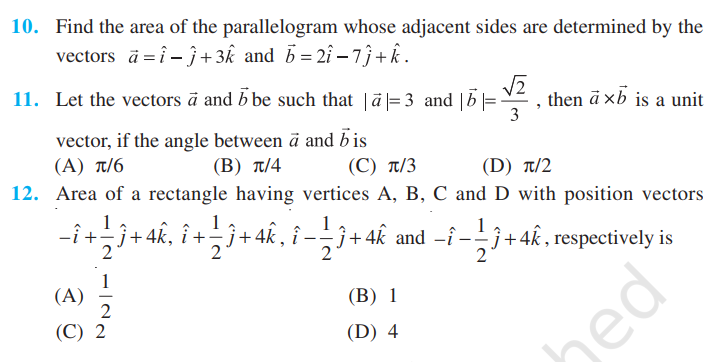
10. Find the area of the parallelogram whose adjacent sides are determined by the vectors $\vec{a} = \hat{i} – \hat{j} + 3\hat{k}$ and $\vec{b} = 2\hat{i} – 7\hat{j} + \hat{k}$.
The area of a parallelogram with adjacent sides $\vec{a}$ and $\vec{b}$ is $\mathbf{|\vec{a} \times \vec{b}|}$.
- Calculate the Cross Product $\vec{a} \times \vec{b}$:$$\vec{a} \times \vec{b} = \begin{vmatrix} \hat{i} & \hat{j} & \hat{k} \\ 1 & -1 & 3 \\ 2 & -7 & 1 \end{vmatrix}$$$$\vec{a} \times \vec{b} = \hat{i}(-1 – (-21)) – \hat{j}(1 – 6) + \hat{k}(-7 – (-2))$$$$\vec{a} \times \vec{b} = \hat{i}(20) – \hat{j}(-5) + \hat{k}(-5) = 20\hat{i} + 5\hat{j} – 5\hat{k}$$
- Calculate the Magnitude:$$|\vec{a} \times \vec{b}| = \sqrt{20^2 + 5^2 + (-5)^2} = \sqrt{400 + 25 + 25} = \sqrt{450}$$$$\sqrt{450} = \sqrt{225 \cdot 2} = 15\sqrt{2}$$
- Area of Parallelogram:$$\text{Area} = \mathbf{15\sqrt{2} \text{ square units}}$$
11. Let the vectors $\vec{a}$ and $\vec{b}$ be such that $|\vec{a}| = 3$ and $|\vec{b}| = \sqrt{2}/3$, then $\vec{a} \times \vec{b}$ is a unit vector, if the angle between $\vec{a}$ and $\vec{b}$ is
$\vec{a} \times \vec{b}$ is a unit vector if $|\vec{a} \times \vec{b}| = 1$.
$$|\vec{a} \times \vec{b}| = |\vec{a}| |\vec{b}| \sin \theta$$
$$1 = (3) \left(\frac{\sqrt{2}}{3}\right) \sin \theta$$
$$1 = \sqrt{2} \sin \theta$$
$$\sin \theta = \frac{1}{\sqrt{2}}$$
The angle $\theta$ can be $\pi/4$ or $3\pi/4$.
The available options are acute angles.
$$\theta = \pi/4$$
The correct answer is (B) $\pi/4$.
12. Area of a rectangle having vertices A, B, C and D with position vectors… is
The vertices are given by their position vectors:
$$\vec{a} = -\frac{1}{2}\hat{i} + \frac{1}{2}\hat{j} + 4\hat{k}$$
$$\vec{b} = \frac{1}{2}\hat{i} + \frac{1}{2}\hat{j} + 4\hat{k}$$
$$\vec{c} = \frac{1}{2}\hat{i} – \frac{1}{2}\hat{j} + 4\hat{k}$$
$$\vec{d} = -\frac{1}{2}\hat{i} – \frac{1}{2}\hat{j} + 4\hat{k}$$
The area of the rectangle is given by the magnitude of the cross product of two adjacent side vectors, e.g., $\vec{AB}$ and $\vec{AD}$.
- Calculate adjacent side vectors:$$\vec{AB} = \vec{b} – \vec{a} = \left(\frac{1}{2} – (-\frac{1}{2})\right)\hat{i} + \left(\frac{1}{2} – \frac{1}{2}\right)\hat{j} + (4-4)\hat{k} = 1\hat{i} + 0\hat{j} + 0\hat{k} = \hat{i}$$$$\vec{AD} = \vec{d} – \vec{a} = \left(-\frac{1}{2} – (-\frac{1}{2})\right)\hat{i} + \left(-\frac{1}{2} – \frac{1}{2}\right)\hat{j} + (4-4)\hat{k} = 0\hat{i} – 1\hat{j} + 0\hat{k} = -\hat{j}$$
- Calculate the Cross Product $\vec{AB} \times \vec{AD}$:$$\vec{AB} \times \vec{AD} = \hat{i} \times (-\hat{j}) = -(\hat{i} \times \hat{j}) = -\hat{k}$$
- Area of Rectangle:$$\text{Area} = |\vec{AB} \times \vec{AD}| = |-\hat{k}| = \mathbf{1}$$The correct answer is (B) 1.