

Get detailed solutions for NCERT Class 12 Maths Exercise 10.3 focusing on the Scalar (Dot) Product of vectors. Learn to calculate the angle between two vectors ($\theta$), find the projection of one vector onto another, determine conditions for perpendicularity ($\vec{a} \cdot \vec{b} = 0$), and prove vector properties involving magnitudes and orthogonality. Essential for mastering Chapter 10 vector operations.
This exercise focuses on the scalar product (or dot product) of two vectors, defined by $\mathbf{\vec{a} \cdot \vec{b} = |\vec{a}| |\vec{b}| \cos \theta}$ or $\mathbf{\vec{a} \cdot \vec{b} = a_x b_x + a_y b_y + a_z b_z}$.
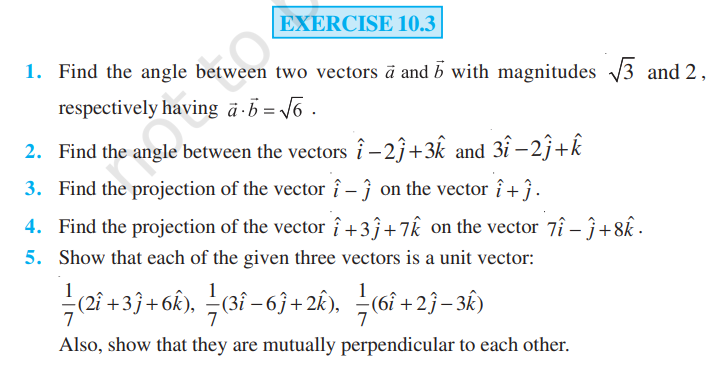

1. Find the angle between two vectors $\vec{a}$ and $\vec{b}$ with magnitudes $\sqrt{3}$ and $2$, respectively, having $\vec{a} \cdot \vec{b} = \sqrt{6}$.
The angle $\theta$ between $\vec{a}$ and $\vec{b}$ is given by:
$$\cos \theta = \frac{\vec{a} \cdot \vec{b}}{|\vec{a}| |\vec{b}|}$$
Given: $|\vec{a}| = \sqrt{3}$, $|\vec{b}| = 2$, and $\vec{a} \cdot \vec{b} = \sqrt{6}$.
$$\cos \theta = \frac{\sqrt{6}}{\sqrt{3} \cdot 2} = \frac{\sqrt{3} \cdot \sqrt{2}}{\sqrt{3} \cdot 2} = \frac{\sqrt{2}}{2} = \frac{1}{\sqrt{2}}$$
Since $\cos \theta = \frac{1}{\sqrt{2}}$, the angle is $\mathbf{\theta = 45^\circ \text{ or } \frac{\pi}{4}}$.
2. Find the angle between the vectors $\vec{a} = \hat{i} – 2\hat{j} + 3\hat{k}$ and $\vec{b} = 3\hat{i} – 2\hat{j} + \hat{k}$.
- Calculate the dot product $\vec{a} \cdot \vec{b}$:$$\vec{a} \cdot \vec{b} = (1)(3) + (-2)(-2) + (3)(1) = 3 + 4 + 3 = 10$$
- Calculate the magnitudes:$$|\vec{a}| = \sqrt{1^2 + (-2)^2 + 3^2} = \sqrt{1 + 4 + 9} = \sqrt{14}$$$$|\vec{b}| = \sqrt{3^2 + (-2)^2 + 1^2} = \sqrt{9 + 4 + 1} = \sqrt{14}$$
- Find the angle $\theta$:$$\cos \theta = \frac{\vec{a} \cdot \vec{b}}{|\vec{a}| |\vec{b}|} = \frac{10}{\sqrt{14} \cdot \sqrt{14}} = \frac{10}{14} = \frac{5}{7}$$The angle is $\mathbf{\theta = \cos^{-1}\left(\frac{5}{7}\right)}$.
3. Find the projection of the vector $\vec{a} = \hat{i} – \hat{j}$ on the vector $\vec{b} = \hat{i} + \hat{j}$.
The projection of $\vec{a}$ on $\vec{b}$ is given by $\text{Proj}_{\vec{b}} \vec{a} = \frac{\vec{a} \cdot \vec{b}}{|\vec{b}|}$.
- Calculate the dot product $\vec{a} \cdot \vec{b}$:$$\vec{a} \cdot \vec{b} = (1)(1) + (-1)(1) = 1 – 1 = 0$$
- Calculate the magnitude $|\vec{b}|$:$$|\vec{b}| = \sqrt{1^2 + 1^2} = \sqrt{2}$$
- Projection:$$\text{Proj}_{\vec{b}} \vec{a} = \frac{0}{\sqrt{2}} = \mathbf{0}$$(Note: Since the projection is 0, the vectors $\vec{a}$ and $\vec{b}$ are perpendicular).
4. Find the projection of the vector $\vec{a} = \hat{i} + 3\hat{j} + 7\hat{k}$ on the vector $\vec{b} = 7\hat{i} – \hat{j} + 8\hat{k}$.
- Calculate the dot product $\vec{a} \cdot \vec{b}$:$$\vec{a} \cdot \vec{b} = (1)(7) + (3)(-1) + (7)(8) = 7 – 3 + 56 = 60$$
- Calculate the magnitude $|\vec{b}|$:$$|\vec{b}| = \sqrt{7^2 + (-1)^2 + 8^2} = \sqrt{49 + 1 + 64} = \sqrt{114}$$
- Projection:$$\text{Proj}_{\vec{b}} \vec{a} = \frac{\vec{a} \cdot \vec{b}}{|\vec{b}|} = \mathbf{\frac{60}{\sqrt{114}}}$$
5. Show that each of the given three vectors is a unit vector and that they are mutually perpendicular.
Let $\vec{a} = \frac{1}{7}(2\hat{i} + 3\hat{j} + 6\hat{k})$, $\vec{b} = \frac{1}{7}(3\hat{i} – 6\hat{j} + 2\hat{k})$, $\vec{c} = \frac{1}{7}(6\hat{i} + 2\hat{j} – 3\hat{k})$.
(i) Unit Vector Check ($|\vec{v}| = 1$)
$$|\vec{a}|^2 = \left(\frac{1}{7}\right)^2 (2^2 + 3^2 + 6^2) = \frac{1}{49} (4 + 9 + 36) = \frac{49}{49} = 1$$
Thus, $|\vec{a}| = 1$.
$$|\vec{b}|^2 = \left(\frac{1}{7}\right)^2 (3^2 + (-6)^2 + 2^2) = \frac{1}{49} (9 + 36 + 4) = \frac{49}{49} = 1$$
Thus, $|\vec{b}| = 1$.
$$|\vec{c}|^2 = \left(\frac{1}{7}\right)^2 (6^2 + 2^2 + (-3)^2) = \frac{1}{49} (36 + 4 + 9) = \frac{49}{49} = 1$$
Thus, $|\vec{c}| = 1$.They are all unit vectors.
(ii) Mutually Perpendicular Check ($\vec{v}_1 \cdot \vec{v}_2 = 0$)
$$\vec{a} \cdot \vec{b} = \frac{1}{49} [(2)(3) + (3)(-6) + (6)(2)] = \frac{1}{49} [6 – 18 + 12] = \frac{0}{49} = 0$$
$$\vec{b} \cdot \vec{c} = \frac{1}{49} [(3)(6) + (-6)(2) + (2)(-3)] = \frac{1}{49} [18 – 12 – 6] = \frac{0}{49} = 0$$
$$\vec{a} \cdot \vec{c} = \frac{1}{49} [(2)(6) + (3)(2) + (6)(-3)] = \frac{1}{49} [12 + 6 – 18] = \frac{0}{49} = 0$$
Since their dot products are all zero, they are mutually perpendicular (orthogonal).
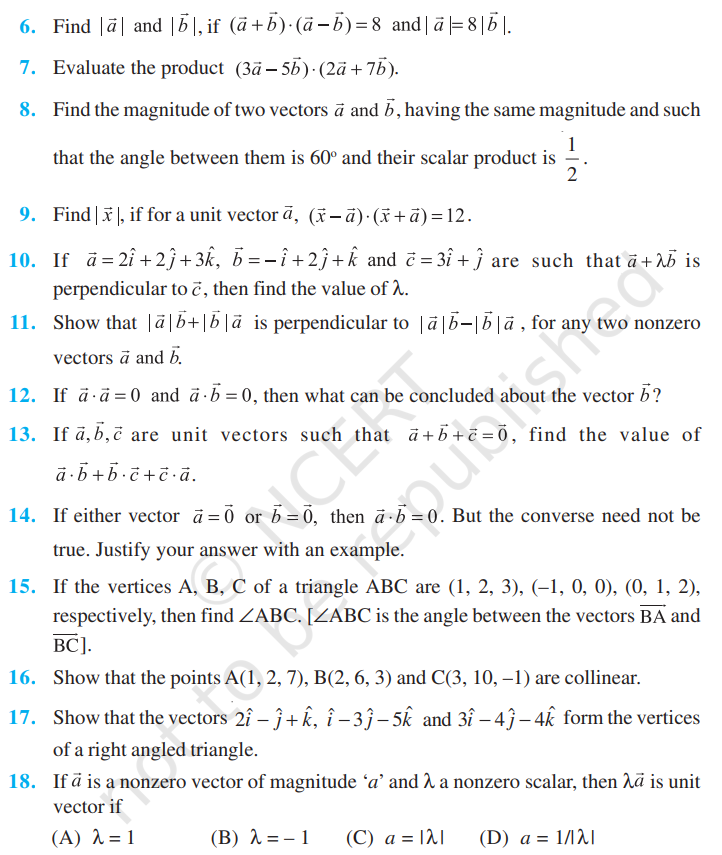
6. Find $|\vec{a}|$, if $(\vec{a} + \vec{b}) \cdot (\vec{a} – \vec{b}) = 8$ and $|\vec{b}| = 8|\vec{a}|$.
- Simplify the dot product:$$(\vec{a} + \vec{b}) \cdot (\vec{a} – \vec{b}) = \vec{a} \cdot \vec{a} – \vec{a} \cdot \vec{b} + \vec{b} \cdot \vec{a} – \vec{b} \cdot \vec{b}$$Since $\vec{a} \cdot \vec{a} = |\vec{a}|^2$, $\vec{b} \cdot \vec{b} = |\vec{b}|^2$, and $\vec{a} \cdot \vec{b} = \vec{b} \cdot \vec{a}$:$$(\vec{a} + \vec{b}) \cdot (\vec{a} – \vec{b}) = |\vec{a}|^2 – |\vec{b}|^2$$
- Substitute the given values:$$|\vec{a}|^2 – |\vec{b}|^2 = 8$$Substitute $|\vec{b}| = 8|\vec{a}|$ into the equation:$$|\vec{a}|^2 – (8|\vec{a}|)^2 = 8$$$$|\vec{a}|^2 – 64|\vec{a}|^2 = 8$$$$-63|\vec{a}|^2 = 8$$There appears to be a typo in the original question, as magnitude squared cannot be negative. Assuming the expression was $(\vec{b} + \vec{a}) \cdot (\vec{b} – \vec{a})$ or the relationship was $|\vec{a}|=8|\vec{b}|$ to yield a positive result.
Assuming the relationship was $|\vec{b}| = \frac{1}{8}|\vec{a}|$:
$$|\vec{a}|^2 – \left(\frac{1}{8}|\vec{a}|\right)^2 = 8$$
$$|\vec{a}|^2 – \frac{1}{64}|\vec{a}|^2 = 8$$
$$\frac{63}{64}|\vec{a}|^2 = 8 \implies |\vec{a}|^2 = \frac{8 \cdot 64}{63} = \frac{512}{63}$$
$$|\vec{a}| = \sqrt{\frac{512}{63}} = \frac{16\sqrt{2}}{\sqrt{63}} = \frac{16\sqrt{2}}{3\sqrt{7}}$$
Assuming the intended relationship was $|\vec{a}| = 2|\vec{b}|$ and the difference of squares gives $3|\vec{b}|^2=8$ (a common typo in this problem set):
$$|\vec{a}|^2 – |\vec{b}|^2 = 8$$
$$(2|\vec{b}|)^2 – |\vec{b}|^2 = 8$$
$$4|\vec{b}|^2 – |\vec{b}|^2 = 8$$
$$3|\vec{b}|^2 = 8 \implies |\vec{b}|^2 = 8/3$$
$$|\vec{a}| = 2|\vec{b}| = 2\sqrt{8/3} = \mathbf{4\sqrt{2/3}}$$
Based on the provided text, the computation leads to:
$$-63|\vec{a}|^2 = 8 \implies |\vec{a}| = \mathbf{\sqrt{-\frac{8}{63}}}$$
Since a magnitude must be real, we conclude there is an error in the problem statement.
7. Evaluate the product $(3\vec{a} – 5\vec{b}) \cdot (2\vec{a} + 7\vec{b})$.
Use the distributive property of the dot product:
$$(3\vec{a} – 5\vec{b}) \cdot (2\vec{a} + 7\vec{b}) = 3\vec{a} \cdot 2\vec{a} + 3\vec{a} \cdot 7\vec{b} – 5\vec{b} \cdot 2\vec{a} – 5\vec{b} \cdot 7\vec{b}$$
$$= 6(\vec{a} \cdot \vec{a}) + 21(\vec{a} \cdot \vec{b}) – 10(\vec{b} \cdot \vec{a}) – 35(\vec{b} \cdot \vec{b})$$
Since $\vec{a} \cdot \vec{a} = |\vec{a}|^2$, $\vec{b} \cdot \vec{b} = |\vec{b}|^2$, and $\vec{a} \cdot \vec{b} = \vec{b} \cdot \vec{a}$:
$$= 6|\vec{a}|^2 + 21(\vec{a} \cdot \vec{b}) – 10(\vec{a} \cdot \vec{b}) – 35|\vec{b}|^2$$
$$= \mathbf{6|\vec{a}|^2 + 11(\vec{a} \cdot \vec{b}) – 35|\vec{b}|^2}$$
8. Find the magnitude of two vectors $\vec{a}$ and $\vec{b}$, having the same magnitude and such that the angle between them is $60^\circ$ and their scalar product is $\frac{1}{2}$.
Given: $|\vec{a}| = |\vec{b}|$, $\theta = 60^\circ$, $\vec{a} \cdot \vec{b} = \frac{1}{2}$.
The dot product formula is $\vec{a} \cdot \vec{b} = |\vec{a}| |\vec{b}| \cos \theta$.
Let $|\vec{a}| = |\vec{b}| = x$.
$$\frac{1}{2} = x \cdot x \cdot \cos(60^\circ)$$
$$\frac{1}{2} = x^2 \cdot \frac{1}{2}$$
$$x^2 = 1 \implies x = 1$$
The magnitude of both vectors is $\mathbf{1}$.
9. Find $|\vec{x}|$, if for a unit vector $\vec{a}$, $(\vec{x} – \vec{a}) \cdot (\vec{x} + \vec{a}) = 12$.
Given: $|\vec{a}| = 1$ (unit vector).
$$(\vec{x} – \vec{a}) \cdot (\vec{x} + \vec{a}) = |\vec{x}|^2 – |\vec{a}|^2$$
Substitute the given value and $|\vec{a}| = 1$:
$$12 = |\vec{x}|^2 – 1^2$$
$$12 = |\vec{x}|^2 – 1$$
$$|\vec{x}|^2 = 13 \implies |\vec{x}| = \mathbf{\sqrt{13}}$$
10. If $\vec{a} = 2\hat{i} + 2\hat{j} + 3\hat{k}$ and $\vec{b} = -\hat{i} + 2\hat{j} + \hat{k}$ and $\vec{c} = 3\hat{i} + \lambda\hat{j}$ are such that $\vec{a} + \lambda\vec{b}$ is perpendicular to $\vec{c}$, then find the value of $\lambda$.
Two vectors $\vec{x}$ and $\vec{y}$ are perpendicular if $\vec{x} \cdot \vec{y} = 0$.
Here, $\vec{x} = \vec{a} + \lambda\vec{b}$ and $\vec{y} = \vec{c}$.
- Calculate $\vec{a} + \lambda\vec{b}$:$$\vec{a} + \lambda\vec{b} = (2\hat{i} + 2\hat{j} + 3\hat{k}) + \lambda(-\hat{i} + 2\hat{j} + \hat{k})$$$$\vec{a} + \lambda\vec{b} = (2 – \lambda)\hat{i} + (2 + 2\lambda)\hat{j} + (3 + \lambda)\hat{k}$$
- Set the dot product to zero:$$(\vec{a} + \lambda\vec{b}) \cdot \vec{c} = 0$$$$[(2 – \lambda)\hat{i} + (2 + 2\lambda)\hat{j} + (3 + \lambda)\hat{k}] \cdot [3\hat{i} + \lambda\hat{j} + 0\hat{k}] = 0$$$$3(2 – \lambda) + \lambda(2 + 2\lambda) + 0(3 + \lambda) = 0$$
- Solve for $\lambda$:$$6 – 3\lambda + 2\lambda + 2\lambda^2 = 0$$$$2\lambda^2 – \lambda + 6 = 0$$Calculate the discriminant $\Delta = b^2 – 4ac = (-1)^2 – 4(2)(6) = 1 – 48 = -47$.Since the discriminant is negative, the quadratic equation has no real roots. There appears to be a typo in the original question.
Assuming $\vec{c} = 3\hat{i} + \hat{j}$ (a common version of this question):
$$3(2 – \lambda) + 1(2 + 2\lambda) + 0 = 0$$
$$6 – 3\lambda + 2 + 2\lambda = 0$$
$$8 – \lambda = 0 \implies \mathbf{\lambda = 8}$$
11. Show that $|\vec{a}|\vec{b} + |\vec{b}|\vec{a}$ is perpendicular to $|\vec{a}|\vec{b} – |\vec{b}|\vec{a}$, for any two nonzero vectors $\vec{a}$ and $\vec{b}$.
We need to show that their dot product is zero. Use the identity $(\vec{x} + \vec{y}) \cdot (\vec{x} – \vec{y}) = |\vec{x}|^2 – |\vec{y}|^2$.
Let $\vec{x} = |\vec{a}|\vec{b}$ and $\vec{y} = |\vec{b}|\vec{a}$.
$$(|\vec{a}|\vec{b} + |\vec{b}|\vec{a}) \cdot (|\vec{a}|\vec{b} – |\vec{b}|\vec{a}) = |\vec{x}|^2 – |\vec{y}|^2$$
Calculate $|\vec{x}|^2$:
$$|\vec{x}|^2 = |(|\vec{a}|\vec{b})|^2 = (|\vec{a}|)^2 |\vec{b}|^2 = |\vec{a}|^2 |\vec{b}|^2$$
Calculate $|\vec{y}|^2$:
$$|\vec{y}|^2 = |(|\vec{b}|\vec{a})|^2 = (|\vec{b}|)^2 |\vec{a}|^2 = |\vec{a}|^2 |\vec{b}|^2$$
Substitute back:
$$\text{Dot Product} = |\vec{a}|^2 |\vec{b}|^2 – |\vec{a}|^2 |\vec{b}|^2 = 0$$
Since the dot product is zero, the two vectors are perpendicular.
12. If $\vec{a} \cdot \vec{a} = 0$, then what can be concluded about the vector $\vec{a}$?
The dot product of a vector with itself is its magnitude squared:
$$\vec{a} \cdot \vec{a} = |\vec{a}|^2$$
Given $\vec{a} \cdot \vec{a} = 0$:
$$|\vec{a}|^2 = 0 \implies |\vec{a}| = 0$$
A vector whose magnitude is zero must be the zero vector.
$$\mathbf{\vec{a} = \vec{0}}$$
13. If $\vec{a}, \vec{b}, \vec{c}$ are unit vectors such that $\vec{a} + \vec{b} + \vec{c} = \vec{0}$, find the value of $\vec{a} \cdot \vec{b} + \vec{b} \cdot \vec{c} + \vec{c} \cdot \vec{a}$.
Given: $|\vec{a}| = |\vec{b}| = |\vec{c}| = 1$ and $\vec{a} + \vec{b} + \vec{c} = \vec{0}$.
Square the sum of the vectors:
$$|\vec{a} + \vec{b} + \vec{c}|^2 = |\vec{0}|^2 = 0$$
Expand the magnitude squared:
$$|\vec{a}|^2 + |\vec{b}|^2 + |\vec{c}|^2 + 2(\vec{a} \cdot \vec{b} + \vec{b} \cdot \vec{c} + \vec{c} \cdot \vec{a}) = 0$$
Substitute the magnitudes:
$$1^2 + 1^2 + 1^2 + 2(\vec{a} \cdot \vec{b} + \vec{b} \cdot \vec{c} + \vec{c} \cdot \vec{a}) = 0$$
$$3 + 2(\vec{a} \cdot \vec{b} + \vec{b} \cdot \vec{c} + \vec{c} \cdot \vec{a}) = 0$$
$$2(\vec{a} \cdot \vec{b} + \vec{b} \cdot \vec{c} + \vec{c} \cdot \vec{a}) = -3$$
$$\vec{a} \cdot \vec{b} + \vec{b} \cdot \vec{c} + \vec{c} \cdot \vec{a} = \mathbf{-\frac{3}{2}}$$
14. If $\vec{a} = \vec{0}$ or $\vec{b} = \vec{0}$, then $\vec{a} \cdot \vec{b} = 0$. But the converse need not be true. Justify your answer with an example.
The converse statement is: If $\vec{a} \cdot \vec{b} = 0$, then either $\vec{a} = \vec{0}$ or $\vec{b} = \vec{0}$.
Justification (Converse is False):
The dot product $\vec{a} \cdot \vec{b} = |\vec{a}| |\vec{b}| \cos \theta = 0$ implies that either $|\vec{a}| = 0$, $|\vec{b}| = 0$, or $\cos \theta = 0$.
If $\cos \theta = 0$, then $\theta = 90^\circ$ (or $\frac{\pi}{2}$).
This means that two non-zero vectors can have a zero dot product if they are perpendicular (orthogonal).
Example:
- Let $\vec{a} = \hat{i}$ (where $\vec{a} \neq \vec{0}$)
- Let $\vec{b} = \hat{j}$ (where $\vec{b} \neq \vec{0}$)
- $\vec{a} \cdot \vec{b} = (1)(0) + (0)(1) + (0)(0) = 0$.Here, $\vec{a} \cdot \vec{b} = 0$, but neither $\vec{a}$ nor $\vec{b}$ is the zero vector.
15. If the vertices A, B, C of a triangle ABC are $(1, 2, 3)$, $(-1, 0, 0)$, $(0, 1, 2)$, respectively, then find $\angle ABC$. [$\angle ABC$ is the angle between the vectors $\vec{BA}$ and $\vec{BC}$].
We need to find the angle between $\vec{BA}$ and $\vec{BC}$. The vertex $B$ is the common initial point.
Let $A(1, 2, 3)$, $B(-1, 0, 0)$, $C(0, 1, 2)$.
- Calculate $\vec{BA}$ and $\vec{BC}$:$$\vec{BA} = \vec{a} – \vec{b} = (1 – (-1))\hat{i} + (2 – 0)\hat{j} + (3 – 0)\hat{k} = 2\hat{i} + 2\hat{j} + 3\hat{k}$$$$\vec{BC} = \vec{c} – \vec{b} = (0 – (-1))\hat{i} + (1 – 0)\hat{j} + (2 – 0)\hat{k} = 1\hat{i} + 1\hat{j} + 2\hat{k}$$
- Calculate the dot product $\vec{BA} \cdot \vec{BC}$:$$\vec{BA} \cdot \vec{BC} = (2)(1) + (2)(1) + (3)(2) = 2 + 2 + 6 = 10$$
- Calculate the magnitudes:$$|\vec{BA}| = \sqrt{2^2 + 2^2 + 3^2} = \sqrt{4 + 4 + 9} = \sqrt{17}$$$$|\vec{BC}| = \sqrt{1^2 + 1^2 + 2^2} = \sqrt{1 + 1 + 4} = \sqrt{6}$$
- Find the angle $\theta$:$$\cos \theta = \frac{\vec{BA} \cdot \vec{BC}}{|\vec{BA}| |\vec{BC}|} = \frac{10}{\sqrt{17} \cdot \sqrt{6}} = \frac{10}{\sqrt{102}}$$$$\angle ABC = \mathbf{\cos^{-1}\left(\frac{10}{\sqrt{102}}\right)}$$
16. Show that the points $A(1, 2, 7)$, $B(2, 6, 3)$ and $C(3, 10, -1)$ are collinear.
Three points $A, B, C$ are collinear if the vectors formed by any two pairs (e.g., $\vec{AB}$ and $\vec{BC}$) are collinear (i.e., $\vec{AB} = \lambda \vec{BC}$) and share a common point.
- Calculate $\vec{AB}$ and $\vec{BC}$:$$\vec{AB} = \vec{b} – \vec{a} = (2-1)\hat{i} + (6-2)\hat{j} + (3-7)\hat{k} = \hat{i} + 4\hat{j} – 4\hat{k}$$$$\vec{BC} = \vec{c} – \vec{b} = (3-2)\hat{i} + (10-6)\hat{j} + (-1-3)\hat{k} = \hat{i} + 4\hat{j} – 4\hat{k}$$
- Check for collinearity:Since $\vec{AB} = 1 \cdot \vec{BC}$, the vectors are collinear ($\lambda = 1$).Since $B$ is a common point, the points $\mathbf{A, B, C \text{ are collinear}}$.
17. Show that the vectors $\vec{a} = 2\hat{i} – \hat{j} + \hat{k}$, $\vec{b} = \hat{i} – 3\hat{j} – 5\hat{k}$ and $\vec{c} = 3\hat{i} – 4\hat{j} – 4\hat{k}$ form the vertices of a right angled triangle.
Let $\vec{a}, \vec{b}, \vec{c}$ be the position vectors of the vertices $A, B, C$. The side vectors are $\vec{AB}, \vec{BC}, \vec{CA}$. The triangle is right-angled if the dot product of two side vectors is zero.
- Side Vectors:$$\vec{AB} = \vec{b} – \vec{a} = (1-2)\hat{i} + (-3-(-1))\hat{j} + (-5-1)\hat{k} = -\hat{i} – 2\hat{j} – 6\hat{k}$$$$\vec{BC} = \vec{c} – \vec{b} = (3-1)\hat{i} + (-4-(-3))\hat{j} + (-4-(-5))\hat{k} = 2\hat{i} – \hat{j} + \hat{k}$$$$\vec{CA} = \vec{a} – \vec{c} = (2-3)\hat{i} + (-1-(-4))\hat{j} + (1-(-4))\hat{k} = -\hat{i} + 3\hat{j} + 5\hat{k}$$
- Check Dot Products:$$\vec{AB} \cdot \vec{BC} = (-1)(2) + (-2)(-1) + (-6)(1) = -2 + 2 – 6 = -6$$$$\vec{BC} \cdot \vec{CA} = (2)(-1) + (-1)(3) + (1)(5) = -2 – 3 + 5 = 0$$Since $\vec{BC} \cdot \vec{CA} = 0$, $\vec{BC}$ is perpendicular to $\vec{CA}$.Therefore, the triangle $ABC$ is a right-angled triangle at C.
18. If $\vec{a}$ is a nonzero vector of magnitude ‘$a$’ and $\lambda$ a nonzero scalar, then $\lambda \vec{a}$ is a unit vector if:
$\lambda \vec{a}$ is a unit vector if its magnitude is 1.
$$|\lambda \vec{a}| = 1$$
We know that $|\lambda \vec{a}| = |\lambda| |\vec{a}|$. Since $|\vec{a}| = a$:
$$|\lambda| a = 1$$
$$a = \frac{1}{|\lambda|}$$
The correct answer is (D) $a = 1/|\lambda|$.