
This exercise combines the concepts of combinations (selection) and permutations (arrangement) to solve various counting problems, including those with constraints.
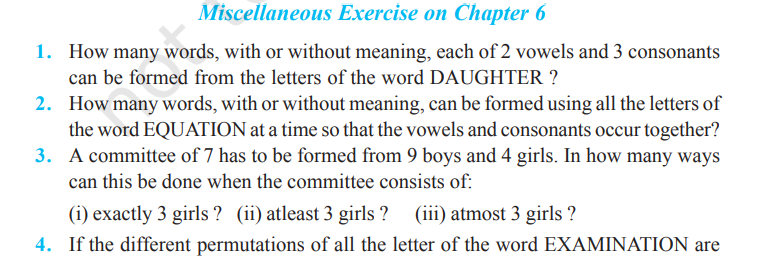

1. Words with 2 Vowels and 3 Consonants from DAUGHTER
The word DAUGHTER has 8 distinct letters.
- Vowels (V): A, U, E (3 vowels)
- Consonants (C): D, G, H, T, R (5 consonants)
- Selection (Combination): Choose 2 vowels from 3 and 3 consonants from 5.$$\text{Ways to select Vowels} = C(3, 2) = 3$$$$\text{Ways to select Consonants} = C(5, 3) = \frac{5 \times 4}{2 \times 1} = 10$$$$\text{Total Selections} = 3 \times 10 = 30$$
- Arrangement (Permutation): Each selection consists of $2 + 3 = 5$ different letters. These 5 letters can be arranged in $5!$ ways.$$\text{Arrangements} = 5! = 120$$
- Total Words:$$\text{Total Words} = \text{Total Selections} \times \text{Arrangements}$$$$\text{Total Words} = 30 \times 120 = \mathbf{3600}$$
2. Arrangement of EQUATION where Vowels and Consonants occur together
The word EQUATION has 8 distinct letters.
- Vowels (V): E, U, A, I, O (5 vowels)
- Consonants (C): Q, T, N (3 consonants)
The vowels must occur together (Block V) and the consonants must occur together (Block C).
- Internal Arrangement:$$\text{Arrangement within V} = 5! = 120$$$$\text{Arrangement within C} = 3! = 6$$
- External Arrangement: We arrange the two blocks, (V) and (C).$$\text{Arrangement of blocks} = 2! = 2 \quad (\text{VC or CV})$$
- Total Words:$$\text{Total Words} = (\text{Arrangement of blocks}) \times (\text{Internal V}) \times (\text{Internal C})$$$$\text{Total Words} = 2 \times 5! \times 3! = 2 \times 120 \times 6 = \mathbf{1440}$$
3. Committee of 7 from 9 Boys and 4 Girls
Total members needed: 7. Total available: 9 boys and 4 girls.
(i) exactly 3 girls
If the committee has exactly 3 girls, it must have $7 – 3 = 4$ boys.
$$\text{Ways} = (\text{Choose } 3 \text{ girls from } 4) \times (\text{Choose } 4 \text{ boys from } 9)$$
$$\text{Ways} = C(4, 3) \times C(9, 4)$$
$$C(4, 3) = 4$$
$$C(9, 4) = \frac{9 \times 8 \times 7 \times 6}{4 \times 3 \times 2 \times 1} = 9 \times 2 \times 7 = 126$$
$$\text{Total ways} = 4 \times 126 = \mathbf{504}$$
(ii) atleast 3 girls
“At least 3 girls” means 3 girls or 4 girls (since only 4 are available).
- Case 1: 3 Girls and 4 Boys: $C(4, 3) \times C(9, 4) = 4 \times 126 = 504$ (from part i)
- Case 2: 4 Girls and 3 Boys: $C(4, 4) \times C(9, 3)$$$C(4, 4) = 1$$$$C(9, 3) = \frac{9 \times 8 \times 7}{3 \times 2 \times 1} = 3 \times 4 \times 7 = 84$$$$\text{Ways for Case 2} = 1 \times 84 = 84$$$$\text{Total ways} = 504 + 84 = \mathbf{588}$$
(iii) atmost 3 girls
“At most 3 girls” means 0, 1, 2, or 3 girls. Since the committee size is 7, the minimum number of boys must be $7 – 4 = 3$.
- Case 1: 3 Girls and 4 Boys: $C(4, 3) \times C(9, 4) = 504$
- Case 2: 2 Girls and 5 Boys: $C(4, 2) \times C(9, 5)$$$C(4, 2) = 6$$$$C(9, 5) = C(9, 4) = 126$$$$\text{Ways for Case 2} = 6 \times 126 = 756$$
- Case 3: 1 Girl and 6 Boys: $C(4, 1) \times C(9, 6)$$$C(4, 1) = 4$$$$C(9, 6) = C(9, 3) = 84$$$$\text{Ways for Case 3} = 4 \times 84 = 336$$
- Case 4: 0 Girls and 7 Boys: $C(4, 0) \times C(9, 7)$$$C(4, 0) = 1$$$$C(9, 7) = C(9, 2) = \frac{9 \times 8}{2} = 36$$$$\text{Ways for Case 4} = 1 \times 36 = 36$$$$\text{Total ways} = 504 + 756 + 336 + 36 = \mathbf{1632}$$
4. Permutations of EXAMINATION listed as in a dictionary
The word EXAMINATION has 11 letters.
- A: 2
- I: 2
- N: 2
- E, X, M, T, O: 1 each
We want the number of words in the list before the first word starting with E. This means we count all words starting with letters alphabetically before E.
The letters, in alphabetical order, are: A, E, I, M, N, O, T, X.
The only letter before E is A.
Words starting with A:
- First place: Fixed as A (1 way).
- Remaining 10 places: Arrange the remaining 10 letters: (X, A, M, I, N, A, T, I, O, N). The remaining letters are (X, M, I, I, N, N, T, O, E).
- I: 2
- N: 2
- All others: 1$$\text{Words starting with A} = \frac{10!}{2! 2!} = \frac{3,628,800}{4} = \mathbf{907,200}$$The first word starting with E follows all these words.$$\text{Number of words before E} = \mathbf{907,200}$$
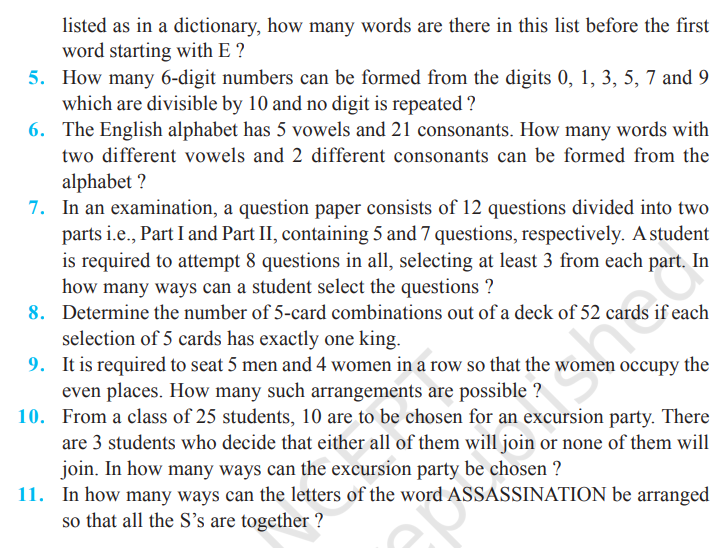
5. 6-digit numbers from 0, 1, 3, 5, 7, 9 divisible by 10 (No Repetition)
A number is divisible by 10 if its Units place must be 0.
We need to form a 6-digit number $\underline{D1} \quad \underline{D2} \quad \underline{D3} \quad \underline{D4} \quad \underline{D5} \quad \underline{D6}$.
- Units place (D6): Must be 0 (1 choice).
- Remaining 5 places (D1 to D5): We arrange the remaining 5 digits $\{1, 3, 5, 7, 9\}$ in the first five places. Since 0 is already used and the remaining digits are non-zero, the thousands place (D1) is not restricted.$$\text{Arrangement of } 5 \text{ digits} = 5!$$$$\text{Total numbers} = 1 \times 5! = 120$$$$\text{Total 6-digit numbers} = \mathbf{120}$$
6. Words with 2 different vowels and 2 different consonants
English alphabet: 5 Vowels (V) and 21 Consonants (C). We form a word using $2V + 2C = 4$ letters.
- Selection (Combination):$$\text{Ways to select } 2V \text{ from } 5 = C(5, 2) = 10$$$$\text{Ways to select } 2C \text{ from } 21 = C(21, 2) = \frac{21 \times 20}{2} = 210$$$$\text{Total Selections} = 10 \times 210 = 2100$$
- Arrangement (Permutation): Each selection consists of 4 distinct letters, which can be arranged in $4!$ ways.$$\text{Arrangements} = 4! = 24$$
- Total Words:$$\text{Total Words} = 2100 \times 24 = \mathbf{50400}$$
7. Selection of 8 questions with at least 3 from each part
Total questions: 12. Part I: 5 questions. Part II: 7 questions. Student must attempt 8 questions, with $\ge 3$ from each part.
Let $x_1$ be the number of questions selected from Part I and $x_2$ from Part II.
- $x_1 + x_2 = 8$
- $3 \le x_1 \le 5$ (since Part I only has 5 questions)
- $3 \le x_2 \le 7$
We check the possible combinations for $(x_1, x_2)$:
| Part I ($x_1$) | Part II ($x_2 = 8 – x_1$) | $x_1 \le 5$ | $x_2 \le 7$ | Ways |
| :—: | :—: | :—: | :—: | :— |
| 3 | 5 | Yes | Yes | $C(5, 3) \times C(7, 5)$ |
| 4 | 4 | Yes | Yes | $C(5, 4) \times C(7, 4)$ |
| 5 | 3 | Yes | Yes | $C(5, 5) \times C(7, 3)$ |
- Case 1: (3 from Part I, 5 from Part II)$$C(5, 3) \times C(7, 5) = 10 \times 21 = 210$$
- Case 2: (4 from Part I, 4 from Part II)$$C(5, 4) \times C(7, 4) = 5 \times 35 = 175$$
- Case 3: (5 from Part I, 3 from Part II)$$C(5, 5) \times C(7, 3) = 1 \times 35 = 35$$
$$\text{Total ways} = 210 + 175 + 35 = \mathbf{420}$$
8. 5-card combinations with exactly one king.
Total cards: 52. Kings: 4. Non-Kings: $52 – 4 = 48$. We select 5 cards in total.
- Select exactly 1 King from 4 Kings:$$C(4, 1) = 4$$
- Select the remaining 4 cards from the 48 non-Kings:$$C(48, 4) = 194,580 \quad (\text{calculated in Ex 6.4, Q.6})$$
$$\text{Total combinations} = C(4, 1) \times C(48, 4)$$
$$\text{Total combinations} = 4 \times 194,580 = \mathbf{778,320}$$
9. Seating 5 men and 4 women in a row so that women occupy even places.
Total people: $5 \text{ men} + 4 \text{ women} = 9$ people.
Total places: 9. Even places: 2nd, 4th, 6th, 8th (4 even places). Odd places: 1st, 3rd, 5th, 7th, 9th (5 odd places).
- Place the 4 Women: The 4 women must occupy the 4 even places. Since the women are distinct, this is a permutation.$$\text{Ways to arrange women} = P(4, 4) = 4! = 24$$
- Place the 5 Men: The 5 men must occupy the 5 remaining odd places.$$\text{Ways to arrange men} = P(5, 5) = 5! = 120$$
$$\text{Total arrangements} = (\text{Arrangement of men}) \times (\text{Arrangement of women})$$
$$\text{Total arrangements} = 120 \times 24 = \mathbf{2880}$$
10. Excursion party of 10 from 25 students (Compulsory decision group)
Total students: 25. Party size: 10.
Decision group (D): 3 students. The constraint is: either all 3 join or none of them join.
Remaining students (R): $25 – 3 = 22$.
- Case 1: All 3 students (D) join the party.
- 3 students from D are chosen (1 way).
- We need $10 – 3 = 7$ more students from R.$$\text{Ways for Case 1} = C(3, 3) \times C(22, 7)$$$$C(22, 7) = \frac{22 \times 21 \times 20 \times 19 \times 18 \times 17 \times 16}{7 \times 6 \times 5 \times 4 \times 3 \times 2 \times 1} = 170,544$$$$\text{Ways for Case 1} = 1 \times 170,544 = 170,544$$
- Case 2: None of the 3 students (D) join the party.
- 0 students from D are chosen (1 way).
- We need $10 – 0 = 10$ students from R.$$\text{Ways for Case 2} = C(3, 0) \times C(22, 10)$$$$C(22, 10) = \frac{22 \times 21 \times 20 \times 19 \times 18 \times 17 \times 16 \times 15 \times 14 \times 13}{10 \times 9 \times 8 \times 7 \times 6 \times 5 \times 4 \times 3 \times 2 \times 1} = 646,646$$$$\text{Ways for Case 2} = 1 \times 646,646 = 646,646$$
$$\text{Total ways} = 170,544 + 646,646 = \mathbf{817,190}$$
11. Arrangements of ASSASSINATION where all the S’s are together
The word ASSASSINATION has 13 letters.
- A: 3
- S: 4
- I: 2
- N: 2
- O, T: 1 each
Treat the four S’s as a single block ($\text{S’s}$). We now have 10 items to arrange: $\{A, A, A, I, I, N, N, O, T, (\text{S’s})\}$.
- Internal Arrangement of S’s: The 4 identical S’s can only be arranged in $\frac{4!}{4!} = 1$ way.
- Arrangement of the 10 Items: The remaining items have repeating letters (A: 3 times, I: 2 times, N: 2 times).$$\text{Arrangements} = \frac{10!}{3! 2! 2!}$$
$$\frac{10!}{3! 2! 2!} = \frac{3,628,800}{6 \times 2 \times 2} = \frac{3,628,800}{24} = \mathbf{151,200}$$