

Get detailed, step-by-step solutions for NCERT Class 11 Maths Chapter 7 Exercise 7.1
This exercise focuses on expanding expressions using the Binomial Theorem, evaluating numerical expressions, and applying the theorem to solve proofs and comparison problems.
The Binomial Theorem states that for any positive integer $n$:
$$(a + b)^n = \sum_{r=0}^{n} C(n, r) a^{n-r} b^r$$
where $C(n, r) = \frac{n!}{r!(n-r)!}$ is the binomial coefficient.
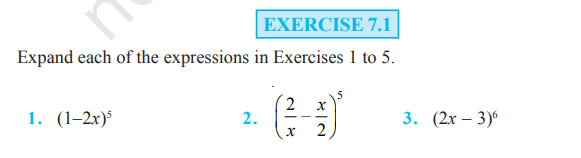
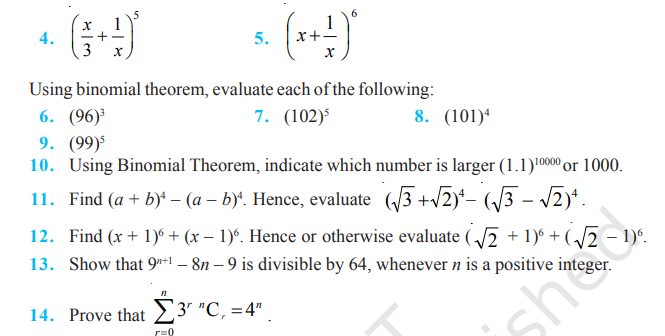

Expansion of Expressions (Exercises 1-5)
1. $(1 – 2x)^5$
Here $a = 1$, $b = -2x$, and $n = 5$.
$$(1 – 2x)^5 = C(5, 0)(1)^5(-2x)^0 + C(5, 1)(1)^4(-2x)^1 + C(5, 2)(1)^3(-2x)^2 + C(5, 3)(1)^2(-2x)^3 + C(5, 4)(1)^1(-2x)^4 + C(5, 5)(1)^0(-2x)^5$$
Using coefficients $C(5, r)$: $1, 5, 10, 10, 5, 1$.
$$(1 – 2x)^5 = 1(1)(1) + 5(1)(-2x) + 10(1)(4x^2) + 10(1)(-8x^3) + 5(1)(16x^4) + 1(1)(-32x^5)$$
$$(1 – 2x)^5 = \mathbf{1 – 10x + 40x^2 – 80x^3 + 80x^4 – 32x^5}$$
2. $\left(\frac{2}{x} – \frac{x}{2}\right)^5$
Here $a = \frac{2}{x}$, $b = -\frac{x}{2}$, and $n = 5$.
$$(a+b)^5 = a^5 + 5a^4b + 10a^3b^2 + 10a^2b^3 + 5ab^4 + b^5$$
$$= \left(\frac{2}{x}\right)^5 + 5\left(\frac{2}{x}\right)^4\left(-\frac{x}{2}\right) + 10\left(\frac{2}{x}\right)^3\left(-\frac{x}{2}\right)^2 + 10\left(\frac{2}{x}\right)^2\left(-\frac{x}{2}\right)^3 + 5\left(\frac{2}{x}\right)\left(-\frac{x}{2}\right)^4 + \left(-\frac{x}{2}\right)^5$$
$$= \frac{32}{x^5} + 5\left(\frac{16}{x^4}\right)\left(-\frac{x}{2}\right) + 10\left(\frac{8}{x^3}\right)\left(\frac{x^2}{4}\right) + 10\left(\frac{4}{x^2}\right)\left(-\frac{x^3}{8}\right) + 5\left(\frac{2}{x}\right)\left(\frac{x^4}{16}\right) + \left(-\frac{x^5}{32}\right)$$
$$= \frac{32}{x^5} – \frac{80x}{2x^4} + \frac{80x^2}{4x^3} – \frac{40x^3}{8x^2} + \frac{10x^4}{16x} – \frac{x^5}{32}$$
$$= \mathbf{\frac{32}{x^5} – \frac{40}{x^3} + \frac{20}{x} – 5x + \frac{5x^3}{8} – \frac{x^5}{32}}$$
3. $(2x – 3)^6$
Here $a = 2x$, $b = -3$, and $n = 6$.
$$(a+b)^6 = C(6, 0)a^6 + C(6, 1)a^5b + C(6, 2)a^4b^2 + C(6, 3)a^3b^3 + C(6, 4)a^2b^4 + C(6, 5)ab^5 + C(6, 6)b^6$$
Using coefficients $C(6, r)$: $1, 6, 15, 20, 15, 6, 1$.
$$= 1(2x)^6(-3)^0 + 6(2x)^5(-3)^1 + 15(2x)^4(-3)^2 + 20(2x)^3(-3)^3 + 15(2x)^2(-3)^4 + 6(2x)^1(-3)^5 + 1(2x)^0(-3)^6$$
$$= 1(64x^6)(1) + 6(32x^5)(-3) + 15(16x^4)(9) + 20(8x^3)(-27) + 15(4x^2)(81) + 6(2x)(-243) + 1(1)(729)$$
$$= 64x^6 – 576x^5 + 2160x^4 – 4320x^3 + 4860x^2 – 2916x + 729$$
4. $\left(\frac{x}{3} + \frac{1}{x}\right)^5$
Here $a = \frac{x}{3}$, $b = \frac{1}{x}$, and $n = 5$.
$$(a+b)^5 = a^5 + 5a^4b + 10a^3b^2 + 10a^2b^3 + 5ab^4 + b^5$$
$$= \left(\frac{x}{3}\right)^5 + 5\left(\frac{x}{3}\right)^4\left(\frac{1}{x}\right) + 10\left(\frac{x}{3}\right)^3\left(\frac{1}{x}\right)^2 + 10\left(\frac{x}{3}\right)^2\left(\frac{1}{x}\right)^3 + 5\left(\frac{x}{3}\right)\left(\frac{1}{x}\right)^4 + \left(\frac{1}{x}\right)^5$$
$$= \frac{x^5}{243} + 5\left(\frac{x^4}{81}\right)\left(\frac{1}{x}\right) + 10\left(\frac{x^3}{27}\right)\left(\frac{1}{x^2}\right) + 10\left(\frac{x^2}{9}\right)\left(\frac{1}{x^3}\right) + 5\left(\frac{x}{3}\right)\left(\frac{1}{x^4}\right) + \frac{1}{x^5}$$
$$= \mathbf{\frac{x^5}{243} + \frac{5x^3}{81} + \frac{10x}{27} + \frac{10}{9x} + \frac{5}{3x^3} + \frac{1}{x^5}}$$
5. $\left(x + \frac{1}{x}\right)^6$
Here $a = x$, $b = \frac{1}{x}$, and $n = 6$.
$$(a+b)^6 = C(6, 0)a^6 + C(6, 1)a^5b + C(6, 2)a^4b^2 + C(6, 3)a^3b^3 + C(6, 4)a^2b^4 + C(6, 5)ab^5 + C(6, 6)b^6$$
Using coefficients $C(6, r)$: $1, 6, 15, 20, 15, 6, 1$.
$$= 1(x)^6\left(\frac{1}{x}\right)^0 + 6(x)^5\left(\frac{1}{x}\right)^1 + 15(x)^4\left(\frac{1}{x}\right)^2 + 20(x)^3\left(\frac{1}{x}\right)^3 + 15(x)^2\left(\frac{1}{x}\right)^4 + 6(x)^1\left(\frac{1}{x}\right)^5 + 1(x)^0\left(\frac{1}{x}\right)^6$$
$$= x^6 + 6x^{5-1} + 15x^{4-2} + 20x^{3-3} + 15x^{2-4} + 6x^{1-5} + x^{-6}$$
$$= \mathbf{x^6 + 6x^4 + 15x^2 + 20 + \frac{15}{x^2} + \frac{6}{x^4} + \frac{1}{x^6}}$$
Evaluation Using Binomial Theorem (Exercises 6-9)
The key is to express the number as a sum or difference of a base power of 10 (e.g., 100 or 10) and a small integer.
6. $(96)^3$
$$(96)^3 = (100 – 4)^3$$
$$(a – b)^3 = a^3 – 3a^2b + 3ab^2 – b^3$$
$$= (100)^3 – 3(100)^2(4) + 3(100)(4)^2 – (4)^3$$
$$= 1,000,000 – 3(10,000)(4) + 3(100)(16) – 64$$
$$= 1,000,000 – 120,000 + 4,800 – 64$$
$$= 880,000 + 4,800 – 64 = 884,800 – 64 = \mathbf{884,736}$$
7. $(102)^5$
$$(102)^5 = (100 + 2)^5$$
$$(a + b)^5 = a^5 + 5a^4b + 10a^3b^2 + 10a^2b^3 + 5ab^4 + b^5$$
Here $a = 100$ and $b = 2$.
$$= (100)^5 + 5(100)^4(2) + 10(100)^3(2)^2 + 10(100)^2(2)^3 + 5(100)(2)^4 + (2)^5$$
$$= 10^{10} + 10 \cdot 10^8 + 40 \cdot 10^6 + 80 \cdot 10^4 + 500 \cdot 16 + 32$$
$$= 10,000,000,000 + 1,000,000,000 + 40,000,000 + 800,000 + 8,000 + 32$$
$$= \mathbf{11,040,808,032}$$
8. $(101)^4$
$$(101)^4 = (100 + 1)^4$$
$$(a + b)^4 = a^4 + 4a^3b + 6a^2b^2 + 4ab^3 + b^4$$
Here $a = 100$ and $b = 1$.
$$= (100)^4 + 4(100)^3(1) + 6(100)^2(1)^2 + 4(100)(1)^3 + (1)^4$$
$$= 100,000,000 + 4(1,000,000) + 6(10,000) + 400 + 1$$
$$= 100,000,000 + 4,000,000 + 60,000 + 400 + 1$$
$$= \mathbf{104,060,401}$$
9. $(99)^5$
$$(99)^5 = (100 – 1)^5$$
$$(a – b)^5 = a^5 – 5a^4b + 10a^3b^2 – 10a^2b^3 + 5ab^4 – b^5$$
Here $a = 100$ and $b = 1$.
$$= (100)^5 – 5(100)^4(1) + 10(100)^3(1)^2 – 10(100)^2(1)^3 + 5(100)(1)^4 – (1)^5$$
$$= 10^{10} – 5 \cdot 10^8 + 10 \cdot 10^6 – 10 \cdot 10^4 + 500 – 1$$
$$= 10,000,000,000 – 500,000,000 + 10,000,000 – 100,000 + 499$$
$$= 9,500,000,000 + 10,000,000 – 100,000 + 499$$
$$= 9,510,000,000 – 100,000 + 499$$
$$= 9,509,900,000 + 499 = \mathbf{9,509,900,499}$$
Application Problems (Exercises 10-14)
10. Which number is larger: $(1.1)^{10000}$ or $1000$?
Expand $(1.1)^{10000}$ using the Binomial Theorem, treating $1.1 = (1 + 0.1)$.
$$(1 + 0.1)^{10000} = \sum_{r=0}^{10000} C(10000, r) (1)^{10000-r} (0.1)^r$$
Since all terms are positive, we can look at the first few terms:
$$= C(10000, 0) (1)^{10000} (0.1)^0 + C(10000, 1) (1)^{9999} (0.1)^1 + C(10000, 2) (1)^{9998} (0.1)^2 + \dots$$
$$= 1(1)(1) + 10000(1)(0.1) + \text{positive terms}$$
$$= 1 + 1000 + \text{positive terms}$$
$$= 1001 + \text{positive terms}$$
Since $(1.1)^{10000} = 1001 + (\text{sum of other positive terms})$, it is clearly greater than $1001$.
Thus, $\mathbf{(1.1)^{10000}}$ is larger than $1000$.
11. Find $(a + b)^4 – (a – b)^4$. Hence, evaluate $(\sqrt{3} + \sqrt{2})^4 – (\sqrt{3} – \sqrt{2})^4$.
First, expand $(a + b)^4$ and $(a – b)^4$:
$$(a + b)^4 = a^4 + 4a^3b + 6a^2b^2 + 4ab^3 + b^4$$
$$(a – b)^4 = a^4 – 4a^3b + 6a^2b^2 – 4ab^3 + b^4$$
Subtract the second expansion from the first:
$$(a + b)^4 – (a – b)^4 = (a^4 – a^4) + (4a^3b – (-4a^3b)) + (6a^2b^2 – 6a^2b^2) + (4ab^3 – (-4ab^3)) + (b^4 – b^4)$$
$$(a + b)^4 – (a – b)^4 = 8a^3b + 8ab^3 = \mathbf{8ab(a^2 + b^2)}$$
Now, evaluate $(\sqrt{3} + \sqrt{2})^4 – (\sqrt{3} – \sqrt{2})^4$.
Substitute $a = \sqrt{3}$ and $b = \sqrt{2}$ into the simplified expression:
$$8(\sqrt{3})(\sqrt{2})((\sqrt{3})^2 + (\sqrt{2})^2)$$
$$= 8\sqrt{6}(3 + 2)$$
$$= 8\sqrt{6}(5) = \mathbf{40\sqrt{6}}$$
12. Find $(x + 1)^6 + (x – 1)^6$. Hence or otherwise evaluate $(\sqrt{2} + 1)^6 + (\sqrt{2} – 1)^6$.
First, expand $(x + 1)^6$ and $(x – 1)^6$. Let the coefficients be $C_r$.
$$(x + 1)^6 = C_0 x^6 + C_1 x^5 + C_2 x^4 + C_3 x^3 + C_4 x^2 + C_5 x + C_6$$
$$(x – 1)^6 = C_0 x^6 – C_1 x^5 + C_2 x^4 – C_3 x^3 + C_4 x^2 – C_5 x + C_6$$
Add the two expansions:
$$(x + 1)^6 + (x – 1)^6 = 2[C_0 x^6 + C_2 x^4 + C_4 x^2 + C_6]$$
Using coefficients $C(6, r)$: $1, 6, 15, 20, 15, 6, 1$.
$$(x + 1)^6 + (x – 1)^6 = 2[1x^6 + 15x^4 + 15x^2 + 1]$$
Now, evaluate $(\sqrt{2} + 1)^6 + (\sqrt{2} – 1)^6$.
Substitute $x = \sqrt{2}$ into the simplified expression:
$$2[(\sqrt{2})^6 + 15(\sqrt{2})^4 + 15(\sqrt{2})^2 + 1]$$
Since $\sqrt{2}^6 = 2^3 = 8$, $\sqrt{2}^4 = 2^2 = 4$, $\sqrt{2}^2 = 2$:
$$= 2[8 + 15(4) + 15(2) + 1]$$
$$= 2[8 + 60 + 30 + 1]$$
$$= 2[99] = \mathbf{198}$$
13. Show that $9^{n+1} – 8n – 9$ is divisible by $64$, whenever $n$ is a positive integer.
We express $9^{n+1}$ using the Binomial Theorem: $9^{n+1} = (1 + 8)^{n+1}$.
$$9^{n+1} = (1 + 8)^{n+1} = \sum_{r=0}^{n+1} C(n+1, r) (1)^{(n+1)-r} (8)^r$$
Expand the first three terms ($r=0, 1, 2$) and group the rest:
$$9^{n+1} = C(n+1, 0) (8)^0 + C(n+1, 1) (8)^1 + C(n+1, 2) (8)^2 + \sum_{r=3}^{n+1} C(n+1, r) (8)^r$$
$$9^{n+1} = 1(1) + (n+1)(8) + C(n+1, 2) 64 + \sum_{r=3}^{n+1} C(n+1, r) 8^r$$
For $r \ge 2$, the term $8^r$ is divisible by $8^2 = 64$. We can factor out 64 from the sum:
$$9^{n+1} = 1 + 8n + 8 + 64 \left[ C(n+1, 2) + \sum_{r=3}^{n+1} C(n+1, r) 8^{r-2} \right]$$
$$9^{n+1} = 8n + 9 + 64K$$
where $K$ is an integer defined by the expression in the brackets (since $n$ is a positive integer, all binomial coefficients are integers).
Rearrange the equation:
$$9^{n+1} – 8n – 9 = 64K$$
Since $K$ is an integer, $9^{n+1} – 8n – 9$ is a multiple of $64$.
Therefore, $\mathbf{9^{n+1} – 8n – 9 \text{ is divisible by } 64}$.
14. Prove that $\sum_{r=0}^{n} 3^r C(n, r) = 4^n$.
The left-hand side (LHS) of the equation is in the form of the Binomial Theorem expansion for $(a + b)^n$:
$$\sum_{r=0}^{n} C(n, r) a^{n-r} b^r = (a + b)^n$$
We can rewrite the LHS of the given equation:
$$\sum_{r=0}^{n} C(n, r) 3^r = \sum_{r=0}^{n} C(n, r) (1)^{n-r} (3)^r$$
By comparing this to the Binomial Theorem formula, we can identify $a=1$ and $b=3$.
Therefore, the sum is the expansion of $(1 + 3)^n$:
$$\sum_{r=0}^{n} 3^r C(n, r) = (1 + 3)^n$$
$$= 4^n$$
Since $\text{LHS} = 4^n$ and $\text{RHS} = 4^n$, the proof is complete.
$$\mathbf{\sum_{r=0}^{n} 3^r C(n, r) = 4^n}$$