
Find complete solutions for the NCERT Class 12 Maths Miscellaneous Exercise on Three Dimensional Geometry (Chapter 11). Review advanced topics including finding the angle between lines using direction ratios, determining the equation of a line parallel to an axis, calculating the value of $k$ for perpendicular lines, and solving complex problems on Shortest Distance (SD) between skew lines in vector form. Essential final chapter revision.
This exercise reviews key concepts in Three Dimensional Geometry, focusing on angles between lines, line equations, and shortest distance.
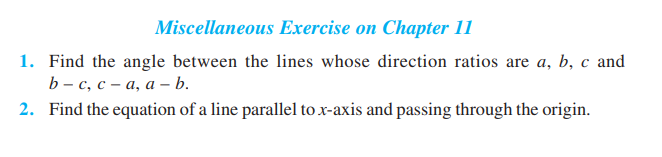

1. Find the angle between the lines whose direction ratios are $a, b, c$ and $b-c, c-a, a-b$.
Let the direction ratios of the two lines be:
- Line 1: $\langle a_1, b_1, c_1 \rangle = \langle a, b, c \rangle$
- Line 2: $\langle a_2, b_2, c_2 \rangle = \langle b-c, c-a, a-b \rangle$
The angle $\theta$ between the lines is given by:
$$\cos \theta = \left| \frac{a_1 a_2 + b_1 b_2 + c_1 c_2}{\sqrt{a_1^2 + b_1^2 + c_1^2} \sqrt{a_2^2 + b_2^2 + c_2^2}} \right|$$
- Calculate the numerator ($a_1 a_2 + b_1 b_2 + c_1 c_2$):$$a(b-c) + b(c-a) + c(a-b)$$$$= ab – ac + bc – ab + ac – bc$$$$= 0$$
- Determine $\cos \theta$:Since the numerator is $0$, and the denominator (product of magnitudes) is non-zero (assuming the lines exist and are not trivial zero vectors):$$\cos \theta = \frac{0}{\text{Denominator}} = 0$$
- Find $\theta$:$$\cos \theta = 0 \implies \theta = \pi/2$$
The angle between the lines is $\mathbf{\pi/2}$ or $\mathbf{90^\circ}$. (The lines are perpendicular).
2. Find the equation of a line parallel to the $x$-axis and passing through the origin.
A line is defined by a point it passes through and its direction vector.
- Point: The line passes through the origin $O(0, 0, 0)$.$$\vec{a} = 0\hat{i} + 0\hat{j} + 0\hat{k} = \vec{0}$$
- Direction: The line is parallel to the $x$-axis.The direction vector of the $x$-axis is $\hat{i}$.$$\vec{b} = \hat{i} + 0\hat{j} + 0\hat{k} = \hat{i}$$
(i) Vector Equation ($\vec{r} = \vec{a} + \lambda \vec{b}$):
$$\vec{r} = \vec{0} + \lambda (\hat{i})$$
$$\mathbf{\vec{r} = \lambda \hat{i}}$$
(ii) Cartesian Equation ($\frac{x-x_1}{a} = \frac{y-y_1}{b} = \frac{z-z_1}{c}$):
$$\frac{x – 0}{1} = \frac{y – 0}{0} = \frac{z – 0}{0}$$
$$\mathbf{\frac{x}{1} = \frac{y}{0} = \frac{z}{0}}$$
(Note: The zeros in the denominator indicate that $y=0$ and $z=0$, confirming the line lies on the $x$-axis).
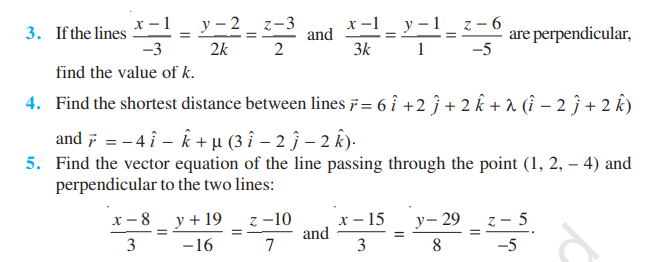
3. If the lines $\frac{x-1}{-3} = \frac{y-2}{2k} = \frac{z-3}{2}$ and $\frac{x-1}{3k} = \frac{y-1}{1} = \frac{z-6}{-5}$ are perpendicular, find the value of $k$.
Two lines are perpendicular if the dot product of their direction ratios is zero: $a_1 a_2 + b_1 b_2 + c_1 c_2 = 0$.
- Line 1 Direction Ratios: $\langle a_1, b_1, c_1 \rangle = \langle -3, 2k, 2 \rangle$
- Line 2 Direction Ratios: $\langle a_2, b_2, c_2 \rangle = \langle 3k, 1, -5 \rangle$
Apply the perpendicularity condition:
$$(-3)(3k) + (2k)(1) + (2)(-5) = 0$$
$$-9k + 2k – 10 = 0$$
$$-7k = 10$$
$$\mathbf{k = -10/7}$$
4. Find the shortest distance between lines $\vec{r} = 6\hat{i} + 2\hat{j} + 2\hat{k} + \lambda (\hat{i} – 2\hat{j} + 2\hat{k})$ and $\vec{r} = -4\hat{i} – \hat{k} + \mu (3\hat{i} – 2\hat{j} – 2\hat{k})$.
The shortest distance (SD) between skew lines $\vec{r} = \vec{a}_1 + \lambda \vec{b}_1$ and $\vec{r} = \vec{a}_2 + \mu \vec{b}_2$ is $\text{SD} = \left| \frac{(\vec{b}_1 \times \vec{b}_2) \cdot (\vec{a}_2 – \vec{a}_1)}{|\vec{b}_1 \times \vec{b}_2|} \right|$.
- $\vec{a}_1 = 6\hat{i} + 2\hat{j} + 2\hat{k}$
- $\vec{b}_1 = \hat{i} – 2\hat{j} + 2\hat{k}$
- $\vec{a}_2 = -4\hat{i} + 0\hat{j} – \hat{k}$
- $\vec{b}_2 = 3\hat{i} – 2\hat{j} – 2\hat{k}$
- Calculate $\vec{a}_2 – \vec{a}_1$:$$\vec{a}_2 – \vec{a}_1 = (-4-6)\hat{i} + (0-2)\hat{j} + (-1-2)\hat{k} = -10\hat{i} – 2\hat{j} – 3\hat{k}$$
- Calculate $\vec{b}_1 \times \vec{b}_2$:$$\vec{b}_1 \times \vec{b}_2 = \begin{vmatrix} \hat{i} & \hat{j} & \hat{k} \\ 1 & -2 & 2 \\ 3 & -2 & -2 \end{vmatrix} = \hat{i}(4 – (-4)) – \hat{j}(-2 – 6) + \hat{k}(-2 – (-6))$$$$\vec{b}_1 \times \vec{b}_2 = 8\hat{i} + 8\hat{j} + 4\hat{k}$$
- Calculate $|\vec{b}_1 \times \vec{b}_2|$:$$|\vec{b}_1 \times \vec{b}_2| = \sqrt{8^2 + 8^2 + 4^2} = \sqrt{64 + 64 + 16} = \sqrt{144} = 12$$
- Calculate the numerator $(\vec{b}_1 \times \vec{b}_2) \cdot (\vec{a}_2 – \vec{a}_1)$:$$(8\hat{i} + 8\hat{j} + 4\hat{k}) \cdot (-10\hat{i} – 2\hat{j} – 3\hat{k})$$$$= (8)(-10) + (8)(-2) + (4)(-3) = -80 – 16 – 12 = -108$$
- Shortest Distance (SD):$$\text{SD} = \left| \frac{-108}{12} \right| = 9$$$$\mathbf{\text{SD} = 9 \text{ units}}$$
5. Find the vector equation of the line passing through the point $(1, 2, –4)$ and perpendicular to the two lines: $\frac{x-8}{3} = \frac{y+19}{-16} = \frac{z-10}{7}$ and $\frac{x-15}{3} = \frac{y-29}{8} = \frac{z-5}{-5}$.
The required line passes through a given point $\vec{a}$ and is perpendicular to two direction vectors $\vec{b}_1$ and $\vec{b}_2$. Its direction vector $\vec{b}$ must be $\vec{b}_1 \times \vec{b}_2$.
- Position Vector ($\vec{a}$):The line passes through $(1, 2, -4)$.$$\vec{a} = \hat{i} + 2\hat{j} – 4\hat{k}$$
- Direction Vectors ($\vec{b}_1, \vec{b}_2$) of the two given lines:
- Line 1 D.R.s: $\langle 3, -16, 7 \rangle \implies \vec{b}_1 = 3\hat{i} – 16\hat{j} + 7\hat{k}$
- Line 2 D.R.s: $\langle 3, 8, -5 \rangle \implies \vec{b}_2 = 3\hat{i} + 8\hat{j} – 5\hat{k}$
- Required Direction Vector ($\vec{b} = \vec{b}_1 \times \vec{b}_2$):$$\vec{b} = \begin{vmatrix} \hat{i} & \hat{j} & \hat{k} \\ 3 & -16 & 7 \\ 3 & 8 & -5 \end{vmatrix} = \hat{i}(80 – 56) – \hat{j}(-15 – 21) + \hat{k}(24 – (-48))$$$$\vec{b} = 24\hat{i} + 36\hat{j} + 72\hat{k}$$We can use a simpler parallel vector by factoring out $12$:$$\vec{b}’ = 12 (2\hat{i} + 3\hat{j} + 6\hat{k}) \implies \vec{b} = 2\hat{i} + 3\hat{j} + 6\hat{k}$$
- Vector Equation ($\vec{r} = \vec{a} + \lambda \vec{b}$):Using the simplified direction vector $\vec{b}$:$$\mathbf{\vec{r} = (\hat{i} + 2\hat{j} – 4\hat{k}) + \lambda (2\hat{i} + 3\hat{j} + 6\hat{k})}$$