
Get step-by-step solutions for NCERT Class 12 Maths Exercise 11.1 (Three Dimensional Geometry). Master calculating Direction Cosines ($l, m, n$) from angles, converting Direction Ratios ($a, b, c$) to Direction Cosines, and using them to prove the collinearity of three points. Includes finding the direction cosines of the sides of a triangle. Essential for the foundation of 3D Geometry (Chapter 11).
This exercise focuses on the direction cosines and direction ratios of a line in three-dimensional space.
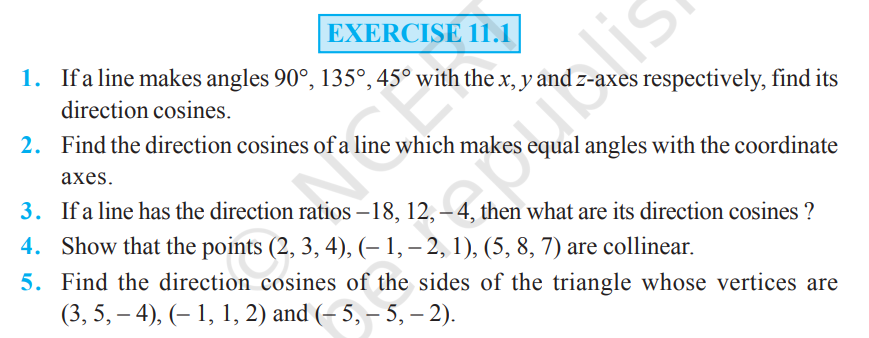

1. Find the direction cosines of a line that makes angles $90^\circ, 135^\circ, 45^\circ$ with the $x, y$ and $z$-axes, respectively.
The direction cosines of a line are $l, m, n$, where $l = \cos \alpha$, $m = \cos \beta$, and $n = \cos \gamma$, and $\alpha, \beta, \gamma$ are the angles the line makes with the $x, y,$ and $z$-axes.
Given: $\alpha = 90^\circ$, $\beta = 135^\circ$, $\gamma = 45^\circ$.
- $l = \cos 90^\circ = 0$
- $m = \cos 135^\circ = \cos (180^\circ – 45^\circ) = -\cos 45^\circ = -1/\sqrt{2}$
- $n = \cos 45^\circ = 1/\sqrt{2}$
The direction cosines are $\mathbf{0, -1/\sqrt{2}, 1/\sqrt{2}}$.
2. Find the direction cosines of a line which makes equal angles with the coordinate axes.
If the line makes equal angles $\alpha$ with the coordinate axes, then $\alpha = \beta = \gamma$.
The direction cosines are equal: $l = m = n = \cos \alpha$.
Using the identity $l^2 + m^2 + n^2 = 1$:
$$(\cos \alpha)^2 + (\cos \alpha)^2 + (\cos \alpha)^2 = 1$$
$$3 \cos^2 \alpha = 1$$
$$\cos^2 \alpha = 1/3$$
$$\cos \alpha = \pm 1/\sqrt{3}$$
The direction cosines are $\mathbf{\pm 1/\sqrt{3}, \pm 1/\sqrt{3}, \pm 1/\sqrt{3}}$.
3. If a line has the direction ratios $-18, 12, -4$, then what are its direction cosines?
If $a, b, c$ are the direction ratios of a line, its direction cosines $l, m, n$ are given by:
$$l = \frac{a}{\sqrt{a^2 + b^2 + c^2}}, \quad m = \frac{b}{\sqrt{a^2 + b^2 + c^2}}, \quad n = \frac{c}{\sqrt{a^2 + b^2 + c^2}}$$
Given direction ratios: $a = -18, b = 12, c = -4$.
- Calculate the magnitude factor:$$\sqrt{a^2 + b^2 + c^2} = \sqrt{(-18)^2 + 12^2 + (-4)^2}$$$$= \sqrt{324 + 144 + 16} = \sqrt{484} = 22$$
- Calculate the direction cosines:
- $l = \frac{-18}{22} = -\frac{9}{11}$
- $m = \frac{12}{22} = \frac{6}{11}$
- $n = \frac{-4}{22} = -\frac{2}{11}$
The direction cosines are $\mathbf{-9/11, 6/11, -2/11}$.
4. Show that the points $(2, 3, 4)$, $(-1, -2, 1)$, $(5, 8, 7)$ are collinear.
Three points $A, B, C$ are collinear if the direction ratios of $\vec{AB}$ are proportional to the direction ratios of $\vec{BC}$.
Let $A(2, 3, 4)$, $B(-1, -2, 1)$, and $C(5, 8, 7)$.
- Direction Ratios of $\vec{AB}$ ($a_1, b_1, c_1$):
- $a_1 = x_2 – x_1 = -1 – 2 = -3$
- $b_1 = y_2 – y_1 = -2 – 3 = -5$
- $c_1 = z_2 – z_1 = 1 – 4 = -3$$$\vec{AB}: \langle -3, -5, -3 \rangle$$
- Direction Ratios of $\vec{BC}$ ($a_2, b_2, c_2$):
- $a_2 = x_3 – x_2 = 5 – (-1) = 6$
- $b_2 = y_3 – y_2 = 8 – (-2) = 10$
- $c_2 = z_3 – z_2 = 7 – 1 = 6$$$\vec{BC}: \langle 6, 10, 6 \rangle$$
- Check for proportionality:$$\frac{a_1}{a_2} = \frac{-3}{6} = -\frac{1}{2}$$$$\frac{b_1}{b_2} = \frac{-5}{10} = -\frac{1}{2}$$$$\frac{c_1}{c_2} = \frac{-3}{6} = -\frac{1}{2}$$
Since $\frac{a_1}{a_2} = \frac{b_1}{b_2} = \frac{c_1}{c_2} = -\frac{1}{2}$, the vectors $\vec{AB}$ and $\vec{BC}$ are parallel (collinear). Since they share the point $B$, the points $A, B, C$ are collinear.
5. Find the direction cosines of the sides of the triangle whose vertices are $A(3, 5, -4)$, $B(-1, 1, 2)$ and $C(-5, -5, -2)$.
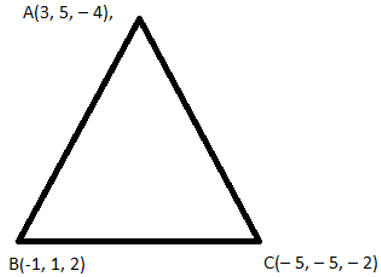
We need to find the direction cosines for each side vector: $\vec{AB}, \vec{BC}, \vec{CA}$.
(i) Side $\vec{AB}$
- Direction Ratios ($a, b, c$):
- $a = -1 – 3 = -4$
- $b = 1 – 5 = -4$
- $c = 2 – (-4) = 6$$$\vec{AB}: \langle -4, -4, 6 \rangle$$
- Magnitude Factor:$$\sqrt{a^2 + b^2 + c^2} = \sqrt{(-4)^2 + (-4)^2 + 6^2} = \sqrt{16 + 16 + 36} = \sqrt{68} = 2\sqrt{17}$$
- Direction Cosines:
- $l = \frac{-4}{2\sqrt{17}} = \frac{-2}{\sqrt{17}}$
- $m = \frac{-4}{2\sqrt{17}} = \frac{-2}{\sqrt{17}}$
- $n = \frac{6}{2\sqrt{17}} = \frac{3}{\sqrt{17}}$$$\mathbf{\text{DC of } \vec{AB}: -2/\sqrt{17}, -2/\sqrt{17}, 3/\sqrt{17}}$$
(ii) Side $\vec{BC}$
- Direction Ratios ($a, b, c$):
- $a = -5 – (-1) = -4$
- $b = -5 – 1 = -6$
- $c = -2 – 2 = -4$$$\vec{BC}: \langle -4, -6, -4 \rangle$$
- Magnitude Factor:$$\sqrt{a^2 + b^2 + c^2} = \sqrt{(-4)^2 + (-6)^2 + (-4)^2} = \sqrt{16 + 36 + 16} = \sqrt{68} = 2\sqrt{17}$$
- Direction Cosines:
- $l = \frac{-4}{2\sqrt{17}} = \frac{-2}{\sqrt{17}}$
- $m = \frac{-6}{2\sqrt{17}} = \frac{-3}{\sqrt{17}}$
- $n = \frac{-4}{2\sqrt{17}} = \frac{-2}{\sqrt{17}}$$$\mathbf{\text{DC of } \vec{BC}: -2/\sqrt{17}, -3/\sqrt{17}, -2/\sqrt{17}}$$
(iii) Side $\vec{CA}$
- Direction Ratios ($a, b, c$):
- $a = 3 – (-5) = 8$
- $b = 5 – (-5) = 10$
- $c = -4 – (-2) = -2$$$\vec{CA}: \langle 8, 10, -2 \rangle$$
- Magnitude Factor:$$\sqrt{a^2 + b^2 + c^2} = \sqrt{8^2 + 10^2 + (-2)^2} = \sqrt{64 + 100 + 4} = \sqrt{168} = 2\sqrt{42}$$
- Direction Cosines:
- $l = \frac{8}{2\sqrt{42}} = \frac{4}{\sqrt{42}}$
- $m = \frac{10}{2\sqrt{42}} = \frac{5}{\sqrt{42}}$
- $n = \frac{-2}{2\sqrt{42}} = \frac{-1}{\sqrt{42}}$$$\mathbf{\text{DC of } \vec{CA}: 4/\sqrt{42}, 5/\sqrt{42}, -1/\sqrt{42}}$$