
Get detailed, step-by-step solutions for NCERT Class 11 Maths Chapter 12 Exercise 12.1
Master techniques for evaluating limits, including direct substitution (Q.1-5), algebraic manipulation of indeterminate forms ($\frac{0}{0}$) using factorization (Q.7-8) and identities (Q.17), and applying the fundamental limit $\lim_{\theta \to 0} \frac{\sin \theta}{\theta} = 1$ (Q.13-20). Learn to evaluate limits for piecewise functions by checking one-sided limits (LHL/RHL) (Q.23-27) and determining conditions for their existence (Q.28, 30, 32).
This exercise involves evaluating limits using various techniques, including direct substitution, factorization, the limit of $\frac{\sin x}{x}$, and one-sided limits.

Evaluating Simple Limits (Q. 1–6)
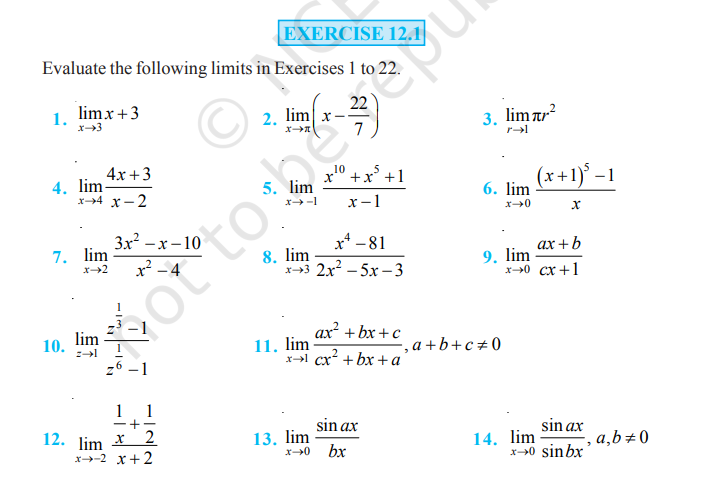
1. $\lim_{x \to 3} (x + 3)$
Substitute $x=3$:
$$3 + 3 = \mathbf{6}$$
2. $\lim_{x \to \pi} \left(x – \frac{22}{7}\right)$
Substitute $x=\pi$:
$$\mathbf{\pi – \frac{22}{7}}$$
3. $\lim_{r \to 1} (\pi r^2)$
Substitute $r=1$:
$$\pi (1)^2 = \mathbf{\pi}$$
4. $\lim_{x \to 4} \frac{4x + 3}{x – 2}$
Substitute $x=4$ (denominator $4-2=2 \ne 0$):
$$\frac{4(4) + 3}{4 – 2} = \frac{16 + 3}{2} = \mathbf{\frac{19}{2}}$$
5. $\lim_{x \to -1} \frac{x^{10} + x^5 + 1}{x – 1}$
Substitute $x=-1$ (denominator $-1-1=-2 \ne 0$):
$$\frac{(-1)^{10} + (-1)^5 + 1}{-1 – 1} = \frac{1 – 1 + 1}{-2} = \mathbf{-\frac{1}{2}}$$
6. $\lim_{x \to 0} \frac{(x + 1)^5 – 1}{x}$
This is $\frac{0}{0}$ form. Use the binomial expansion for $(x+1)^5$:
$$\lim_{x \to 0} \frac{(1 + 5x + 10x^2 + 10x^3 + 5x^4 + x^5) – 1}{x}$$
$$\lim_{x \to 0} \frac{5x + 10x^2 + 10x^3 + 5x^4 + x^5}{x}$$
$$\lim_{x \to 0} (5 + 10x + 10x^2 + 5x^3 + x^4)$$
Substitute $x=0$:
$$\mathbf{5}$$
Evaluating Indeterminate Forms $\frac{0}{0}$ by Factorization (Q. 7–8)
7. $\lim_{x \to 2} \frac{3x^2 – x – 10}{x^2 – 4}$
This is $\frac{0}{0}$ form. Factorize the numerator and denominator.
Denominator: $x^2 – 4 = (x – 2)(x + 2)$.
Numerator: $3x^2 – x – 10 = 3x^2 – 6x + 5x – 10 = 3x(x – 2) + 5(x – 2) = (3x + 5)(x – 2)$.
$$\lim_{x \to 2} \frac{(3x + 5)(x – 2)}{(x – 2)(x + 2)}$$
$$\lim_{x \to 2} \frac{3x + 5}{x + 2}$$
Substitute $x=2$:
$$\frac{3(2) + 5}{2 + 2} = \frac{11}{4}$$
8. $\lim_{x \to 3} \frac{x^4 – 81}{2x^2 – 5x – 3}$
This is $\frac{0}{0}$ form. Factorize.
Numerator: $x^4 – 81 = (x^2 – 9)(x^2 + 9) = (x – 3)(x + 3)(x^2 + 9)$.
Denominator: $2x^2 – 5x – 3 = 2x^2 – 6x + x – 3 = 2x(x – 3) + 1(x – 3) = (2x + 1)(x – 3)$.
$$\lim_{x \to 3} \frac{(x – 3)(x + 3)(x^2 + 9)}{(2x + 1)(x – 3)}$$
$$\lim_{x \to 3} \frac{(x + 3)(x^2 + 9)}{2x + 1}$$
Substitute $x=3$:
$$\frac{(3 + 3)(3^2 + 9)}{2(3) + 1} = \frac{(6)(18)}{7} = \mathbf{\frac{108}{7}}$$
Evaluating Limits with Algebraic Manipulation (Q. 9–12)
9. $\lim_{x \to 0} \frac{ax + b}{cx + 1}$
Substitute $x=0$ (denominator $c(0) + 1 = 1 \ne 0$):
$$\frac{a(0) + b}{c(0) + 1} = \mathbf{b}$$
10. $\lim_{z \to 1} \frac{z^{1/3} – 1}{z^{1/6} – 1}$
This is $\frac{0}{0}$ form. Use substitution $u = z^{1/6}$. Then $u^2 = z^{1/3}$ and as $z \to 1$, $u \to 1$.
$$\lim_{u \to 1} \frac{u^2 – 1}{u – 1} = \lim_{u \to 1} \frac{(u – 1)(u + 1)}{u – 1}$$
$$\lim_{u \to 1} (u + 1) = 1 + 1 = \mathbf{2}$$
Alternatively, use $\lim_{x \to a} \frac{x^n – a^n}{x^m – a^m} = \frac{n}{m} a^{n-m}$. Here $n=1/3, m=1/6, a=1$. $\frac{1/3}{1/6} (1)^{…} = 2$.
11. $\lim_{x \to -1} \frac{ax^2 + bx + c}{cx^2 + bx + a}$, where $a+b+c \ne 0$
Substitute $x=-1$:
$$\frac{a(-1)^2 + b(-1) + c}{c(-1)^2 + b(-1) + a} = \frac{a – b + c}{c – b + a}$$
Since $a+c-b$ is in both the numerator and denominator, and we need to assume it’s non-zero for the division to be valid (otherwise it’s $\frac{0}{0}$ form), the limit is:
$$\mathbf{1}$$
12. $\lim_{x \to -2} \frac{1/x + 1/2}{x + 2}$
This is $\frac{0}{0}$ form. Simplify the numerator:
$$\frac{1}{x} + \frac{1}{2} = \frac{2 + x}{2x}$$
$$\lim_{x \to -2} \frac{(2 + x)/2x}{x + 2} = \lim_{x \to -2} \frac{1}{2x}$$
Substitute $x=-2$:
$$\frac{1}{2(-2)} = \mathbf{-\frac{1}{4}}$$
Evaluating Limits using $\lim_{\theta \to 0} \frac{\sin \theta}{\theta} = 1$ (Q. 13–20)
13. $\lim_{x \to 0} \frac{\sin ax}{bx}$
$$\lim_{x \to 0} \frac{\sin ax}{bx} = \lim_{x \to 0} \left(\frac{\sin ax}{ax} \cdot \frac{ax}{bx}\right) = \lim_{x \to 0} \left(\frac{\sin ax}{ax}\right) \cdot \lim_{x \to 0} \left(\frac{a}{b}\right) = 1 \cdot \frac{a}{b} = \mathbf{\frac{a}{b}}$$
14. $\lim_{x \to 0} \frac{\sin ax}{\sin bx}$
$$\lim_{x \to 0} \frac{\sin ax}{\sin bx} = \lim_{x \to 0} \left(\frac{\sin ax}{ax} \cdot ax \cdot \frac{bx}{\sin bx} \cdot \frac{1}{bx}\right) = \lim_{x \to 0} \left(\frac{\sin ax}{ax}\right) \cdot \lim_{x \to 0} \left(\frac{bx}{\sin bx}\right) \cdot \lim_{x \to 0} \left(\frac{ax}{bx}\right)$$
$$= 1 \cdot 1 \cdot \frac{a}{b} = \mathbf{\frac{a}{b}}$$
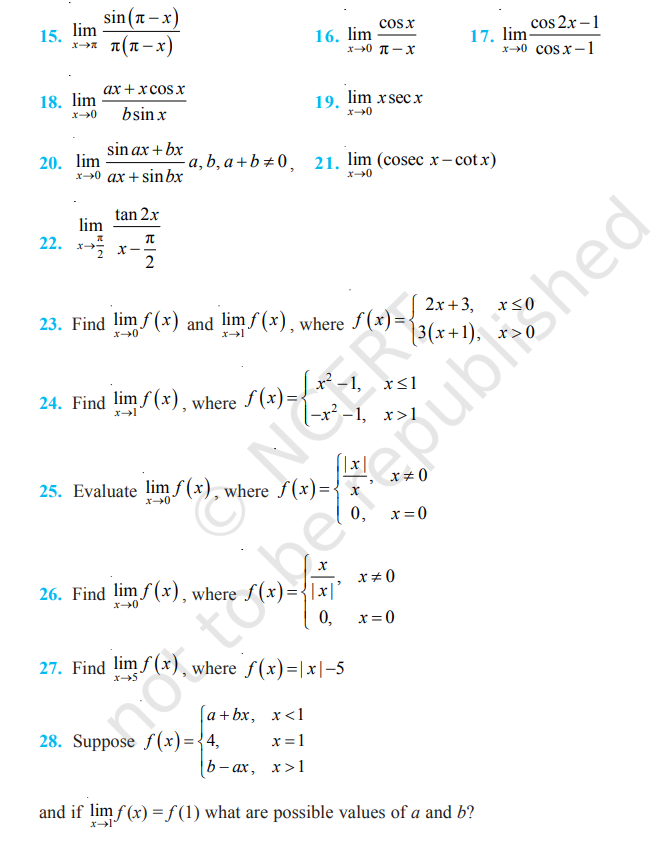
15. $\lim_{x \to \pi} \frac{\sin(\pi – x)}{\pi(\pi – x)}$
Let $y = \pi – x$. As $x \to \pi$, $y \to 0$.
$$\lim_{y \to 0} \frac{\sin y}{\pi y} = \frac{1}{\pi} \lim_{y \to 0} \frac{\sin y}{y} = \frac{1}{\pi} \cdot 1 = \mathbf{\frac{1}{\pi}}$$
16. $\lim_{x \to 0} \frac{\cos x}{\pi – x}$
Substitute $x=0$ (denominator $\pi – 0 = \pi \ne 0$):
$$\frac{\cos(0)}{\pi – 0} = \mathbf{\frac{1}{\pi}}$$
17. $\lim_{x \to 0} \frac{\cos 2x – 1}{\cos x – 1}$
This is $\frac{0}{0}$ form. Use the identities $\cos 2\theta – 1 = -2\sin^2 \theta$ and $\cos \theta – 1 = -2\sin^2(\theta/2)$:
$$\lim_{x \to 0} \frac{-2\sin^2 x}{-2\sin^2 (x/2)} = \lim_{x \to 0} \frac{\sin^2 x}{\sin^2 (x/2)}$$
Divide numerator and denominator by $x^2$:
$$\lim_{x \to 0} \frac{(\sin x/x)^2}{(\sin (x/2)/x)^2} = \lim_{x \to 0} \frac{(\sin x/x)^2}{(\sin (x/2)/(x/2) \cdot 1/2)^2}$$
$$= \frac{(1)^2}{(1 \cdot 1/2)^2} = \frac{1}{1/4} = \mathbf{4}$$
18. $\lim_{x \to 0} \frac{ax + x \cos x}{b \sin x}$
This is $\frac{0}{0}$ form. Divide numerator and denominator by $x$:
$$\lim_{x \to 0} \frac{a + \cos x}{b (\sin x/x)}$$
Substitute $x=0$ and use $\lim_{x \to 0} \frac{\sin x}{x} = 1$:
$$\frac{a + \cos(0)}{b(1)} = \mathbf{\frac{a + 1}{b}}$$
19. $\lim_{x \to 0} x \sec x$
$$\lim_{x \to 0} \frac{x}{\cos x}$$
Substitute $x=0$ (denominator $\cos(0) = 1 \ne 0$):
$$\frac{0}{1} = \mathbf{0}$$
20. $\lim_{x \to 0} \frac{\sin ax + bx}{ax + \sin bx}$
This is $\frac{0}{0}$ form. Divide numerator and denominator by $x$:
$$\lim_{x \to 0} \frac{\sin ax/x + b}{a + \sin bx/x}$$
Use $\lim_{x \to 0} \frac{\sin kx}{x} = k$:
$$\frac{a + b}{a + b} = \mathbf{1}$$
Evaluating Limits with Trigonometric Identities (Q. 21–22)
21. $\lim_{x \to 0} (\text{cosec } x – \cot x)$
This is $\infty – \infty$ form. Convert to $\sin x$ and $\cos x$:
$$\lim_{x \to 0} \left(\frac{1}{\sin x} – \frac{\cos x}{\sin x}\right) = \lim_{x \to 0} \frac{1 – \cos x}{\sin x}$$
This is $\frac{0}{0}$ form. Use $1 – \cos x = 2\sin^2(x/2)$ and $\sin x = 2\sin(x/2)\cos(x/2)$:
$$\lim_{x \to 0} \frac{2\sin^2(x/2)}{2\sin(x/2)\cos(x/2)} = \lim_{x \to 0} \frac{\sin(x/2)}{\cos(x/2)}$$
$$\lim_{x \to 0} \tan(x/2) = \tan(0) = \mathbf{0}$$
22. $\lim_{x \to \pi/2} \frac{\tan 2x}{x – \pi/2}$
This is $\frac{0}{0}$ form. Let $y = x – \pi/2$. As $x \to \pi/2$, $y \to 0$. Then $x = y + \pi/2$.
$$\tan 2x = \tan 2(y + \pi/2) = \tan (2y + \pi) = \tan (2y)$$
$$\lim_{y \to 0} \frac{\tan 2y}{y} = \lim_{y \to 0} \frac{\tan 2y}{2y} \cdot 2$$
Using $\lim_{\theta \to 0} \frac{\tan \theta}{\theta} = 1$:
$$1 \cdot 2 = \mathbf{2}$$
Evaluating Piecewise Function Limits (Q. 23–27)
To evaluate $\lim_{x \to a} f(x)$ for a piecewise function, we must check the left-hand limit (LHL) and the right-hand limit (RHL). The limit exists if and only if LHL = RHL.
23. $f(x) = \begin{cases} x + 3, & x \le 0 \\ 3x + 1, & x > 0 \end{cases}$
Part I: $\lim_{x \to 0} f(x)$
- LHL ($\lim_{x \to 0^-} f(x)$): Use $f(x) = x + 3$.$$\lim_{x \to 0^-} (x + 3) = 0 + 3 = 3$$
- RHL ($\lim_{x \to 0^+} f(x)$): Use $f(x) = 3x + 1$.$$\lim_{x \to 0^+} (3x + 1) = 3(0) + 1 = 1$$Since LHL $\ne$ RHL ($3 \ne 1$), $\lim_{x \to 0} f(x)$ does not exist.
Part II: $\lim_{x \to 1} f(x)$
Since $x=1 > 0$, we only use $f(x) = 3x + 1$:
$$\lim_{x \to 1} (3x + 1) = 3(1) + 1 = \mathbf{4}$$
24. $f(x) = \begin{cases} x^2 – 1, & x \le 1 \\ -x^2 – 1, & x > 1 \end{cases}$
$\lim_{x \to 1} f(x)$
- LHL ($\lim_{x \to 1^-} f(x)$): Use $f(x) = x^2 – 1$.$$\lim_{x \to 1^-} (x^2 – 1) = 1^2 – 1 = 0$$
- RHL ($\lim_{x \to 1^+} f(x)$): Use $f(x) = -x^2 – 1$.$$\lim_{x \to 1^+} (-x^2 – 1) = -(1)^2 – 1 = -2$$Since LHL $\ne$ RHL ($0 \ne -2$), $\lim_{x \to 1} f(x)$ does not exist.
25. $f(x) = \begin{cases} |x|/x, & x \ne 0 \\ 0, & x = 0 \end{cases}$
$\lim_{x \to 0} f(x)$
- LHL ($\lim_{x \to 0^-} f(x)$): For $x < 0$, $|x| = -x$. $f(x) = -x/x = -1$.$$\lim_{x \to 0^-} f(x) = -1$$
- RHL ($\lim_{x \to 0^+} f(x)$): For $x > 0$, $|x| = x$. $f(x) = x/x = 1$.$$\lim_{x \to 0^+} f(x) = 1$$Since LHL $\ne$ RHL ($-1 \ne 1$), $\lim_{x \to 0} f(x)$ does not exist.
26. $f(x) = \begin{cases} x/|x|, & x \ne 0 \\ 0, & x = 0 \end{cases}$
$\lim_{x \to 0} f(x)$
- LHL ($\lim_{x \to 0^-} f(x)$): For $x < 0$, $|x| = -x$. $f(x) = x/(-x) = -1$.$$\lim_{x \to 0^-} f(x) = -1$$
- RHL ($\lim_{x \to 0^+} f(x)$): For $x > 0$, $|x| = x$. $f(x) = x/x = 1$.$$\lim_{x \to 0^+} f(x) = 1$$Since LHL $\ne$ RHL ($-1 \ne 1$), $\lim_{x \to 0} f(x)$ does not exist.
27. $f(x) = |x – 5|$
$\lim_{x \to 5} f(x)$
- LHL ($\lim_{x \to 5^-} f(x)$): For $x < 5$, $x – 5 < 0$, so $|x – 5| = -(x – 5) = 5 – x$.$$\lim_{x \to 5^-} (5 – x) = 5 – 5 = 0$$
- RHL ($\lim_{x \to 5^+} f(x)$): For $x > 5$, $x – 5 > 0$, so $|x – 5| = x – 5$.$$\lim_{x \to 5^+} (x – 5) = 5 – 5 = 0$$Since LHL = RHL = 0, $\lim_{x \to 5} f(x) = \mathbf{0}$.
Finding Unknowns for Limit Existence (Q. 28)
28. $f(x) = \begin{cases} a + bx, & x < 1 \\ 4, & x = 1 \\ b – ax, & x > 1 \end{cases}$
The condition is $\lim_{x \to 1} f(x) = f(1)$.
First, find $f(1)$: $f(1) = \mathbf{4}$.
Second, for $\lim_{x \to 1} f(x)$ to exist, LHL = RHL.
- LHL ($\lim_{x \to 1^-} f(x)$): Use $f(x) = a + bx$.$$\lim_{x \to 1^-} (a + bx) = a + b(1) = a + b$$
- RHL ($\lim_{x \to 1^+} f(x)$): Use $f(x) = b – ax$.$$\lim_{x \to 1^+} (b – ax) = b – a(1) = b – a$$Set LHL = RHL:$$a + b = b – a \implies 2a = 0 \implies \mathbf{a = 0}$$
Third, set the limit equal to $f(1)$:
$$\lim_{x \to 1} f(x) = f(1) \implies a + b = 4$$
Substitute $a = 0$:
$$0 + b = 4 \implies \mathbf{b = 4}$$
The possible values are $a = 0$ and $b = 4$.
Limits of Polynomials (Q. 29)
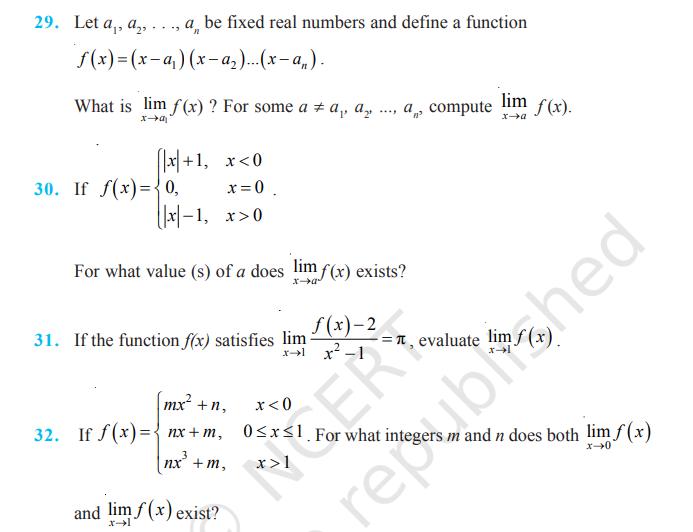
29. $f(x) = (x – a_1)(x – a_2)…(x – a_n)$
Part I: $\lim_{x \to a_1} f(x)$
Since $f(x)$ is a polynomial, the limit is found by direct substitution:
$$\lim_{x \to a_1} f(x) = (a_1 – a_1)(a_1 – a_2)…(a_1 – a_n) = 0 \cdot (a_1 – a_2)…(a_1 – a_n) = \mathbf{0}$$
Part II: $\lim_{x \to a} f(x)$ for $a \ne a_1, a_2, …, a_n$
Direct substitution:
$$\lim_{x \to a} f(x) = (a – a_1)(a – a_2)…(a – a_n)$$
Since $a \ne a_i$ for any $i$, the result is $\mathbf{(a – a_1)(a – a_2)…(a – a_n)}$ (a non-zero real number).
Existence of Limit for $f(x)$ (Q. 30–32)
30. $f(x) = \begin{cases} 1 + x, & x < 0 \\ 0, & x = 0 \\ 1 – x, & x > 0 \end{cases}$
For what value(s) of $a$ does $\lim_{x \to a} f(x)$ exist?
- Case 1: $a = 0$
- LHL: $\lim_{x \to 0^-} (1 + x) = 1 + 0 = 1$
- RHL: $\lim_{x \to 0^+} (1 – x) = 1 – 0 = 1$Since LHL = RHL = 1, $\lim_{x \to 0} f(x)$ exists.
- Case 2: $a \ne 0$
- If $a < 0$, $f(x) = 1 + x$ near $a$. $\lim_{x \to a} (1 + x) = 1 + a$. (Limit exists)
- If $a > 0$, $f(x) = 1 – x$ near $a$. $\lim_{x \to a} (1 – x) = 1 – a$. (Limit exists)
The limit $\lim_{x \to a} f(x)$ exists for all real values of $a$.
31. $\lim_{x \to 1} \frac{f(x)}{x – 1} = \pi$, evaluate $\lim_{x \to 1} f(x)$.
For the limit $\lim_{x \to 1} \frac{f(x)}{x – 1}$ to be a finite number ($\pi$) while the denominator $\lim_{x \to 1} (x – 1) = 0$, the numerator must also approach 0 (i.e., it must be the $\frac{0}{0}$ indeterminate form).
Therefore, $\lim_{x \to 1} f(x) = 0$.
If $\lim_{x \to 1} f(x) = L \ne 0$, then $\lim_{x \to 1} \frac{f(x)}{x – 1} = \frac{L}{0} = \infty$, which contradicts the given limit of $\pi$.
Thus, $\lim_{x \to 1} f(x) = \mathbf{0}$.
32. $f(x) = \begin{cases} mx + n, & x < 0 \\ nx + m, & 0 \le x \le 1 \\ nx^3 + m, & x > 1 \end{cases}$
Find integers $m$ and $n$ such that $\lim_{x \to 0} f(x)$ and $\lim_{x \to 1} f(x)$ exist.
Part I: Limit at $x = 0$ exists (LHL = RHL)
- LHL ($\lim_{x \to 0^-} f(x)$): Use $f(x) = mx + n$.$$\lim_{x \to 0^-} (mx + n) = m(0) + n = n$$
- RHL ($\lim_{x \to 0^+} f(x)$): Use $f(x) = nx + m$.$$\lim_{x \to 0^+} (nx + m) = n(0) + m = m$$For the limit to exist at $x=0$, $n = m$.
Part II: Limit at $x = 1$ exists (LHL = RHL)
- LHL ($\lim_{x \to 1^-} f(x)$): Use $f(x) = nx + m$.$$\lim_{x \to 1^-} (nx + m) = n(1) + m = n + m$$
- RHL ($\lim_{x \to 1^+} f(x)$): Use $f(x) = nx^3 + m$.$$\lim_{x \to 1^+} (nx^3 + m) = n(1)^3 + m = n + m$$The limit at $x=1$ always exists for any $m$ and $n$ because $n + m = n + m$.
Conclusion: The condition for both limits to exist is $n = m$. Since $m$ and $n$ must be integers, the solution set is any pair of equal integers (e.g., $m=1, n=1$; $m=5, n=5$; $m=-2, n=-2$, etc.).