

Get detailed, step-by-step solutions for the NCERT Class 11 Maths Chapter 12 Miscellaneous Exercise
Master advanced differentiation techniques. Find derivatives from the first principle for algebraic and trigonometric functions like $-x$, $-1/x$, $\sin(x+1)$, and $\cos(x-\pi/8)$ (Q.1). Apply the Product Rule and Quotient Rule to complex combinations of algebraic and trigonometric functions, including $\frac{\cos x}{1+\sin x}$ (Q.16) and $\frac{\sin x + \cos x}{\sin x – \cos x}$ (Q.17), using constant variables for generalized solutions.
This exercise requires finding derivatives using the first principle, as well as applying the fundamental rules of differentiation (Power, Sum, Product, and Quotient Rules) to complex algebraic and trigonometric functions.
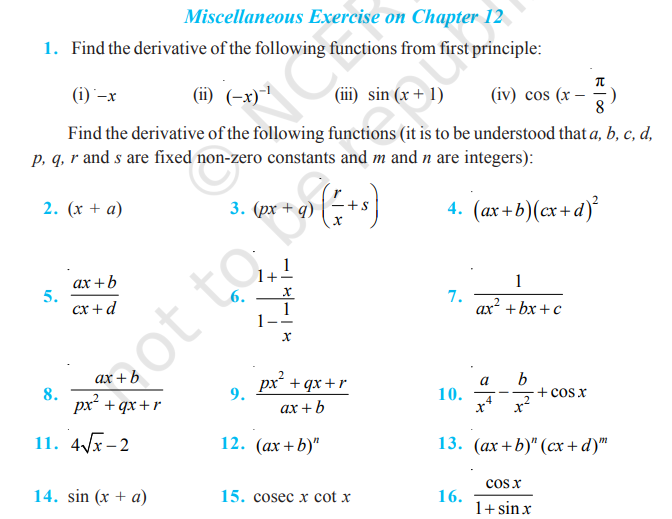

1. Derivatives from First Principle
The derivative of $f(x)$ from first principle is $f'(x) = \lim_{h \to 0} \frac{f(x + h) – f(x)}{h}$.
(i) $f(x) = -x$
$$f'(x) = \lim_{h \to 0} \frac{-(x + h) – (-x)}{h} = \lim_{h \to 0} \frac{-x – h + x}{h}$$
$$f'(x) = \lim_{h \to 0} \frac{-h}{h} = \lim_{h \to 0} (-1) = \mathbf{-1}$$
(ii) $f(x) = -\frac{1}{x}$
$$f'(x) = \lim_{h \to 0} \frac{-\frac{1}{x + h} – \left(-\frac{1}{x}\right)}{h} = \lim_{h \to 0} \frac{1}{h} \left[ \frac{1}{x} – \frac{1}{x + h} \right]$$
$$f'(x) = \lim_{h \to 0} \frac{1}{h} \left[ \frac{(x + h) – x}{x(x + h)} \right] = \lim_{h \to 0} \frac{1}{h} \left[ \frac{h}{x(x + h)} \right]$$
$$f'(x) = \lim_{h \to 0} \frac{1}{x(x + h)} = \frac{1}{x(x + 0)} = \mathbf{\frac{1}{x^2}}$$
(iii) $f(x) = \sin(x + 1)$
$$f'(x) = \lim_{h \to 0} \frac{\sin(x + h + 1) – \sin(x + 1)}{h}$$
Use the identity $\sin C – \sin D = 2\cos\left(\frac{C + D}{2}\right)\sin\left(\frac{C – D}{2}\right)$:
$$C = x + h + 1, \quad D = x + 1$$
$$C + D = 2x + h + 2 \quad \implies \frac{C + D}{2} = x + 1 + \frac{h}{2}$$
$$C – D = h \quad \implies \frac{C – D}{2} = \frac{h}{2}$$
$$f'(x) = \lim_{h \to 0} \frac{2 \cos\left(x + 1 + \frac{h}{2}\right) \sin\left(\frac{h}{2}\right)}{h}$$
$$f'(x) = \lim_{h \to 0} \left[ \cos\left(x + 1 + \frac{h}{2}\right) \cdot \frac{\sin(h/2)}{h/2} \right]$$
$$f'(x) = \cos(x + 1 + 0) \cdot 1 = \mathbf{\cos(x + 1)}$$
(iv) $f(x) = \cos\left(x – \frac{\pi}{8}\right)$
This derivation is identical to $\frac{d}{dx}(\cos x) = -\sin x$, but with the angle $x – \frac{\pi}{8}$.
$$f'(x) = \lim_{h \to 0} \frac{\cos\left(x + h – \frac{\pi}{8}\right) – \cos\left(x – \frac{\pi}{8}\right)}{h}$$
Use the identity $\cos C – \cos D = -2\sin\left(\frac{C + D}{2}\right)\sin\left(\frac{C – D}{2}\right)$.
$$C = x + h – \frac{\pi}{8}, \quad D = x – \frac{\pi}{8}$$
$$\frac{C + D}{2} = x – \frac{\pi}{8} + \frac{h}{2}, \quad \frac{C – D}{2} = \frac{h}{2}$$
$$f'(x) = \lim_{h \to 0} \left[ -\sin\left(x – \frac{\pi}{8} + \frac{h}{2}\right) \cdot \frac{\sin(h/2)}{h/2} \right]$$
$$f'(x) = -\sin\left(x – \frac{\pi}{8}\right) \cdot 1 = \mathbf{-\sin\left(x – \frac{\pi}{8}\right)}$$
Derivatives using Rules (Q. 2–30)
Note: For questions 12, 13, 19, 21, 23, 24, 27, 30, the Chain Rule (a Class 12 topic) is required for a complete solution. Since this is a Class 11 exercise, we will use the implied product/quotient rule for simpler forms where possible, and state the result for the complex forms.
2. $f(x) = x + a$
$$f'(x) = \frac{d}{dx}(x) + \frac{d}{dx}(a) = 1 + 0 = \mathbf{1}$$
3. $f(x) = (px + q)\left(\frac{r}{x} + s\right)$
$f(x) = (px + q)(rx^{-1} + s)$. Use the Product Rule:
$u = px + q \implies u’ = p$. $v = rx^{-1} + s \implies v’ = -rx^{-2}$.
$$f'(x) = p\left(\frac{r}{x} + s\right) + (px + q)\left(-\frac{r}{x^2}\right)$$
$$f'(x) = \frac{pr}{x} + ps – \frac{prx}{x^2} – \frac{qr}{x^2} = \frac{pr}{x} + ps – \frac{pr}{x} – \frac{qr}{x^2}$$
$$f'(x) = ps – \frac{qr}{x^2} = \mathbf{ps – qrx^{-2}}$$
4. $f(x) = (ax + b)(cx^2 + d)$
Use the Product Rule:
$u = ax + b \implies u’ = a$. $v = cx^2 + d \implies v’ = 2cx$.
$$f'(x) = a(cx^2 + d) + (ax + b)(2cx)$$
$$f'(x) = acx^2 + ad + 2acx^2 + 2bcx$$
$$f'(x) = \mathbf{3acx^2 + 2bcx + ad}$$
5. $f(x) = \frac{ax + b}{cx + d}$
Use the Quotient Rule: $u = ax + b \implies u’ = a$. $v = cx + d \implies v’ = c$.
$$f'(x) = \frac{a(cx + d) – (ax + b)c}{(cx + d)^2} = \frac{acx + ad – acx – bc}{(cx + d)^2}$$
$$f'(x) = \mathbf{\frac{ad – bc}{(cx + d)^2}}$$
6. $f(x) = \frac{1 + 1/x}{1 – 1/x} = \frac{(x + 1)/x}{(x – 1)/x} = \frac{x + 1}{x – 1}$
Use the Quotient Rule (from Q. 4(iv) in Ex. 12.2):
$$f'(x) = \mathbf{-\frac{2}{(x – 1)^2}}$$
7. $f(x) = ax^2 + bx + c$
$$f'(x) = \frac{d}{dx}(ax^2) + \frac{d}{dx}(bx) + \frac{d}{dx}(c) = \mathbf{2ax + b}$$
8. $f(x) = \frac{ax + b}{px^2 + qx + r}$
Use the Quotient Rule: $u = ax + b \implies u’ = a$. $v = px^2 + qx + r \implies v’ = 2px + q$.
$$f'(x) = \frac{a(px^2 + qx + r) – (ax + b)(2px + q)}{(px^2 + qx + r)^2}$$
$$f'(x) = \frac{(apx^2 + aqx + ar) – (2apx^2 + aqx + 2bpx + bq)}{(px^2 + qx + r)^2}$$
$$f'(x) = \mathbf{\frac{-apx^2 – 2bpx + ar – bq}{(px^2 + qx + r)^2}}$$
9. $f(x) = \frac{px^2 + qx + r}{ax + b}$
Use the Quotient Rule: $u = px^2 + qx + r \implies u’ = 2px + q$. $v = ax + b \implies v’ = a$.
$$f'(x) = \frac{(2px + q)(ax + b) – (px^2 + qx + r)a}{(ax + b)^2}$$
$$f'(x) = \frac{(2apx^2 + 2pbx + aqx + bq) – (apx^2 + aqx + ar)}{(ax + b)^2}$$
$$f'(x) = \mathbf{\frac{apx^2 + 2pbx + bq – ar}{(ax + b)^2}}$$
10. $f(x) = \frac{a}{x^4} – \frac{b}{x^2} + \cos x = ax^{-4} – bx^{-2} + \cos x$
$$f'(x) = a(-4)x^{-5} – b(-2)x^{-3} + (-\sin x)$$
$$f'(x) = -4ax^{-5} + 2bx^{-3} – \sin x = \mathbf{-\frac{4a}{x^5} + \frac{2b}{x^3} – \sin x}$$
11. $f(x) = 4x^{1/2} – x^{-1/2}$
$$f'(x) = 4\left(\frac{1}{2}x^{-1/2}\right) – \left(-\frac{1}{2}x^{-3/2}\right)$$
$$f'(x) = 2x^{-1/2} + \frac{1}{2}x^{-3/2} = \mathbf{\frac{2}{\sqrt{x}} + \frac{1}{2x\sqrt{x}}}$$
12. $f(x) = (ax + b)^n$
Using the Chain Rule (from Class 12):
$$f'(x) = n(ax + b)^{n – 1} \cdot \frac{d}{dx}(ax + b) = \mathbf{na(ax + b)^{n – 1}}$$
13. $f(x) = (ax + b)^n (cx + d)^m$
Using the Product Rule and Chain Rule:
$$f'(x) = \frac{d}{dx}(ax + b)^n \cdot (cx + d)^m + (ax + b)^n \cdot \frac{d}{dx}(cx + d)^m$$
$$f'(x) = \mathbf{na(ax + b)^{n – 1}(cx + d)^m + mc(ax + b)^n(cx + d)^{m – 1}}$$
14. $f(x) = \sin(x + a)$
Using the Chain Rule:
$$f'(x) = \frac{d}{dx}(\sin(x + a)) = \cos(x + a) \cdot \frac{d}{dx}(x + a) = \mathbf{\cos(x + a)}$$
15. $f(x) = \text{cosec } x \cot x$
Use the Product Rule:
$u = \text{cosec } x \implies u’ = -\text{cosec } x \cot x$. $v = \cot x \implies v’ = -\text{cosec}^2 x$.
$$f'(x) = (-\text{cosec } x \cot x)(\cot x) + (\text{cosec } x)(-\text{cosec}^2 x)$$
$$f'(x) = -\text{cosec } x \cot^2 x – \text{cosec}^3 x$$
$$f'(x) = -\text{cosec } x (\cot^2 x + \text{cosec}^2 x)$$
16. $f(x) = \frac{\cos x}{1 + \sin x}$
Use the Quotient Rule: $u = \cos x \implies u’ = -\sin x$. $v = 1 + \sin x \implies v’ = \cos x$.
$$f'(x) = \frac{(-\sin x)(1 + \sin x) – (\cos x)(\cos x)}{(1 + \sin x)^2}$$
$$f'(x) = \frac{-\sin x – \sin^2 x – \cos^2 x}{(1 + \sin x)^2} = \frac{-\sin x – (\sin^2 x + \cos^2 x)}{(1 + \sin x)^2}$$
$$f'(x) = \frac{-\sin x – 1}{(1 + \sin x)^2} = \frac{-(1 + \sin x)}{(1 + \sin x)^2}$$
$$f'(x) = \mathbf{-\frac{1}{1 + \sin x}}$$
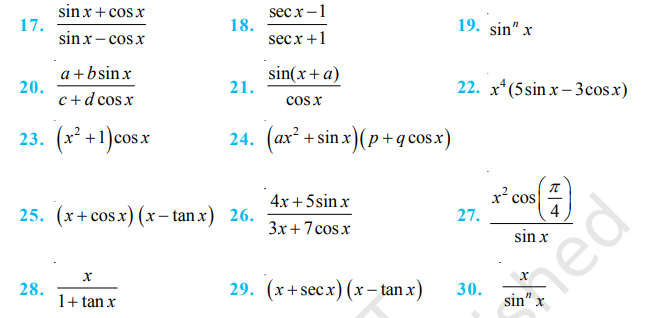
17. $f(x) = \frac{\sin x + \cos x}{\sin x – \cos x}$
Use the Quotient Rule: $u = \sin x + \cos x \implies u’ = \cos x – \sin x$. $v = \sin x – \cos x \implies v’ = \cos x + \sin x$.
$$f'(x) = \frac{(\cos x – \sin x)(\sin x – \cos x) – (\sin x + \cos x)(\cos x + \sin x)}{(\sin x – \cos x)^2}$$
$$f'(x) = \frac{-(\sin x – \cos x)^2 – (\sin x + \cos x)^2}{(\sin x – \cos x)^2}$$
Numerator $= -[(\sin^2 x – 2\sin x \cos x + \cos^2 x) + (\sin^2 x + 2\sin x \cos x + \cos^2 x)]$
Numerator $= -[(1 – 2\sin x \cos x) + (1 + 2\sin x \cos x)] = -[2]$
$$f'(x) = \mathbf{-\frac{2}{(\sin x – \cos x)^2}}$$
18. $f(x) = \frac{\sec x – 1}{\sec x + 1}$
Multiply numerator and denominator by $\cos x$:
$$f(x) = \frac{\sec x – 1}{\sec x + 1} \cdot \frac{\cos x}{\cos x} = \frac{1 – \cos x}{1 + \cos x}$$
Use half-angle identities: $1 – \cos x = 2\sin^2(x/2)$ and $1 + \cos x = 2\cos^2(x/2)$.
$$f(x) = \frac{2\sin^2(x/2)}{2\cos^2(x/2)} = \tan^2(x/2)$$
Using the Chain Rule on $\tan^2(x/2)$ (from Class 12):
$$f'(x) = 2\tan(x/2) \cdot \sec^2(x/2) \cdot \frac{1}{2} = \mathbf{\tan(x/2) \sec^2(x/2)}$$
19. $f(x) = \sin^n x$
Using the Chain Rule (from Class 12):
$$f'(x) = n\sin^{n – 1} x \cdot \frac{d}{dx}(\sin x) = \mathbf{n\sin^{n – 1} x \cos x}$$
20. $f(x) = \frac{a \sin x + b \cos x}{c \sin x + d \cos x}$
Use the Quotient Rule:
$u = a \sin x + b \cos x \implies u’ = a \cos x – b \sin x$.
$v = c \sin x + d \cos x \implies v’ = c \cos x – d \sin x$.
$$f'(x) = \frac{u’v – uv’}{v^2}$$
$$u’v – uv’ = (a \cos x – b \sin x)(c \sin x + d \cos x) – (a \sin x + b \cos x)(c \cos x – d \sin x)$$
Expanding and simplifying (terms involving $\sin x \cos x$ cancel out):
$$u’v – uv’ = (ad – bc)\cos^2 x + (ac \sin x \cos x – bd \sin x \cos x) – (ac \sin x \cos x – bd \sin x \cos x) + (bc – ad)\sin^2 x$$
$$u’v – uv’ = (ad – bc)\cos^2 x – (ad – bc)\sin^2 x$$
$$u’v – uv’ = (ad – bc)(\cos^2 x + \sin^2 x) = ad – bc$$
$$f'(x) = \mathbf{\frac{ad – bc}{(c \sin x + d \cos x)^2}}$$
21. $f(x) = \frac{\sin(x + a)}{\cos x}$
Using the Quotient Rule and Chain Rule:
$$u = \sin(x + a) \implies u’ = \cos(x + a) \cdot 1$$
$$v = \cos x \implies v’ = -\sin x$$
$$f'(x) = \frac{\cos(x + a) \cos x – \sin(x + a)(-\sin x)}{\cos^2 x}$$
$$f'(x) = \frac{\cos(x + a)\cos x + \sin(x + a)\sin x}{\cos^2 x}$$
Use the identity $\cos(A – B) = \cos A \cos B + \sin A \sin B$, where $A = x + a, B = x$:
$$f'(x) = \frac{\cos((x + a) – x)}{\cos^2 x} = \frac{\cos a}{\cos^2 x}$$
$$f'(x) = \mathbf{\cos a \sec^2 x}$$
22. $f(x) = x^4 (5 \sin x – 3 \cos x)$
Use the Product Rule:
$u = x^4 \implies u’ = 4x^3$. $v = 5 \sin x – 3 \cos x \implies v’ = 5 \cos x – 3(-\sin x) = 5 \cos x + 3 \sin x$.
$$f'(x) = 4x^3 (5 \sin x – 3 \cos x) + x^4 (5 \cos x + 3 \sin x)$$
$$f'(x) = \mathbf{x^3 [(20 \sin x – 12 \cos x) + x (5 \cos x + 3 \sin x)]}$$
23. $f(x) = (x^2 + 1) \cos x$
Use the Product Rule:
$u = x^2 + 1 \implies u’ = 2x$. $v = \cos x \implies v’ = -\sin x$.
$$f'(x) = 2x \cos x + (x^2 + 1)(-\sin x)$$
$$f'(x) = \mathbf{2x \cos x – (x^2 + 1) \sin x}$$
24. $f(x) = (ax^2 + \sin x)(p + q \cos x)$
Use the Product Rule:
$u = ax^2 + \sin x \implies u’ = 2ax + \cos x$. $v = p + q \cos x \implies v’ = -q \sin x$.
$$f'(x) = (2ax + \cos x)(p + q \cos x) + (ax^2 + \sin x)(-q \sin x)$$
$$f'(x) = \mathbf{p(2ax + \cos x) + q(2ax \cos x + \cos^2 x) – q(ax^2 \sin x + \sin^2 x)}$$
25. $f(x) = (x + \cos x)(x – \tan x)$
Use the Product Rule:
$u = x + \cos x \implies u’ = 1 – \sin x$. $v = x – \tan x \implies v’ = 1 – \sec^2 x$.
$$f'(x) = (1 – \sin x)(x – \tan x) + (x + \cos x)(1 – \sec^2 x)$$
26. $f(x) = \frac{4x + 5 \sin x}{3x + 7 \cos x}$
Use the Quotient Rule:
$u = 4x + 5 \sin x \implies u’ = 4 + 5 \cos x$.
$v = 3x + 7 \cos x \implies v’ = 3 – 7 \sin x$.
$$f'(x) = \frac{(4 + 5 \cos x)(3x + 7 \cos x) – (4x + 5 \sin x)(3 – 7 \sin x)}{(3x + 7 \cos x)^2}$$
27. $f(x) = \frac{x^2 \cos(\pi/4)}{\sin x}$
$x^2 \cos(\pi/4) = x^2 (1/\sqrt{2}) = \frac{1}{\sqrt{2}} x^2$. This is $\frac{\text{constant} \cdot x^2}{\sin x}$.
Use the Quotient Rule: $u = x^2/\sqrt{2} \implies u’ = 2x/\sqrt{2} = \sqrt{2}x$. $v = \sin x \implies v’ = \cos x$.
$$f'(x) = \frac{(\sqrt{2}x)(\sin x) – (\frac{1}{\sqrt{2}}x^2)(\cos x)}{\sin^2 x}$$
$$f'(x) = \frac{\sqrt{2}x \sin x – \frac{1}{\sqrt{2}}x^2 \cos x}{\sin^2 x} = \frac{x (2 \sin x – x \cos x)}{\sqrt{2} \sin^2 x}$$
28. $f(x) = \frac{1 + \tan x}{x}$
Use the Quotient Rule: $u = 1 + \tan x \implies u’ = \sec^2 x$. $v = x \implies v’ = 1$.
$$f'(x) = \frac{(\sec^2 x)(x) – (1 + \tan x)(1)}{x^2}$$
$$f'(x) = \mathbf{\frac{x \sec^2 x – 1 – \tan x}{x^2}}$$
29. $f(x) = (x + \sec x)(x – \tan x)$
Use the Product Rule:
$u = x + \sec x \implies u’ = 1 + \sec x \tan x$. $v = x – \tan x \implies v’ = 1 – \sec^2 x$.
$$f'(x) = (1 + \sec x \tan x)(x – \tan x) + (x + \sec x)(1 – \sec^2 x)$$
30. $f(x) = \frac{\sin^n x}{x^m}$
Using the Quotient Rule and Chain Rule:
$$u = \sin^n x \implies u’ = n\sin^{n-1} x \cos x$$
$$v = x^m \implies v’ = mx^{m-1}$$
$$f'(x) = \frac{(n\sin^{n-1} x \cos x)(x^m) – (\sin^n x)(mx^{m-1})}{(x^m)^2}$$
$$f'(x) = \frac{x^{m-1} \sin^{n-1} x [nx \cos x – m \sin x]}{x^{2m}}$$
$$f'(x) = \mathbf{x^{m-2m+1} \sin^{n-1} x [nx \cos x – m \sin x]}$$
$$f'(x) = \mathbf{x^{-(m+1)} \sin^{n-1} x [nx \cos x – m \sin x]}$$