
Get detailed, step-by-step solutions for NCERT Class 11 Maths Chapter 13 Exercise 13.1 The Mean Deviation (MD) is a measure of dispersion calculated as the average of the absolute differences between the data values and the mean or median.
Learn to calculate Mean Deviation ($\text{MD}$) for ungrouped data about both the Mean ($\bar{x}$) (Q.1-2) and the Median ($M$) (Q.3-4). Master the calculation of $\text{MD}$ for discrete (Q.5-8) and continuous frequency distributions (Q.9-12). Solutions include calculating the mean, median, absolute deviations, and applying the correct formula for each type of data set.

Mean Deviation for Ungrouped Data
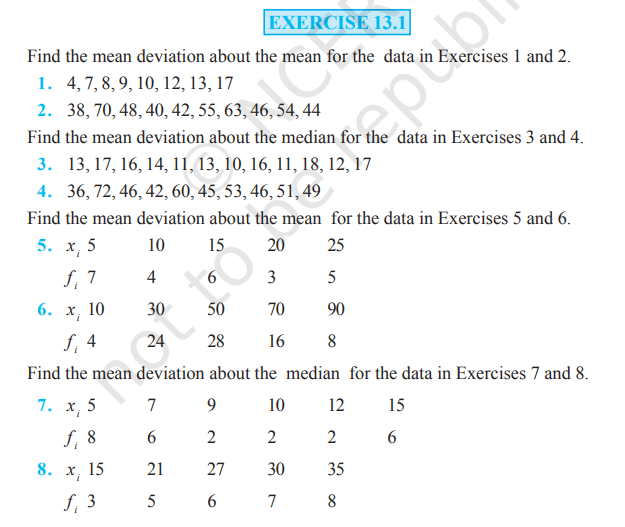
1. Mean Deviation about the Mean ($\bar{x}$) for $4, 7, 8, 9, 10, 12, 13, 17$
Here, $n=8$.
- Calculate the Mean ($\bar{x}$):$$\bar{x} = \frac{\sum x_i}{n} = \frac{4 + 7 + 8 + 9 + 10 + 12 + 13 + 17}{8} = \frac{80}{8} = 10$$
- Calculate the Absolute Deviations ($|x_i – \bar{x}|$):| $x_i$ | $|x_i – 10|$ || :—: | :—: || 4 | $|4 – 10| = 6$ || 7 | $|7 – 10| = 3$ || 8 | $|8 – 10| = 2$ || 9 | $|9 – 10| = 1$ || 10 | $|10 – 10| = 0$ || 12 | $|12 – 10| = 2$ || 13 | $|13 – 10| = 3$ || 17 | $|17 – 10| = 7$ || Total | $\sum |x_i – \bar{x}| = 24$ |
- Calculate the Mean Deviation about the Mean ($\text{MD}(\bar{x})$):$$\text{MD}(\bar{x}) = \frac{\sum |x_i – \bar{x}|}{n} = \frac{24}{8} = \mathbf{3}$$
2. Mean Deviation about the Mean ($\bar{x}$) for $38, 70, 48, 40, 42, 55, 63, 46, 54, 44$
Here, $n=10$.
- Calculate the Mean ($\bar{x}$):$$\bar{x} = \frac{\sum x_i}{n} = \frac{38 + 70 + 48 + 40 + 42 + 55 + 63 + 46 + 54 + 44}{10} = \frac{500}{10} = 50$$
- Calculate the Absolute Deviations ($|x_i – 50|$):| $x_i$ | $|x_i – 50|$ || :—: | :—: || 38 | 12 || 70 | 20 || 48 | 2 || 40 | 10 || 42 | 8 || 55 | 5 || 63 | 13 || 46 | 4 || 54 | 4 || 44 | 6 || Total | $\sum |x_i – \bar{x}| = 84$ |
- Calculate the Mean Deviation about the Mean ($\text{MD}(\bar{x})$):$$\text{MD}(\bar{x}) = \frac{\sum |x_i – \bar{x}|}{n} = \frac{84}{10} = \mathbf{8.4}$$
3. Mean Deviation about the Median ($M$) for $13, 17, 16, 14, 11, 13, 10, 16, 11, 18, 12, 17$
Here, $n=12$ (even).
- Order the Data:$$10, 11, 11, 12, 13, 13, 14, 16, 16, 17, 17, 18$$
- Calculate the Median ($M$):The median is the average of the $\frac{n}{2}$-th and $(\frac{n}{2} + 1)$-th observations (6th and 7th).$$M = \frac{13 + 14}{2} = 13.5$$
- Calculate the Absolute Deviations ($|x_i – 13.5|$):| $x_i$ | $|x_i – 13.5|$ || :—: | :—: || 10 | 3.5 || 11 | 2.5 || 11 | 2.5 || 12 | 1.5 || 13 | 0.5 || 13 | 0.5 || 14 | 0.5 || 16 | 2.5 || 16 | 2.5 || 17 | 3.5 || 17 | 3.5 || 18 | 4.5 || Total | $\sum |x_i – M| = 28$ |
- Calculate the Mean Deviation about the Median ($\text{MD}(M)$):$$\text{MD}(M) = \frac{\sum |x_i – M|}{n} = \frac{28}{12} = \frac{7}{3} \approx \mathbf{2.33}$$
4. Mean Deviation about the Median ($M$) for $36, 72, 46, 42, 60, 45, 53, 46, 51, 49$
Here, $n=10$ (even).
- Order the Data:$$36, 42, 45, 46, 46, 49, 51, 53, 60, 72$$
- Calculate the Median ($M$):The median is the average of the 5th and 6th observations.$$M = \frac{46 + 49}{2} = 47.5$$
- Calculate the Absolute Deviations ($|x_i – 47.5|$):| $x_i$ | $|x_i – 47.5|$ || :—: | :—: || 36 | 11.5 || 42 | 5.5 || 45 | 2.5 || 46 | 1.5 || 46 | 1.5 || 49 | 1.5 || 51 | 3.5 || 53 | 5.5 || 60 | 12.5 || 72 | 24.5 || Total | $\sum |x_i – M| = 70$ |
- Calculate the Mean Deviation about the Median ($\text{MD}(M)$):$$\text{MD}(M) = \frac{\sum |x_i – M|}{n} = \frac{70}{10} = \mathbf{7}$$
Mean Deviation for Discrete Frequency Distribution
The formula for $\text{MD}(\bar{x})$ is $\frac{\sum f_i|x_i – \bar{x}|}{\sum f_i}$.
5. Mean Deviation about the Mean ($\bar{x}$)
| $x_i$ | $f_i$ | $f_i x_i$ | $|x_i – \bar{x}|$ | $f_i|x_i – \bar{x}|$ |
| :—: | :—: | :—: | :—: | :—: |
| 5 | 7 | 35 | 9 | 63 |
| 10 | 4 | 40 | 4 | 16 |
| 15 | 6 | 90 | 1 | 6 |
| 20 | 3 | 60 | 6 | 18 |
| 25 | 5 | 125 | 11 | 55 |
| Total | $\sum f_i = 25$ | $\sum f_i x_i = 350$ | | $\sum f_i|x_i – \bar{x}| = 158$ |
- Calculate the Mean ($\bar{x}$):$$\bar{x} = \frac{\sum f_i x_i}{\sum f_i} = \frac{350}{25} = 14$$
- Calculate $\text{MD}(\bar{x})$:$$\text{MD}(\bar{x}) = \frac{\sum f_i|x_i – \bar{x}|}{\sum f_i} = \frac{158}{25} = \mathbf{6.32}$$
6. Mean Deviation about the Mean ($\bar{x}$)
| $x_i$ | $f_i$ | $f_i x_i$ | $|x_i – \bar{x}|$ | $f_i|x_i – \bar{x}|$ |
| :—: | :—: | :—: | :—: | :—: |
| 10 | 4 | 40 | 40 | 160 |
| 30 | 24 | 720 | 20 | 480 |
| 50 | 28 | 1400 | 0 | 0 |
| 70 | 16 | 1120 | 20 | 320 |
| 90 | 8 | 720 | 40 | 320 |
| Total | $\sum f_i = 80$ | $\sum f_i x_i = 4000$ | | $\sum f_i|x_i – \bar{x}| = 1280$ |
- Calculate the Mean ($\bar{x}$):$$\bar{x} = \frac{\sum f_i x_i}{\sum f_i} = \frac{4000}{80} = 50$$
- Calculate $\text{MD}(\bar{x})$:$$\text{MD}(\bar{x}) = \frac{\sum f_i|x_i – \bar{x}|}{\sum f_i} = \frac{1280}{80} = \mathbf{16}$$
7. Mean Deviation about the Median ($M$)
| $x_i$ | $f_i$ | Cumulative Frequency ($C_f$) | $|x_i – M|$ | $f_i|x_i – M|$ |
| :—: | :—: | :—: | :—: | :—: |
| 5 | 8 | 8 | 4 | 32 |
| 7 | 6 | 14 | 2 | 12 |
| 9 | 2 | 16 | 0 | 0 |
| 10 | 2 | 18 | 1 | 2 |
| 12 | 2 | 20 | 3 | 6 |
| 15 | 6 | 26 | 6 | 36 |
| Total | $\sum f_i = 26$ | | | $\sum f_i|x_i – M| = 88$ |
- Calculate the Median ($M$):$\sum f_i = 26$ (even). The median is the average of the $\frac{N}{2}=13$th and $\frac{N}{2}+1=14$th observations. Both observations fall in the class $x_i=7$.$$M = 7$$
- Calculate $\text{MD}(M)$:$$\text{MD}(M) = \frac{\sum f_i|x_i – M|}{\sum f_i} = \frac{88}{26} = \frac{44}{13} \approx \mathbf{3.38}$$
8. Mean Deviation about the Median ($M$)
| $x_i$ | $f_i$ | Cumulative Frequency ($C_f$) | $|x_i – M|$ | $f_i|x_i – M|$ |
| :—: | :—: | :—: | :—: | :—: |
| 15 | 3 | 3 | 12 | 36 |
| 21 | 5 | 8 | 6 | 30 |
| 27 | 6 | 14 | 0 | 0 |
| 30 | 7 | 21 | 3 | 21 |
| 35 | 8 | 29 | 8 | 64 |
| Total | $\sum f_i = 29$ | | | $\sum f_i|x_i – M| = 151$ |
- Calculate the Median ($M$):$\sum f_i = 29$ (odd). The median is the $\frac{N+1}{2}=15$th observation. The 15th observation falls in the class $x_i=30$.$$M = 30$$
- Calculate $\text{MD}(M)$:$$\text{MD}(M) = \frac{\sum f_i|x_i – M|}{\sum f_i} = \frac{151}{29} \approx \mathbf{5.21}$$
Mean Deviation for Continuous Frequency Distribution
The formulas remain the same, but $x_i$ is taken as the midpoint of the class interval.
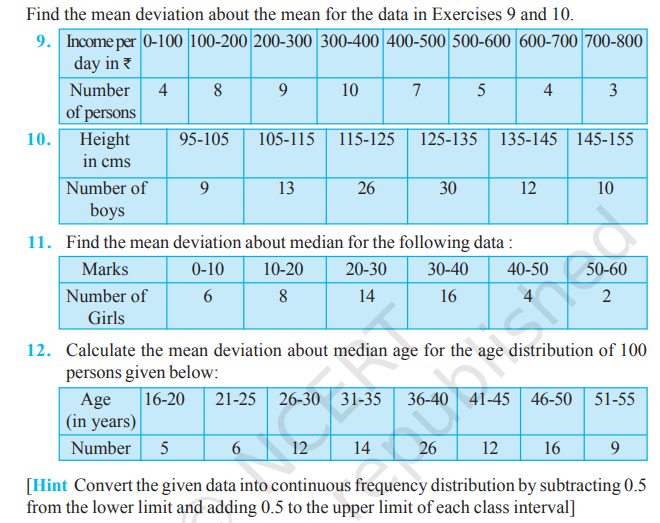
9. Mean Deviation about the Mean ($\bar{x}$)
| Class Interval | Midpoint ($x_i$) | $f_i$ | $f_i x_i$ | $|x_i – \bar{x}|$ | $f_i|x_i – \bar{x}|$ |
| :—: | :—: | :—: | :—: | :—: | :—: |
| 0-100 | 50 | 4 | 200 | 350 | 1400 |
| 100-200 | 150 | 8 | 1200 | 250 | 2000 |
| 200-300 | 250 | 9 | 2250 | 150 | 1350 |
| 300-400 | 350 | 10 | 3500 | 50 | 500 |
| 400-500 | 450 | 7 | 3150 | 50 | 350 |
| 500-600 | 550 | 5 | 2750 | 150 | 750 |
| 600-700 | 650 | 4 | 2600 | 250 | 1000 |
| 700-800 | 750 | 3 | 2250 | 350 | 1050 |
| Total | | $\sum f_i = 50$ | $\sum f_i x_i = 17900$ | | $\sum f_i|x_i – \bar{x}| = 8400$ |
- Calculate the Mean ($\bar{x}$):$$\bar{x} = \frac{\sum f_i x_i}{\sum f_i} = \frac{17900}{50} = 358$$
- Calculate $\text{MD}(\bar{x})$:$$\text{MD}(\bar{x}) = \frac{\sum f_i|x_i – \bar{x}|}{\sum f_i} = \frac{8400}{50} = \mathbf{168}$$
10. Mean Deviation about the Mean ($\bar{x}$)
| Class Interval | Midpoint ($x_i$) | $f_i$ | $f_i x_i$ | $|x_i – \bar{x}|$ | $f_i|x_i – \bar{x}|$ |
| :—: | :—: | :—: | :—: | :—: | :—: |
| 95-105 | 100 | 9 | 900 | 25 | 225 |
| 105-115 | 110 | 13 | 1430 | 15 | 195 |
| 115-125 | 120 | 26 | 3120 | 5 | 130 |
| 125-135 | 130 | 30 | 3900 | 5 | 150 |
| 135-145 | 140 | 12 | 1680 | 15 | 180 |
| 145-155 | 150 | 10 | 1500 | 25 | 250 |
| Total | | $\sum f_i = 100$ | $\sum f_i x_i = 12530$ | | $\sum f_i|x_i – \bar{x}| = 1130$ |
- Calculate the Mean ($\bar{x}$):$$\bar{x} = \frac{\sum f_i x_i}{\sum f_i} = \frac{12530}{100} = 125.3$$
- Calculate $\text{MD}(\bar{x})$:$$\text{MD}(\bar{x}) = \frac{\sum f_i|x_i – \bar{x}|}{\sum f_i} = \frac{1130}{100} = \mathbf{11.3}$$
11. Mean Deviation about the Median ($M$)
| Class Interval | $f_i$ | Cumulative Frequency ($C_f$) | Midpoint ($x_i$) | $|x_i – M|$ | $f_i|x_i – M|$ |
| :—: | :—: | :—: | :—: | :—: | :—: |
| 0-10 | 6 | 6 | 5 | 15 | 90 |
| 10-20 | 8 | 14 | 15 | 5 | 40 |
| 20-30 | 14 | 28 | 25 | 5 | 70 |
| 30-40 | 16 | 44 | 35 | 15 | 240 |
| 40-50 | 4 | 48 | 45 | 25 | 100 |
| 50-60 | 2 | 50 | 55 | 35 | 70 |
| Total | $\sum f_i = 50$ | | | | $\sum f_i|x_i – M| = 610$ |
- Calculate the Median ($M$):$\frac{N}{2} = \frac{50}{2} = 25$. This falls in the class 20-30 ($C_f=28$).Median Class: 20-30. $L=20, f=14, C_f=14, h=10$.$$M = L + \frac{N/2 – C_f}{f} \times h = 20 + \frac{25 – 14}{14} \times 10$$$$M = 20 + \frac{110}{14} = 20 + 7.857 \approx 27.86$$
- Calculate $\text{MD}(M)$:$$\text{MD}(M) = \frac{\sum f_i|x_i – M|}{\sum f_i} = \frac{610}{50} = \mathbf{12.2}$$
12. Mean Deviation about the Median ($M$)
First, convert the data to a continuous frequency distribution by adjusting the limits (subtract 0.5 from L.L., add 0.5 to U.L.). [The hint applies only to non-continuous data, here the classes are 16-20, 21-25, which means they are non-continuous and need conversion.]
| Continuous Class Interval | $f_i$ | Cumulative Frequency ($C_f$) | Midpoint ($x_i$) | $|x_i – M|$ | $f_i|x_i – M|$ |
| :—: | :—: | :—: | :—: | :—: | :—: |
| 15.5-20.5 | 5 | 5 | 18 | 18.5 | 92.5 |
| 20.5-25.5 | 6 | 11 | 23 | 13.5 | 81.0 |
| 25.5-30.5 | 12 | 23 | 28 | 8.5 | 102.0 |
| 30.5-35.5 | 14 | 37 | 33 | 3.5 | 49.0 |
| 35.5-40.5 | 26 | 63 | 38 | 1.5 | 39.0 |
| 40.5-45.5 | 12 | 75 | 43 | 6.5 | 78.0 |
| 45.5-50.5 | 16 | 91 | 48 | 11.5 | 184.0 |
| 50.5-55.5 | 9 | 100 | 53 | 16.5 | 148.5 |
| Total | $\sum f_i = 100$ | | | | $\sum f_i|x_i – M| = 774.0$ |
- Calculate the Median ($M$):$\frac{N}{2} = \frac{100}{2} = 50$. This falls in the class 35.5-40.5 ($C_f=63$).Median Class: 35.5-40.5. $L=35.5, f=26, C_f=37, h=5$.$$M = L + \frac{N/2 – C_f}{f} \times h = 35.5 + \frac{50 – 37}{26} \times 5$$$$M = 35.5 + \frac{13 \times 5}{26} = 35.5 + \frac{65}{26} = 35.5 + 2.5 = 38$$
- Calculate $\text{MD}(M)$:$$\text{MD}(M) = \frac{\sum f_i|x_i – M|}{\sum f_i} = \frac{774.0}{100} = \mathbf{7.74}$$