
Get detailed, step-by-step solutions for NCERT Class 11 Maths Chapter 8 Exercise 8.1. Learn to write the first five terms of sequences defined by the $n$-th term formula, including linear, rational, and exponential forms (Q.1-6). Practice finding indicated terms (Q.7-10). Master sequences defined by recurrence relations (Q.11-13) and write out the corresponding series. Includes the calculation of terms and ratios for the Fibonacci sequence (Q.14).
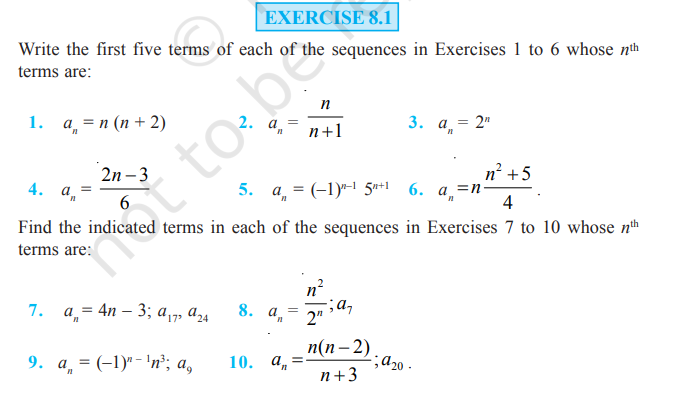

This exercise involves finding terms of sequences defined by explicit formulas for the $n$-th term ($a_n$) or by recurrence relations.
Finding the First Five Terms (Exercises 1–6)
We substitute $n = 1, 2, 3, 4, 5$ into the given $n$-th term formula $a_n$.
1. $a_n = n(n + 2)$
- $a_1 = 1(1 + 2) = 1(3) = \mathbf{3}$
- $a_2 = 2(2 + 2) = 2(4) = \mathbf{8}$
- $a_3 = 3(3 + 2) = 3(5) = \mathbf{15}$
- $a_4 = 4(4 + 2) = 4(6) = \mathbf{24}$
- $a_5 = 5(5 + 2) = 5(7) = \mathbf{35}$$$\text{Sequence: } 3, 8, 15, 24, 35$$
2. $a_n = \frac{n}{n + 1}$
- $a_1 = \frac{1}{1 + 1} = \mathbf{\frac{1}{2}}$
- $a_2 = \frac{2}{2 + 1} = \mathbf{\frac{2}{3}}$
- $a_3 = \frac{3}{3 + 1} = \mathbf{\frac{3}{4}}$
- $a_4 = \frac{4}{4 + 1} = \mathbf{\frac{4}{5}}$
- $a_5 = \frac{5}{5 + 1} = \mathbf{\frac{5}{6}}$$$\text{Sequence: } \frac{1}{2}, \frac{2}{3}, \frac{3}{4}, \frac{4}{5}, \frac{5}{6}$$
3. $a_n = 2^n$
- $a_1 = 2^1 = \mathbf{2}$
- $a_2 = 2^2 = \mathbf{4}$
- $a_3 = 2^3 = \mathbf{8}$
- $a_4 = 2^4 = \mathbf{16}$
- $a_5 = 2^5 = \mathbf{32}$$$\text{Sequence: } 2, 4, 8, 16, 32$$
4. $a_n = \frac{2n – 3}{6}$
- $a_1 = \frac{2(1) – 3}{6} = \frac{-1}{6} = \mathbf{-\frac{1}{6}}$
- $a_2 = \frac{2(2) – 3}{6} = \frac{1}{6} = \mathbf{\frac{1}{6}}$
- $a_3 = \frac{2(3) – 3}{6} = \frac{3}{6} = \mathbf{\frac{1}{2}}$
- $a_4 = \frac{2(4) – 3}{6} = \frac{5}{6} = \mathbf{\frac{5}{6}}$
- $a_5 = \frac{2(5) – 3}{6} = \frac{7}{6} = \mathbf{\frac{7}{6}}$$$\text{Sequence: } -\frac{1}{6}, \frac{1}{6}, \frac{1}{2}, \frac{5}{6}, \frac{7}{6}$$
5. $a_n = (-1)^{n-1} 5^{n+1}$
- $a_1 = (-1)^{1-1} 5^{1+1} = (-1)^0 5^2 = 1(25) = \mathbf{25}$
- $a_2 = (-1)^{2-1} 5^{2+1} = (-1)^1 5^3 = -1(125) = \mathbf{-125}$
- $a_3 = (-1)^{3-1} 5^{3+1} = (-1)^2 5^4 = 1(625) = \mathbf{625}$
- $a_4 = (-1)^{4-1} 5^{4+1} = (-1)^3 5^5 = -1(3125) = \mathbf{-3125}$
- $a_5 = (-1)^{5-1} 5^{5+1} = (-1)^4 5^6 = 1(15625) = \mathbf{15625}$$$\text{Sequence: } 25, -125, 625, -3125, 15625$$
6. $a_n = \frac{n(n^2 + 5)}{4}$
- $a_1 = \frac{1(1^2 + 5)}{4} = \frac{6}{4} = \mathbf{\frac{3}{2}}$
- $a_2 = \frac{2(2^2 + 5)}{4} = \frac{2(9)}{4} = \frac{18}{4} = \mathbf{\frac{9}{2}}$
- $a_3 = \frac{3(3^2 + 5)}{4} = \frac{3(14)}{4} = \frac{42}{4} = \mathbf{\frac{21}{2}}$
- $a_4 = \frac{4(4^2 + 5)}{4} = \frac{4(21)}{4} = \mathbf{21}$
- $a_5 = \frac{5(5^2 + 5)}{4} = \frac{5(30)}{4} = \frac{150}{4} = \mathbf{\frac{75}{2}}$$$\text{Sequence: } \frac{3}{2}, \frac{9}{2}, \frac{21}{2}, 21, \frac{75}{2}$$
Finding Indicated Terms (Exercises 7–10)
We substitute the specific value of $n$ into the given $a_n$ formula.
7. $a_n = 4n – 3$; $a_{17}, a_{24}$
- $a_{17} = 4(17) – 3 = 68 – 3 = \mathbf{65}$
- $a_{24} = 4(24) – 3 = 96 – 3 = \mathbf{93}$
8. $a_n = \frac{n^2}{2^n}$; $a_7$
- $a_7 = \frac{7^2}{2^7} = \frac{49}{128} = \mathbf{\frac{49}{128}}$
9. $a_n = (-1)^{n-1} n^3$; $a_9$
- $a_9 = (-1)^{9-1} 9^3 = (-1)^8 (9 \times 9 \times 9) = 1(729) = \mathbf{729}$
10. $a_n = \frac{n(n – 2)}{n + 3}$; $a_{20}$
- $a_{20} = \frac{20(20 – 2)}{20 + 3} = \frac{20(18)}{23} = \frac{360}{23} = \mathbf{\frac{360}{23}}$
Sequences and Corresponding Series (Exercises 11–13)
A series is the sum of the terms of a sequence. The corresponding series for a sequence $a_1, a_2, a_3, \dots$ is $a_1 + a_2 + a_3 + \dots$.
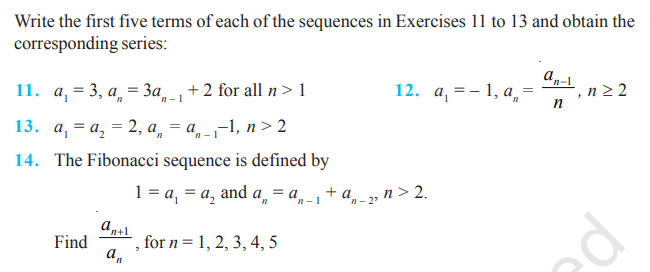
11. $a_1 = 3$, $a_n = 3a_{n-1} + 2$ for all $n > 1$
- $a_1 = \mathbf{3}$
- $a_2 = 3a_1 + 2 = 3(3) + 2 = 9 + 2 = \mathbf{11}$
- $a_3 = 3a_2 + 2 = 3(11) + 2 = 33 + 2 = \mathbf{35}$
- $a_4 = 3a_3 + 2 = 3(35) + 2 = 105 + 2 = \mathbf{107}$
- $a_5 = 3a_4 + 2 = 3(107) + 2 = 321 + 2 = \mathbf{323}$
$$\text{First five terms: } 3, 11, 35, 107, 323$$
$$\text{Corresponding series: } 3 + 11 + 35 + 107 + 323 + \dots$$
12. $a_1 = -1$, $a_n = \frac{a_{n-1}}{n}$, $n \ge 2$
- $a_1 = \mathbf{-1}$
- $a_2 = \frac{a_1}{2} = \frac{-1}{2} = \mathbf{-\frac{1}{2}}$
- $a_3 = \frac{a_2}{3} = \frac{-1/2}{3} = \mathbf{-\frac{1}{6}}$
- $a_4 = \frac{a_3}{4} = \frac{-1/6}{4} = \mathbf{-\frac{1}{24}}$
- $a_5 = \frac{a_4}{5} = \frac{-1/24}{5} = \mathbf{-\frac{1}{120}}$
$$\text{First five terms: } -1, -\frac{1}{2}, -\frac{1}{6}, -\frac{1}{24}, -\frac{1}{120}$$
$$\text{Corresponding series: } -1 – \frac{1}{2} – \frac{1}{6} – \frac{1}{24} – \frac{1}{120} + \dots$$
13. $a_1 = a_2 = 2$, $a_n = a_{n-1} – 1$, $n > 2$
- $a_1 = \mathbf{2}$
- $a_2 = \mathbf{2}$
- $a_3 = a_2 – 1 = 2 – 1 = \mathbf{1}$
- $a_4 = a_3 – 1 = 1 – 1 = \mathbf{0}$
- $a_5 = a_4 – 1 = 0 – 1 = \mathbf{-1}$
$$\text{First five terms: } 2, 2, 1, 0, -1$$
$$\text{Corresponding series: } 2 + 2 + 1 + 0 + (-1) + \dots$$
14. Fibonacci Sequence
The Fibonacci sequence is defined by $a_1 = a_2 = 1$ and $a_n = a_{n-1} + a_{n-2}$ for $n > 2$.
First, find the first few terms of the sequence:
- $a_1 = 1$
- $a_2 = 1$
- $a_3 = a_2 + a_1 = 1 + 1 = 2$
- $a_4 = a_3 + a_2 = 2 + 1 = 3$
- $a_5 = a_4 + a_3 = 3 + 2 = 5$
- $a_6 = a_5 + a_4 = 5 + 3 = 8$
Now, find the ratio $\frac{a_{n+1}}{a_n}$ for $n = 1, 2, 3, 4, 5$:
- $n = 1$: $\frac{a_2}{a_1} = \frac{1}{1} = \mathbf{1}$
- $n = 2$: $\frac{a_3}{a_2} = \frac{2}{1} = \mathbf{2}$
- $n = 3$: $\frac{a_4}{a_3} = \frac{3}{2} = \mathbf{1.5}$
- $n = 4$: $\frac{a_5}{a_4} = \frac{5}{3} \approx \mathbf{1.67}$
- $n = 5$: $\frac{a_6}{a_5} = \frac{8}{5} = \mathbf{1.6}$
The sequence of ratios is $1, 2, \frac{3}{2}, \frac{5}{3}, \frac{8}{5}$.