

Get detailed, step-by-step solutions for NCERT Class 11 Maths Miscellaneous Exercise on Chapter 8 This exercise covers a range of problems involving Sequences and Series, primarily focusing on Geometric Progression (G.P.) and its interaction with Arithmetic Progression (A.P.).
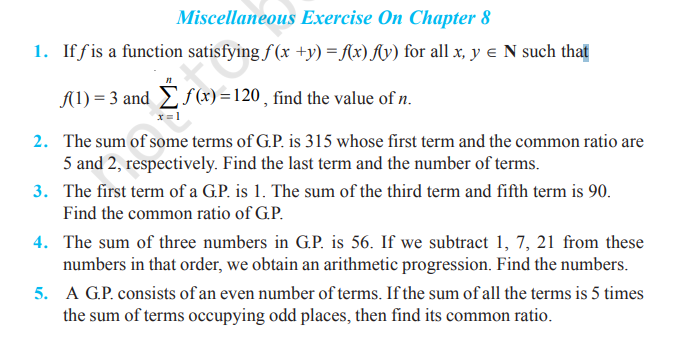

1. Finding $n$ in a Function Sum
Given a function $f$ satisfying $f(x + y) = f(x) f(y)$ and $f(1) = 3$.
- $f(2) = f(1 + 1) = f(1) f(1) = 3 \cdot 3 = 3^2$
- $f(3) = f(2 + 1) = f(2) f(1) = 3^2 \cdot 3 = 3^3$In general, $f(x) = 3^x$.
We are given the sum:
$$\sum_{x=1}^{n} f(x) = 120$$
$$\sum_{x=1}^{n} 3^x = 3^1 + 3^2 + 3^3 + \dots + 3^n = 120$$
This is a Geometric Progression with first term $a=3$, common ratio $r=3$, and $n$ terms.
The sum formula for G.P. is $S_n = \frac{a(r^n – 1)}{r – 1}$:
$$\frac{3(3^n – 1)}{3 – 1} = 120$$
$$\frac{3(3^n – 1)}{2} = 120$$
$$3(3^n – 1) = 240$$
$$3^n – 1 = 80$$
$$3^n = 81$$
Since $81 = 3^4$, we have $n = \mathbf{4}$.
2. Sum of Terms in a G.P.
Given: $S_n = 315$, first term $a=5$, common ratio $r=2$. Find the last term ($a_n$) and the number of terms ($n$).
Find $n$ (Number of terms):
$$S_n = \frac{a(r^n – 1)}{r – 1}$$
$$315 = \frac{5(2^n – 1)}{2 – 1}$$
$$315 = 5(2^n – 1)$$
$$63 = 2^n – 1$$
$$2^n = 64$$
Since $64 = 2^6$, $n = \mathbf{6}$ terms.
Find $a_n$ (Last term):
$$a_n = a r^{n-1}$$
$$a_6 = 5 (2)^{6-1} = 5 (2)^5 = 5 (32) = \mathbf{160}$$
3. Finding the Common Ratio
Given: First term $a=1$. The sum of the third term ($a_3$) and fifth term ($a_5$) is 90.
$$a_3 + a_5 = 90$$
Using $a_n = a r^{n-1}$ with $a=1$:
$$a r^2 + a r^4 = 90$$
$$1 \cdot r^2 + 1 \cdot r^4 = 90$$
$$r^4 + r^2 – 90 = 0$$
Let $y = r^2$. The equation becomes a quadratic in $y$:
$$y^2 + y – 90 = 0$$
Factor the quadratic: $(y + 10)(y – 9) = 0$
$$y = -10 \quad \text{or} \quad y = 9$$
Since $y = r^2$ and $r$ must be a real number for a real G.P., $r^2$ cannot be negative.
$$r^2 = 9$$
$$r = \mathbf{\pm 3}$$
The common ratio is $\mathbf{3}$ or $\mathbf{-3}$.
4. G.P. and A.P. Relationship
Given: Three numbers in G.P. sum to 56. Let the numbers be $a, ar, ar^2$.
$$a + ar + ar^2 = 56 \quad \text{(i)}$$
If we subtract $1, 7, 21$ from these numbers, we get an A.P.:
$$(a – 1), (ar – 7), (ar^2 – 21) \quad \text{are in A.P.}$$
For three terms $x, y, z$ to be in A.P., the middle term is the average: $2y = x + z$.
$$2(ar – 7) = (a – 1) + (ar^2 – 21)$$
$$2ar – 14 = a + ar^2 – 22$$
$$2ar – 14 = a(1 + r^2) – 22$$
$$a(1 + r^2) = 2ar – 14 + 22$$
$$a(1 + r^2) = 2ar + 8 \quad \text{(ii)}$$
From (i), we can isolate $a(1 + r^2)$:
$$a + ar + ar^2 = 56$$
$$a(1 + r^2) = 56 – ar \quad \text{(iii)}$$
Equate (ii) and (iii):
$$2ar + 8 = 56 – ar$$
$$3ar = 48$$
$$ar = 16 \quad \text{(iv)}$$
Now substitute $ar = 16$ into (i):
$$a + 16 + ar^2 = 56$$
$$a + ar^2 = 40$$
Factor $a$: $a(1 + r^2) = 40 \quad \text{(v)}$
From (iv), $a = \frac{16}{r}$. Substitute this into (v):
$$\frac{16}{r} (1 + r^2) = 40$$
$$16 + 16r^2 = 40r$$
$$16r^2 – 40r + 16 = 0$$
Divide by 8:
$$2r^2 – 5r + 2 = 0$$
Factor: $(2r – 1)(r – 2) = 0$
$$r = \frac{1}{2} \quad \text{or} \quad r = 2$$
Case 1: $r = 2$
From (iv): $a(2) = 16 \implies a = 8$.
The G.P. numbers are $a, ar, ar^2$: $\mathbf{8, 16, 32}$.
(Check: $8+16+32 = 56$. A.P. terms: $7, 9, 11$. Common difference $2$. Correct.)
Case 2: $r = 1/2$
From (iv): $a(1/2) = 16 \implies a = 32$.
The G.P. numbers are $a, ar, ar^2$: $32, 16, 8$.
(Check: $32+16+8 = 56$. A.P. terms: $31, 9, -13$. This is an A.P. with $d=-22$. Correct.)
The numbers are $\mathbf{8, 16, 32}$ or $\mathbf{32, 16, 8}$.
5. Sum of Terms at Odd Places
Given: A G.P. has an even number of terms, $2n$.
Sum of all terms ($S_{2n}$) is 5 times the sum of terms occupying odd places ($S_{odd}$).
$S_{2n} = 5 S_{odd}$.
The G.P. is $a, ar, ar^2, ar^3, \dots, ar^{2n-1}$.
- Sum of all terms ($S_{2n}$):$$S_{2n} = \frac{a(r^{2n} – 1)}{r – 1} \quad \text{(i)}$$
- Sum of terms in odd places ($S_{odd}$):The terms are $a_1, a_3, a_5, \dots$ which is $a, ar^2, ar^4, \dots, ar^{2n-2}$.This is a G.P. with $n$ terms, first term $a’=a$, and common ratio $r’ = r^2$.$$S_{odd} = \frac{a'((r’)^n – 1)}{r’ – 1} = \frac{a((r^2)^n – 1)}{r^2 – 1} = \frac{a(r^{2n} – 1)}{r^2 – 1} \quad \text{(ii)}$$
Substitute (i) and (ii) into the given relation $S_{2n} = 5 S_{odd}$:
$$\frac{a(r^{2n} – 1)}{r – 1} = 5 \left[ \frac{a(r^{2n} – 1)}{r^2 – 1} \right]$$
Cancel common factors $a(r^{2n} – 1)$ (assuming $a \ne 0$ and $r \ne 1$):
$$\frac{1}{r – 1} = \frac{5}{r^2 – 1}$$
Use the difference of squares formula, $r^2 – 1 = (r – 1)(r + 1)$:
$$\frac{1}{r – 1} = \frac{5}{(r – 1)(r + 1)}$$
Multiply by $(r – 1)$:
$$1 = \frac{5}{r + 1}$$
$$r + 1 = 5$$
$$r = \mathbf{4}$$
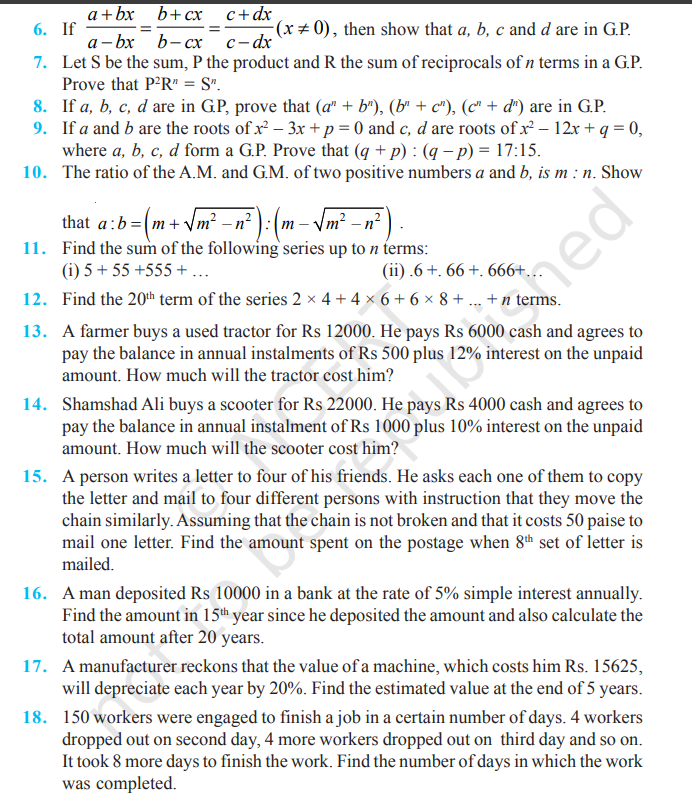
6. Prove $a, b, c, d$ are in G.P.
Given:
$$\frac{a + b x}{a – b x} = \frac{b + c x}{b – c x} = \frac{c + d x}{c – d x}$$
Consider the first ratio and apply the property of fractions Componendo and Dividendo: if $\frac{A}{B} = \frac{C}{D}$, then $\frac{A + B}{A – B} = \frac{C + D}{C – D}$.
Let $k_1 = \frac{a + b x}{a – b x}$.
$$\frac{(a + b x) + (a – b x)}{(a + b x) – (a – b x)} = \frac{2a}{2bx} = \frac{a}{bx}$$
Similarly, for the second and third ratios:
$$\frac{(b + c x) + (b – c x)}{(b + c x) – (b – c x)} = \frac{2b}{2cx} = \frac{b}{cx}$$
$$\frac{(c + d x) + (c – d x)}{(c + d x) – (c – d x)} = \frac{2c}{2dx} = \frac{c}{dx}$$
Since the original ratios are equal, their transformed ratios are also equal:
$$\frac{a}{bx} = \frac{b}{cx} = \frac{c}{dx}$$
Multiply the equality by $x$ (since $x \ne 0$):
$$\frac{a}{b} = \frac{b}{c} = \frac{c}{d}$$
Since the ratio of consecutive terms is equal, $a, b, c, d$ are in G.P.
7. Prove $P^2 R^n = S^n$
Given: $S$ is the sum, $P$ the product, and $R$ the sum of reciprocals of $n$ terms in a G.P. with first term $a$ and common ratio $r$.
- Sum $S$:$$S = \frac{a(r^n – 1)}{r – 1}$$
- Product $P$:$$P = a^n r^{\frac{n(n-1)}{2}} \quad (\text{from Ex. 8.2, Q.23})$$
- Sum of Reciprocals $R$:The reciprocals form a G.P.: $\frac{1}{a}, \frac{1}{ar}, \frac{1}{ar^2}, \dots, \frac{1}{ar^{n-1}}$.First term $a’ = \frac{1}{a}$, common ratio $r’ = \frac{1}{r}$.$$R = \frac{a'(1 – (r’)^n)}{1 – r’} = \frac{\frac{1}{a} \left(1 – \frac{1}{r^n}\right)}{1 – \frac{1}{r}}$$$$R = \frac{\frac{1}{a} \left(\frac{r^n – 1}{r^n}\right)}{\frac{r – 1}{r}} = \frac{1}{a} \frac{r^n – 1}{r^n} \frac{r}{r – 1} = \frac{1}{a r^{n-1}} \frac{r^n – 1}{r – 1}$$
Now we evaluate the left-hand side (LHS): $P^2 R^n$.
- $P^2$:$$P^2 = \left(a^n r^{\frac{n(n-1)}{2}}\right)^2 = a^{2n} r^{n(n-1)}$$
- $R^n$:$$R^n = \left(\frac{1}{a r^{n-1}} \frac{r^n – 1}{r – 1}\right)^n = \left(\frac{1}{a r^{n-1}}\right)^n \left(\frac{r^n – 1}{r – 1}\right)^n$$$$R^n = \frac{1}{a^n r^{n(n-1)}} \left(\frac{r^n – 1}{r – 1}\right)^n$$
- $P^2 R^n$:$$P^2 R^n = \left[ a^{2n} r^{n(n-1)} \right] \left[ \frac{1}{a^n r^{n(n-1)}} \left(\frac{r^n – 1}{r – 1}\right)^n \right]$$Cancel $r^{n(n-1)}$ and $a^n$:$$P^2 R^n = a^{2n – n} \left(\frac{r^n – 1}{r – 1}\right)^n = a^n \left(\frac{r^n – 1}{r – 1}\right)^n$$$$P^2 R^n = \left[ \frac{a(r^n – 1)}{r – 1} \right]^n$$
- Right-hand side (RHS): $S^n$$$S^n = \left[ \frac{a(r^n – 1)}{r – 1} \right]^n$$
Since $P^2 R^n = S^n$, the proof is complete.
8. Prove $(a^n + b^n), (b^n + c^n), (c^n + d^n)$ are in G.P.
Given: $a, b, c, d$ are in G.P. with common ratio $r$.
$$b = ar, \quad c = ar^2, \quad d = ar^3$$
For the three new terms to be in G.P., the ratio of consecutive terms must be equal:
$$\frac{b^n + c^n}{a^n + b^n} = \frac{c^n + d^n}{b^n + c^n}$$
LHS Ratio:
$$\frac{b^n + c^n}{a^n + b^n} = \frac{(ar)^n + (ar^2)^n}{a^n + (ar)^n} = \frac{a^n r^n + a^n r^{2n}}{a^n + a^n r^n}$$
Factor $a^n$:
$$\frac{a^n (r^n + r^{2n})}{a^n (1 + r^n)} = \frac{r^n (1 + r^n)}{1 + r^n} = r^n$$
RHS Ratio:
$$\frac{c^n + d^n}{b^n + c^n} = \frac{(ar^2)^n + (ar^3)^n}{(ar)^n + (ar^2)^n} = \frac{a^n r^{2n} + a^n r^{3n}}{a^n r^n + a^n r^{2n}}$$
Factor $a^n$:
$$\frac{a^n (r^{2n} + r^{3n})}{a^n (r^n + r^{2n})} = \frac{r^{2n} (1 + r^n)}{r^n (1 + r^n)} = \frac{r^{2n}}{r^n} = r^n$$
Since the ratios are equal to $r^n$, the terms $(a^n + b^n), (b^n + c^n), (c^n + d^n)$ are in G.P.
9. Roots and G.P. Ratio
Given:
- $x^2 – 3x + p = 0$ has roots $a, b$.
- $x^2 – 12x + q = 0$ has roots $c, d$.
- $a, b, c, d$ form a G.P.
Let the G.P. terms be $a, ar, ar^2, ar^3$. Then $b = ar$, $c = ar^2$, $d = ar^3$.
From the first quadratic:
- Sum of roots: $a + b = 3 \implies a + ar = 3 \implies a(1 + r) = 3$ (i)
- Product of roots: $ab = p \implies a(ar) = p \implies a^2 r = p$ (ii)
From the second quadratic:
- Sum of roots: $c + d = 12 \implies ar^2 + ar^3 = 12 \implies ar^2(1 + r) = 12$ (iii)
- Product of roots: $cd = q \implies (ar^2)(ar^3) = q \implies a^2 r^5 = q$ (iv)
Divide (iii) by (i) to find $r$:
$$\frac{ar^2(1 + r)}{a(1 + r)} = \frac{12}{3}$$
$$r^2 = 4 \implies r = 2 \quad (\text{since the terms are likely positive})$$
Substitute $r=2$ into (i) to find $a$:
$$a(1 + 2) = 3 \implies 3a = 3 \implies a = 1$$
Now find $p$ and $q$:
- $p = a^2 r = (1)^2 (2) = 2$
- $q = a^2 r^5 = (1)^2 (2)^5 = 32$
Prove the ratio $(q + p) : (q – p) = 17:15$:
$$\frac{q + p}{q – p} = \frac{32 + 2}{32 – 2} = \frac{34}{30} = \frac{17}{15}$$
The ratio is $17:15$.
10. A.M. and G.M. Ratio
Given: A.M. and G.M. of two positive numbers $a$ and $b$ is $m:n$.
$$\frac{\text{A.M.}}{\text{G.M.}} = \frac{(a + b)/2}{\sqrt{ab}} = \frac{m}{n}$$
$$\frac{a + b}{2\sqrt{ab}} = \frac{m}{n}$$
Apply Componendo and Dividendo:
$$\frac{a + b + 2\sqrt{ab}}{a + b – 2\sqrt{ab}} = \frac{m + n}{m – n}$$
Recognize the squares on the LHS:
$$\frac{(\sqrt{a} + \sqrt{b})^2}{(\sqrt{a} – \sqrt{b})^2} = \frac{m + n}{m – n}$$
Take the square root of both sides:
$$\frac{\sqrt{a} + \sqrt{b}}{\sqrt{a} – \sqrt{b}} = \frac{\sqrt{m + n}}{\sqrt{m – n}}$$
Apply Componendo and Dividendo again:
$$\frac{(\sqrt{a} + \sqrt{b}) + (\sqrt{a} – \sqrt{b})}{(\sqrt{a} + \sqrt{b}) – (\sqrt{a} – \sqrt{b})} = \frac{\sqrt{m + n} + \sqrt{m – n}}{\sqrt{m + n} – \sqrt{m – n}}$$
$$\frac{2\sqrt{a}}{2\sqrt{b}} = \frac{\sqrt{a}}{\sqrt{b}} = \frac{\sqrt{m + n} + \sqrt{m – n}}{\sqrt{m + n} – \sqrt{m – n}}$$
Square both sides to get the ratio $\frac{a}{b}$:
$$\frac{a}{b} = \left(\frac{\sqrt{m + n} + \sqrt{m – n}}{\sqrt{m + n} – \sqrt{m – n}}\right)^2$$
Rationalize the numerator of the square:
$$\frac{a}{b} = \frac{(\sqrt{m + n} + \sqrt{m – n})^2}{(\sqrt{m + n} – \sqrt{m – n})^2} = \frac{(m + n) + (m – n) + 2\sqrt{(m + n)(m – n)}}{(m + n) + (m – n) – 2\sqrt{(m + n)(m – n)}}$$
$$\frac{a}{b} = \frac{2m + 2\sqrt{m^2 – n^2}}{2m – 2\sqrt{m^2 – n^2}}$$
Divide by 2:
$$\frac{a}{b} = \frac{m + \sqrt{m^2 – n^2}}{m – \sqrt{m^2 – n^2}}$$
The ratio $a:b$ is $\mathbf{(m + \sqrt{m^2 – n^2}) : (m – \sqrt{m^2 – n^2})}$. (The question is missing a square root on $m^2 – n^2$)
11. Sum of Special Series
(i) $S_n = 5 + 55 + 555 + \dots$ to $n$ terms
$$S_n = 5(1 + 11 + 111 + \dots + \text{n terms})$$
$$S_n = \frac{5}{9}(9 + 99 + 999 + \dots + \text{n terms})$$
$$S_n = \frac{5}{9}[(10 – 1) + (10^2 – 1) + (10^3 – 1) + \dots + (10^n – 1)]$$
$$S_n = \frac{5}{9} [ (10 + 10^2 + \dots + 10^n) – n ]$$
The G.P. sum is $\frac{10(10^n – 1)}{10 – 1} = \frac{10(10^n – 1)}{9}$.
$$S_n = \frac{5}{9} \left[ \frac{10(10^n – 1)}{9} – n \right] = \mathbf{\frac{50}{81} (10^n – 1) – \frac{5n}{9}}$$
(ii) $S_n = 0.6 + 0.66 + 0.666 + \dots$ to $n$ terms
$$S_n = 6(0.1 + 0.11 + 0.111 + \dots)$$
$$S_n = \frac{6}{9}(0.9 + 0.99 + 0.999 + \dots)$$
$$S_n = \frac{2}{3} [(1 – 0.1) + (1 – 0.01) + (1 – 0.001) + \dots + (1 – (0.1)^n)]$$
$$S_n = \frac{2}{3} \left[ (1 + 1 + \dots + 1) – (0.1 + 0.01 + 0.001 + \dots + (0.1)^n) \right]$$
$$S_n = \frac{2}{3} \left[ n – (0.1 + 0.1^2 + \dots + 0.1^n) \right]$$
The G.P. sum has $a=0.1, r=0.1$. $S’_n = \frac{0.1(1 – 0.1^n)}{1 – 0.1} = \frac{0.1(1 – 0.1^n)}{0.9} = \frac{1}{9} (1 – 0.1^n)$.
$$S_n = \frac{2}{3} \left[ n – \frac{1}{9} (1 – 0.1^n) \right] = \mathbf{\frac{2n}{3} – \frac{2}{27} (1 – 0.1^n)}$$
12. Finding the 20th Term
The series is $2 \times 4 + 4 \times 6 + 6 \times 8 + \dots$
The $n$-th term $a_n$ is the product of two factors.
- First factor: $2, 4, 6, \dots$ which is $2n$.
- Second factor: $4, 6, 8, \dots$ which is $2n + 2$.The $n$-th term is:$$a_n = (2n)(2n + 2) = 4n(n + 1) = 4n^2 + 4n$$
The 20th term ($a_{20}$):
$$a_{20} = 4(20)^2 + 4(20) = 4(400) + 80$$
$$a_{20} = 1600 + 80 = \mathbf{1680}$$
13. Tractor Cost (A.P. of Interest)
Cost of tractor: Rs 12000. Cash paid: Rs 6000. Balance: Rs 6000.
The balance is paid in annual installments of Rs 500 (principal) plus $12\%$ interest on the unpaid amount.
The total amount to be paid is the sum of the principal balance (Rs 6000) and the total interest.
The number of instalments is $N = \frac{6000}{500} = 12$.
The unpaid amounts at the start of each year are:
$6000, 5500, 5000, \dots, 500$.
This is an A.P. of 12 terms, with $a=6000$ and $d=-500$.
Total Interest Paid ($I$): $12\%$ of the unpaid amount each year.
$$I = 0.12 \times (6000 + 5500 + 5000 + \dots + 500)$$
The sum of this A.P. is $S_{12} = \frac{12}{2} (a + a_{12}) = 6 (6000 + 500) = 6 (6500) = 39000$.
$$I = 0.12 \times 39000 = \mathbf{4680}$$
Total Cost of Tractor:
$$\text{Total Cost} = \text{Cash} + \text{Balance Principal} + \text{Total Interest}$$
$$\text{Total Cost} = 6000 + 6000 + 4680 = \mathbf{\text{Rs } 16680}$$
14. Scooter Cost (A.P. of Interest)
Cost of scooter: Rs 22000. Cash paid: Rs 4000. Balance: Rs 18000.
The balance is paid in annual installments of Rs 1000 (principal) plus $10\%$ interest.
The number of instalments is $N = \frac{18000}{1000} = 18$.
The unpaid amounts at the start of each year are:
$18000, 17000, 16000, \dots, 1000$. (18 terms)
Total Interest Paid ($I$): $10\%$ of the unpaid amount each year.
$$I = 0.10 \times (18000 + 17000 + \dots + 1000)$$
The sum of this A.P. is $S_{18} = \frac{18}{2} (a + a_{18}) = 9 (18000 + 1000) = 9 (19000) = 171000$.
$$I = 0.10 \times 171000 = \mathbf{17100}$$
Total Cost of Scooter:
$$\text{Total Cost} = \text{Cash} + \text{Balance Principal} + \text{Total Interest}$$
$$\text{Total Cost} = 4000 + 18000 + 17100 = \mathbf{\text{Rs } 39100}$$
15. Chain Letter (G.P.)
A person writes a letter to 4 friends, and each subsequent recipient mails to 4 new persons. This forms a G.P. with common ratio $r=4$.
- $a_1 = 4$ (First set of letters mailed by the person)
We need the amount spent on postage when the 8th set of letters is mailed, meaning we need the number of letters in the 8th set ($a_8$) and the sum of letters mailed up to the 8th set ($S_8$). The phrasing is slightly ambiguous; we’ll assume it means the total amount spent up to and including the 8th set.
The number of letters in each set $a_n$ is: $4, 4^2, 4^3, \dots$
The total number of letters mailed up to the 8th set is $S_8$:
$$S_8 = \frac{a(r^8 – 1)}{r – 1} = \frac{4(4^8 – 1)}{4 – 1} = \frac{4}{3} (65536 – 1)$$
$$S_8 = \frac{4}{3} (65535) = 4 \times 21845 = 87380 \text{ letters}$$
Cost per letter: 50 paise = Rs 0.50.
$$\text{Total Cost} = S_8 \times 0.50 = 87380 \times \frac{1}{2} = \mathbf{\text{Rs } 43690}$$
16. Simple Interest (A.P.)
Principal $P = 10000$. Rate $R = 5\%$ simple interest annually.
The simple interest earned each year is constant: $I = P \times R = 10000 \times 0.05 = 500$.
The amount $A_n$ after $n$ years is $P + nI$. The amounts form an A.P.
Amount in the 15th year since he deposited the amount:
This means the amount at the end of 15 years ($n=15$):
$$A_{15} = P + 15I = 10000 + 15(500)$$
$$A_{15} = 10000 + 7500 = \mathbf{\text{Rs } 17500}$$
Total amount after 20 years ($n=20$):
$$A_{20} = P + 20I = 10000 + 20(500)$$
$$A_{20} = 10000 + 10000 = \mathbf{\text{Rs } 20000}$$
17. Machine Depreciation (G.P.)
Cost of machine ($P_0$): Rs 15625. Depreciation rate: $20\%$ each year.
The value remaining each year is $100\% – 20\% = 80\% = 0.8$.
This forms a G.P. where the value is multiplied by $r=0.8$ each year.
Find the estimated value at the end of 5 years ($V_5$):
$$V_5 = P_0 (r)^5 = 15625 (0.8)^5$$
$$(0.8)^5 = \left(\frac{4}{5}\right)^5 = \frac{4^5}{5^5} = \frac{1024}{3125}$$
$$V_5 = 15625 \times \frac{1024}{3125}$$
Since $15625 = 5^6$ (Wait, $5^5=3125$, so $15625=5^5 \times 5 = 78125$ – check $5^6$). Correction: $5^5 = 3125$. $\frac{15625}{3125}=5$.
Ah, $5 \times 3125 = 15625$. So $15625/3125 = 5$.
$$V_5 = 5 \times 1024 = \mathbf{\text{Rs } 5120}$$
18. Worker Dropout (A.P.)
Total initial workforce: 150 workers. 4 workers drop out each day.
Let $W$ be the total work required (constant).
Let $d$ be the original number of days planned.
Let $w$ be the amount of work one worker does in one day.
$$W = 150 \times d \times w$$
The workers form an A.P. of man-days: $150, 146, 142, \dots$
The job took $d + 8$ days to finish. The sum of the man-days for $d+8$ terms equals $W/w$.
$$\frac{W}{w} = \sum_{k=1}^{d+8} a_k = S_{d+8}$$
Work completed:
$$S_{d+8} = \frac{d + 8}{2} [ 2(150) + (d + 8 – 1)(-4) ]$$
$$S_{d+8} = \frac{d + 8}{2} [ 300 – 4(d + 7) ]$$
$$S_{d+8} = (d + 8) [ 150 – 2(d + 7) ] = (d + 8) [ 150 – 2d – 14 ]$$
$$S_{d+8} = (d + 8) (136 – 2d)$$
Total work is $W/w = 150d$. Equate the man-days:
$$150d = (d + 8) (136 – 2d)$$
$$150d = 136d – 2d^2 + 1088 – 16d$$
$$150d = 120d – 2d^2 + 1088$$
$$2d^2 + 30d – 1088 = 0$$
Divide by 2:
$$d^2 + 15d – 544 = 0$$
Use the quadratic formula $d = \frac{-b \pm \sqrt{b^2 – 4ac}}{2a}$:
$$d = \frac{-15 \pm \sqrt{15^2 – 4(1)(-544)}}{2}$$
$$d = \frac{-15 \pm \sqrt{225 + 2176}}{2} = \frac{-15 \pm \sqrt{2401}}{2}$$
Since $\sqrt{2401} = 49$:
$$d = \frac{-15 + 49}{2} = \frac{34}{2} = 17 \quad (\text{Since } d > 0)$$
The original number of days planned was $d=17$.
The number of days the work was completed is $d + 8 = 17 + 8 = \mathbf{25 \text{ days}}$.