
Master finding the $n$-th term and common ratio (Q.1-6). Calculate the sum of $n$ terms for various G.P.s (Q.7-10) and evaluate complex summations (Q.11). Solve word problems involving G.P. properties, including finding the ratio and terms based on sum and product (Q.12, 14, 16). Includes essential proofs related to G.P. terms (Q.3, 17, 20, 22-25) and problems involving A.M. and G.M. (Q.27-29).
This exercise deals with Geometric Progression (G.P.), where the ratio of consecutive terms is constant, known as the common ratio ($r$).
The $n$-th term of a G.P. is $a_n = a r^{n-1}$, and the sum of the first $n$ terms is:
$$S_n = \frac{a(r^n – 1)}{r – 1} \quad \text{if } r \ne 1$$



Finding Terms and Ratios (Exercises 1–6)
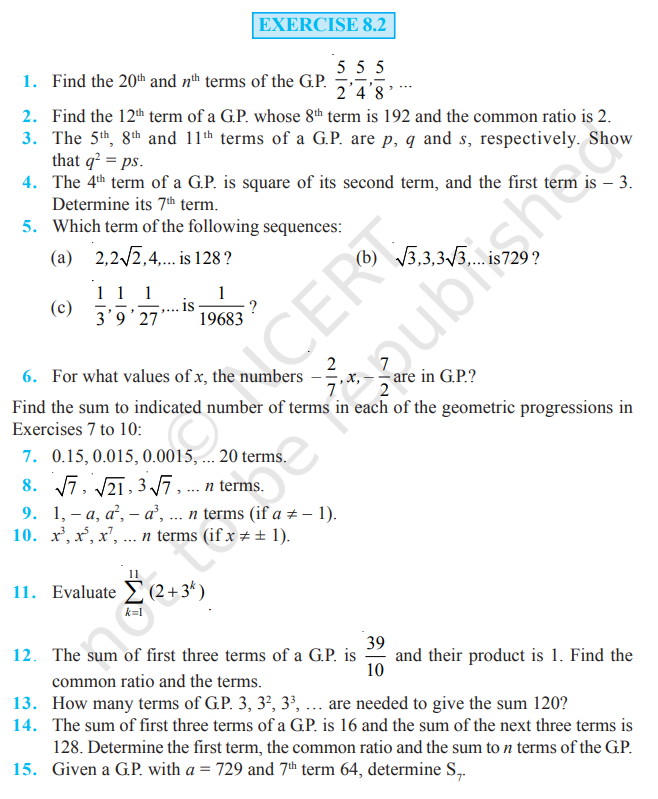
1. Find the 20th and $n$-th terms of the G.P. $\frac{5}{2}, \frac{5}{4}, \frac{5}{8}, \dots$
- First term ($a$): $a = \frac{5}{2}$
- Common ratio ($r$): $r = \frac{a_2}{a_1} = \frac{5/4}{5/2} = \frac{5}{4} \times \frac{2}{5} = \frac{1}{2}$
- $n$-th term ($a_n$):$$a_n = a r^{n-1} = \frac{5}{2} \left(\frac{1}{2}\right)^{n-1} = 5 \cdot \frac{1}{2} \cdot \left(\frac{1}{2}\right)^{n-1} = 5 \left(\frac{1}{2}\right)^n = \mathbf{\frac{5}{2^n}}$$
- 20th term ($a_{20}$):$$a_{20} = a r^{19} = \frac{5}{2} \left(\frac{1}{2}\right)^{19} = 5 \left(\frac{1}{2^{20}}\right) = \mathbf{\frac{5}{2^{20}}}$$
2. Find the 12th term of a G.P. whose 8th term is 192 and the common ratio is 2.
Given: $a_8 = 192$, $r = 2$.
We use $a_n = a r^{n-1}$:
$$a_8 = a (2)^{8-1} = a (2)^7 = 192$$
$$a \cdot 128 = 192 \implies a = \frac{192}{128} = \frac{3}{2}$$
The 12th term ($a_{12}$):
$$a_{12} = a r^{11} = \frac{3}{2} (2)^{11} = 3 \cdot 2^{10} = 3 \cdot 1024 = \mathbf{3072}$$
3. The 5th, 8th and 11th terms of a G.P. are $p, q$ and $s$. Show that $q^2 = ps$.
Let the first term be $a$ and the common ratio be $r$.
- $a_5 = p \implies a r^4 = p$ (i)
- $a_8 = q \implies a r^7 = q$ (ii)
- $a_{11} = s \implies a r^{10} = s$ (iii)
Multiply (i) and (iii):
$$ps = (a r^4) (a r^{10}) = a^2 r^{14}$$
Square (ii):
$$q^2 = (a r^7)^2 = a^2 r^{14}$$
Since $q^2 = a^2 r^{14}$ and $ps = a^2 r^{14}$, we have $\mathbf{q^2 = ps}$.
(This is a property of G.P.: any term squared equals the product of the terms equidistant from it).
4. The 4th term of a G.P. is square of its second term, and the first term is $-3$. Determine its 7th term.
Given: $a_4 = (a_2)^2$, $a = -3$.
Use $a_n = a r^{n-1}$:
$$a r^3 = (a r)^2$$
Substitute $a = -3$:
$$(-3) r^3 = ((-3) r)^2$$
$$-3 r^3 = 9 r^2$$
Since the terms must exist, $r \ne 0$. Divide by $r^2$:
$$-3r = 9 \implies r = -3$$
The 7th term ($a_7$):
$$a_7 = a r^6 = (-3) (-3)^6 = (-3)^1 (-3)^6 = (-3)^7$$
$$a_7 = -3^7 = \mathbf{-2187}$$
5. Which term of the following sequences is the given number?
(a) $2, 2\sqrt{2}, 4, \dots$ is 128?
- $a = 2$. $r = \frac{2\sqrt{2}}{2} = \sqrt{2}$. $a_n = 128$.$$a r^{n-1} = 128$$$$2 (\sqrt{2})^{n-1} = 128$$$$(\sqrt{2})^{n-1} = 64$$Write both sides with base 2: $\sqrt{2} = 2^{1/2}$ and $64 = 2^6$.$$(2^{1/2})^{n-1} = 2^6$$$$2^{\frac{n-1}{2}} = 2^6$$Equate exponents: $\frac{n-1}{2} = 6 \implies n – 1 = 12 \implies n = \mathbf{13}$$
(b) $\sqrt{3}, 3, 3\sqrt{3}, \dots$ is 729?
- $a = \sqrt{3}$. $r = \frac{3}{\sqrt{3}} = \sqrt{3}$. $a_n = 729$.$$a r^{n-1} = 729$$$$\sqrt{3} (\sqrt{3})^{n-1} = 729$$$$(\sqrt{3})^n = 729$$Write both sides with base 3: $\sqrt{3} = 3^{1/2}$ and $729 = 3^6$.$$(3^{1/2})^n = 3^6$$$$3^{n/2} = 3^6$$Equate exponents: $\frac{n}{2} = 6 \implies n = \mathbf{12}$$
(c) $\frac{1}{3}, \frac{1}{9}, \frac{1}{27}, \dots$ is $\frac{1}{19683}$?
- $a = \frac{1}{3}$. $r = \frac{1/9}{1/3} = \frac{1}{3}$. $a_n = \frac{1}{19683}$.$$a r^{n-1} = \frac{1}{19683}$$$$\frac{1}{3} \left(\frac{1}{3}\right)^{n-1} = \frac{1}{19683}$$$$\left(\frac{1}{3}\right)^n = \frac{1}{19683}$$Since $3^8 = 6561$ and $3^9 = 19683$:$$\left(\frac{1}{3}\right)^n = \left(\frac{1}{3}\right)^9 \implies n = \mathbf{9}$$
6. For what values of $x$, the numbers $\frac{-2}{7}, x, \frac{-7}{2}$ are in G.P.?
If three numbers $a, b, c$ are in G.P., then $b^2 = ac$.
$$x^2 = \left(\frac{-2}{7}\right) \left(\frac{-7}{2}\right)$$
$$x^2 = 1$$
$$x = \mathbf{\pm 1}$$
Sum of $n$ Terms (Exercises 7–10)
7. $0.15, 0.015, 0.0015, \dots$ 20 terms.
- $a = 0.15$. $r = \frac{0.015}{0.15} = 0.1 = \frac{1}{10}$. $n = 20$.Since $|r| < 1$, we can use the formula $S_n = \frac{a(1 – r^n)}{1 – r}$.$$S_{20} = \frac{0.15 (1 – (0.1)^{20})}{1 – 0.1}$$$$S_{20} = \frac{0.15 (1 – (0.1)^{20})}{0.9}$$$$S_{20} = \frac{15/100}{9/10} (1 – (0.1)^{20})$$$$S_{20} = \frac{15}{100} \times \frac{10}{9} (1 – (0.1)^{20}) = \frac{15}{90} (1 – (0.1)^{20}) = \mathbf{\frac{1}{6} (1 – (0.1)^{20})}$$
8. $\sqrt{7}, \sqrt{21}, 3\sqrt{7}, \dots n$ terms.
- $a = \sqrt{7}$. $r = \frac{\sqrt{21}}{\sqrt{7}} = \sqrt{\frac{21}{7}} = \sqrt{3}$.Since $|r| > 1$, we use $S_n = \frac{a(r^n – 1)}{r – 1}$.$$S_n = \frac{\sqrt{7} ((\sqrt{3})^n – 1)}{\sqrt{3} – 1}$$To rationalize the denominator, multiply top and bottom by $\sqrt{3} + 1$:$$S_n = \frac{\sqrt{7} ((\sqrt{3})^n – 1)}{(\sqrt{3} – 1)} \times \frac{(\sqrt{3} + 1)}{(\sqrt{3} + 1)}$$$$S_n = \frac{\sqrt{7} (\sqrt{3} + 1) ((\sqrt{3})^n – 1)}{3 – 1} = \mathbf{\frac{\sqrt{21} + \sqrt{7}}{2} ((\sqrt{3})^n – 1)}$$
9. $1, -a, a^2, -a^3, \dots n$ terms (if $a \ne -1$).
- $a = 1$. $r = \frac{-a}{1} = -a$.Since $a \ne -1$, $r \ne 1$. We use $S_n = \frac{a(1 – r^n)}{1 – r}$.$$S_n = \frac{1 (1 – (-a)^n)}{1 – (-a)} = \mathbf{\frac{1 – (-a)^n}{1 + a}}$$
10. $x^3, x^5, x^7, \dots n$ terms (if $x \ne \pm 1$).
- $a = x^3$. $r = \frac{x^5}{x^3} = x^2$.Since $x \ne \pm 1$, $r = x^2 \ne 1$. We use $S_n = \frac{a(r^n – 1)}{r – 1}$.$$S_n = \frac{x^3 ((x^2)^n – 1)}{x^2 – 1} = \mathbf{\frac{x^3 (x^{2n} – 1)}{x^2 – 1}}$$
Summation and Evaluation (Exercises 11–13)
11. Evaluate $\sum_{k=1}^{11} (2 + 3^k)$.
Split the sum into two parts:
$$\sum_{k=1}^{11} (2 + 3^k) = \sum_{k=1}^{11} 2 + \sum_{k=1}^{11} 3^k$$
- Part 1: $\sum_{k=1}^{11} 2 = 2 \times 11 = 22$
- Part 2: $\sum_{k=1}^{11} 3^k = 3^1 + 3^2 + 3^3 + \dots + 3^{11}$. This is a G.P. with $a=3$, $r=3$, $n=11$.$$S_{11} = \frac{a(r^{11} – 1)}{r – 1} = \frac{3 (3^{11} – 1)}{3 – 1} = \frac{3}{2} (3^{11} – 1)$$
- Total Sum:$$\text{Sum} = 22 + \frac{3}{2} (3^{11} – 1)$$$$3^{11} = 177,147$$$$\text{Sum} = 22 + \frac{3}{2} (177,147 – 1) = 22 + \frac{3}{2} (177,146)$$$$\text{Sum} = 22 + 3(88,573) = 22 + 265,719 = \mathbf{265,741}$$
12. The sum of first three terms of a G.P. is $\frac{39}{10}$ and their product is 1. Find the common ratio and the terms.
Let the three terms be $\frac{a}{r}, a, a r$.
- Product:$$\left(\frac{a}{r}\right) (a) (a r) = a^3 = 1 \implies a = 1$$
- Sum:$$\frac{a}{r} + a + a r = \frac{39}{10}$$Substitute $a = 1$:$$\frac{1}{r} + 1 + r = \frac{39}{10}$$$$\frac{1}{r} + r = \frac{39}{10} – 1 = \frac{29}{10}$$Multiply by $10r$:$$10 + 10r^2 = 29r$$$$10r^2 – 29r + 10 = 0$$Using the quadratic formula or factoring $(5r – 2)(2r – 5) = 0$:$$r = \frac{2}{5} \quad \text{or} \quad r = \frac{5}{2}$$
- Terms: $a=1$.
- If $r = \frac{2}{5}$: Terms are $\frac{1}{2/5}, 1, 1(\frac{2}{5}) \implies \mathbf{\frac{5}{2}, 1, \frac{2}{5}}$
- If $r = \frac{5}{2}$: Terms are $\frac{1}{5/2}, 1, 1(\frac{5}{2}) \implies \mathbf{\frac{2}{5}, 1, \frac{5}{2}}$
The common ratio is $\frac{2}{5}$ or $\frac{5}{2}$.
13. How many terms of G.P. $3, 3^2, 3^3, \dots$ are needed to give the sum 120?
- $a = 3$, $r = \frac{3^2}{3} = 3$. $S_n = 120$.$$S_n = \frac{a(r^n – 1)}{r – 1}$$$$120 = \frac{3 (3^n – 1)}{3 – 1}$$$$120 = \frac{3}{2} (3^n – 1)$$Multiply by $\frac{2}{3}$:$$120 \times \frac{2}{3} = 3^n – 1$$$$80 = 3^n – 1$$$$3^n = 81$$Since $81 = 3^4$, $n = \mathbf{4}$ terms.
Complex G.P. Problems (Exercises 14–17)
14. The sum of first three terms ($S_3$) is 16 and the sum of the next three terms ($S_{6} – S_3$) is 128.
Given: $a + ar + ar^2 = 16$ (i)
$$ar^3 + ar^4 + ar^5 = 128$$
Factor out $r^3$:
$$r^3 (a + ar + ar^2) = 128$$
Substitute (i) into the equation:
$$r^3 (16) = 128$$
$$r^3 = \frac{128}{16} = 8$$
$$r = \mathbf{2}$$
Substitute $r=2$ back into (i):
$$a + a(2) + a(2)^2 = 16$$
$$a + 2a + 4a = 16$$
$$7a = 16 \implies a = \mathbf{\frac{16}{7}}$$
Sum to $n$ terms ($S_n$):
$$S_n = \frac{a(r^n – 1)}{r – 1} = \frac{\frac{16}{7} (2^n – 1)}{2 – 1} = \mathbf{\frac{16}{7} (2^n – 1)}$$
15. Given a G.P. with $a = 729$ and 7th term 64, determine $S_7$.
Given: $a = 729$, $a_7 = 64$.
Find $r$:
$$a_7 = a r^6$$
$$64 = 729 r^6$$
$$r^6 = \frac{64}{729} = \left(\frac{2}{3}\right)^6 \implies r = \mathbf{\frac{2}{3}}$$
Find $S_7$. Since $|r| < 1$, use $S_n = \frac{a(1 – r^n)}{1 – r}$.
$$S_7 = \frac{729 \left(1 – \left(\frac{2}{3}\right)^7\right)}{1 – \frac{2}{3}}$$
$$S_7 = \frac{729 \left(1 – \frac{128}{2187}\right)}{\frac{1}{3}}$$
Since $729 = 3^6$:
$$S_7 = 3 \cdot 729 \left(\frac{2187 – 128}{2187}\right)$$
$$S_7 = 3 \cdot 3^6 \left(\frac{2059}{3^7}\right) = 3^7 \left(\frac{2059}{3^7}\right) = \mathbf{2059}$$
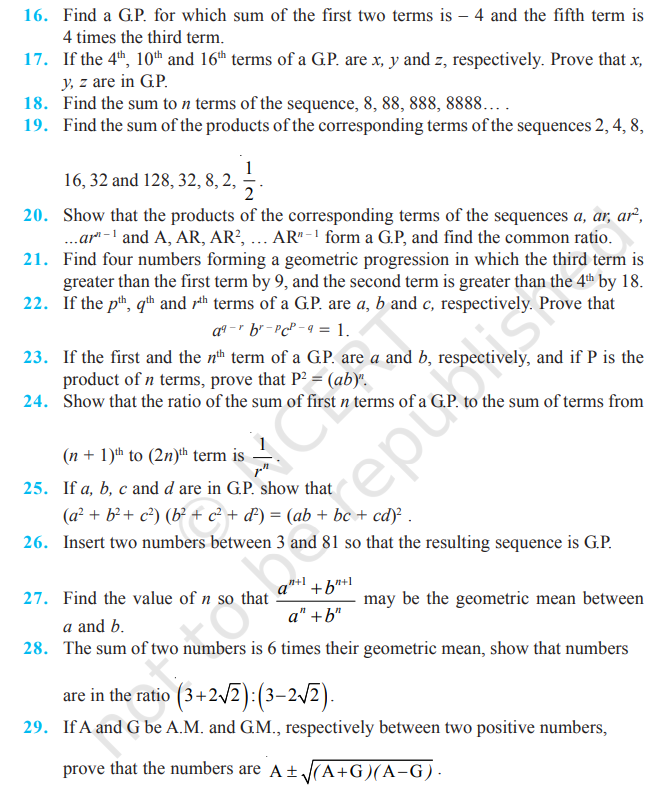
16. Sum of the first two terms is $-4$ and the fifth term is 4 times the third term. Find the G.P.
Given: $a_1 + a_2 = -4$ (i); $a_5 = 4 a_3$ (ii).
From (ii):
$$a r^4 = 4 (a r^2)$$
Since $a \ne 0$ and $r \ne 0$ (otherwise the sequence is trivial), divide by $a r^2$:
$$r^2 = 4 \implies r = \pm 2$$
From (i): $a + ar = -4 \implies a(1 + r) = -4$.
- Case 1: $r = 2$$$a(1 + 2) = -4 \implies 3a = -4 \implies a = -\frac{4}{3}$$$$\text{G.P. is } \mathbf{-\frac{4}{3}, -\frac{8}{3}, -\frac{16}{3}, \dots}$$
- Case 2: $r = -2$$$a(1 – 2) = -4 \implies -a = -4 \implies a = 4$$$$\text{G.P. is } \mathbf{4, -8, 16, -32, \dots}$$
17. If the 4th, 10th and 16th terms of a G.P. are $x, y$ and $z$. Prove that $x, y, z$ are in G.P.
- $a_4 = x \implies a r^3 = x$
- $a_{10} = y \implies a r^9 = y$
- $a_{16} = z \implies a r^{15} = z$
For $x, y, z$ to be in G.P., we must show that $y^2 = x z$.
- $x z$:$$x z = (a r^3) (a r^{15}) = a^2 r^{18}$$
- $y^2$:$$y^2 = (a r^9)^2 = a^2 r^{18}$$
Since $y^2 = x z$, the terms $x, y, z$ are in G.P.
Summation of Special Series (Exercises 18–19)
18. Find the sum to $n$ terms of the sequence, $8, 88, 888, 8888, \dots$.
Let $S_n$ be the sum:
$$S_n = 8 + 88 + 888 + \dots + a_n$$
$$S_n = 8 (1 + 11 + 111 + \dots + \text{n terms})$$
Multiply and divide by 9:
$$S_n = \frac{8}{9} (9 + 99 + 999 + \dots + \text{n terms})$$
Write terms as powers of 10:
$$S_n = \frac{8}{9} [(10 – 1) + (10^2 – 1) + (10^3 – 1) + \dots + (10^n – 1)]$$
Group the powers of 10 and the $-1$ terms:
$$S_n = \frac{8}{9} [(10 + 10^2 + 10^3 + \dots + 10^n) – (1 + 1 + 1 + \dots \text{ n times})]$$
The first bracket is a G.P. with $a=10, r=10$. The sum is $S’_n = \frac{10(10^n – 1)}{10 – 1} = \frac{10(10^n – 1)}{9}$.
The second bracket sum is $n$.
$$S_n = \frac{8}{9} \left[ \frac{10(10^n – 1)}{9} – n \right]$$
$$S_n = \mathbf{\frac{80}{81} (10^n – 1) – \frac{8n}{9}}$$
19. Find the sum of the products of the corresponding terms of the sequences $2, 4, 8, 16, 32$ and $128, 32, 8, 2, \frac{1}{2}$.
Let $A$ be the first sequence and $B$ be the second.
$$A: 2, 4, 8, 16, 32 \implies a_A=2, r_A=2$$
$$B: 128, 32, 8, 2, \frac{1}{2} \implies a_B=128, r_B=\frac{32}{128}=\frac{1}{4}$$
The product sequence $P$ is $P_k = a_k b_k$:
$$P: 2 \times 128, 4 \times 32, 8 \times 8, 16 \times 2, 32 \times \frac{1}{2}$$
$$P: 256, 128, 64, 32, 16$$
This is a G.P. with $a_P = 256$ and $r_P = \frac{128}{256} = \frac{1}{2}$. $n=5$.
The sum $S_5$:
$$S_5 = \frac{a_P (1 – r_P^5)}{1 – r_P} = \frac{256 (1 – (1/2)^5)}{1 – 1/2}$$
$$S_5 = \frac{256 (1 – 1/32)}{1/2} = 256 \times 2 \left(\frac{32 – 1}{32}\right)$$
$$S_5 = 512 \left(\frac{31}{32}\right) = 16 \times 31 = \mathbf{496}$$
Proofs (Exercises 20, 22–25)
20. Show that the products of the corresponding terms of the sequences $a, ar, ar^2, \dots ar^{n-1}$ and $A, AR, AR^2, \dots AR^{n-1}$ form a G.P, and find the common ratio.
Let the terms of the first G.P. be $a_k = a r^{k-1}$ and the second be $b_k = A R^{k-1}$.
The product sequence $P$ has terms $P_k = a_k b_k$:
$$P_k = (a r^{k-1}) (A R^{k-1}) = (a A) (r R)^{k-1}$$
This is the form of a G.P. with:
- First term: $a_P = a A$
- Common ratio: $r_P = r R$
To prove it is a G.P., we check the ratio of consecutive terms:
$$\frac{P_{k+1}}{P_k} = \frac{(a A) (r R)^k}{(a A) (r R)^{k-1}} = r R$$
Since the ratio $r R$ is constant and independent of $k$, the product sequence is a G.P. with common ratio $r R$.
22. If the $p$-th, $q$-th and $r$-th terms of a G.P. are $a, b$ and $c$, respectively. Prove that $a^{q – r} b^{r – p} c^{p – q} = 1$.
Let the first term of the G.P. be $A$ and the common ratio be $R$.
- $p$-th term: $A R^{p-1} = a$ (i)
- $q$-th term: $A R^{q-1} = b$ (ii)
- $r$-th term: $A R^{r-1} = c$ (iii)
Consider the left-hand side (LHS) of the identity:
$$\text{LHS} = a^{q-r} b^{r-p} c^{p-q}$$
Substitute $a, b, c$ using (i), (ii), and (iii):
$$\text{LHS} = (A R^{p-1})^{q-r} (A R^{q-1})^{r-p} (A R^{r-1})^{p-q}$$
Group powers of $A$:
$$\text{Power of } A = (q – r) + (r – p) + (p – q) = 0$$
$$\text{Term in } A = A^0 = 1$$
Group powers of $R$:
$$\text{Power of } R = (p – 1)(q – r) + (q – 1)(r – p) + (r – 1)(p – q)$$
Expand the exponents:
$$\text{Exp of } R = (pq – pr – q + r) + (qr – qp – r + p) + (rp – rq – p + q)$$
Rearrange and cancel:
$$\text{Exp of } R = (pq – qp) + (pr – rp) + (qr – rq) + (-q + q) + (-r + r) + (-p + p) = 0$$
$$\text{Term in } R = R^0 = 1$$
$$\text{LHS} = A^0 R^0 = 1 \cdot 1 = 1$$
Thus, $\mathbf{a^{q – r} b^{r – p} c^{p – q} = 1}$.
23. If the first and $n$-th term of a G.P. are $a$ and $b$, and $P$ is the product of $n$ terms, prove that $P^2 = (ab)^n$.
The $n$ terms are $a_1, a_2, \dots, a_n$.
- $a_1 = a$
- $a_n = b$
The terms of the G.P. are: $a, ar, ar^2, \dots, ar^{n-1}$.
The product $P$:
$$P = (a)(ar)(ar^2) \dots (ar^{n-1})$$
$$P = a^n \cdot r^{(0 + 1 + 2 + \dots + n-1)}$$
The sum of the exponents of $r$ is the sum of an A.P.: $S_{n-1} = \frac{(n-1)(0 + n-1)}{2} = \frac{n(n-1)}{2}$.
$$P = a^n r^{\frac{n(n-1)}{2}}$$
The $n$-th term $b$ is:
$$b = a r^{n-1} \implies r^{n-1} = \frac{b}{a}$$
Square the product $P$:
$$P^2 = \left(a^n r^{\frac{n(n-1)}{2}}\right)^2 = a^{2n} r^{n(n-1)}$$
$$P^2 = a^{2n} (r^{n-1})^n$$
Substitute $r^{n-1} = \frac{b}{a}$:
$$P^2 = a^{2n} \left(\frac{b}{a}\right)^n = a^{2n} \frac{b^n}{a^n} = a^{2n-n} b^n = a^n b^n$$
$$P^2 = (ab)^n$$
Thus, $\mathbf{P^2 = (ab)^n}$.
24. Show that the ratio of the sum of first $n$ terms of a G.P. to the sum of terms from $(n+1)$-th to $(2n)$-th term is $\frac{1}{r^n}$.
Let $S_{1..n}$ be the sum of the first $n$ terms, and $S_{n+1..2n}$ be the sum of the next $n$ terms.
- $S_{1..n}$:$$S_{1..n} = \frac{a(r^n – 1)}{r – 1}$$
- $S_{n+1..2n}$:The sequence starts at $a_{n+1} = a r^n$ and has $n$ terms. The first term is $a r^n$.$$S_{n+1..2n} = \frac{(a r^n) (r^n – 1)}{r – 1}$$
The ratio is:
$$\frac{S_{1..n}}{S_{n+1..2n}} = \frac{\frac{a(r^n – 1)}{r – 1}}{\frac{a r^n (r^n – 1)}{r – 1}}$$
Cancel the common factors:
$$\frac{S_{1..n}}{S_{n+1..2n}} = \frac{1}{r^n}$$
Thus, the ratio is $\mathbf{\frac{1}{r^n}}$.
25. If $a, b, c$ and $d$ are in G.P. show that $(a^2 + b^2 + c^2) (b^2 + c^2 + d^2) = (ab + bc + cd)^2$.
Since $a, b, c, d$ are in G.P., let $r$ be the common ratio.
$$b = ar, \quad c = ar^2, \quad d = ar^3$$
- Simplify $(ab + bc + cd)$:$$ab + bc + cd = a(ar) + (ar)(ar^2) + (ar^2)(ar^3)$$$$= a^2 r + a^2 r^3 + a^2 r^5 = a^2 r (1 + r^2 + r^4)$$
- RHS: $(ab + bc + cd)^2$$$\text{RHS} = [a^2 r (1 + r^2 + r^4)]^2 = \mathbf{a^4 r^2 (1 + r^2 + r^4)^2}$$
- Simplify $(a^2 + b^2 + c^2)$:$$a^2 + b^2 + c^2 = a^2 + (ar)^2 + (ar^2)^2 = a^2 + a^2 r^2 + a^2 r^4$$$$= a^2 (1 + r^2 + r^4)$$
- Simplify $(b^2 + c^2 + d^2)$:$$b^2 + c^2 + d^2 = (ar)^2 + (ar^2)^2 + (ar^3)^2 = a^2 r^2 + a^2 r^4 + a^2 r^6$$$$= a^2 r^2 (1 + r^2 + r^4)$$
- LHS: $(a^2 + b^2 + c^2) (b^2 + c^2 + d^2)$$$\text{LHS} = [a^2 (1 + r^2 + r^4)] [a^2 r^2 (1 + r^2 + r^4)]$$$$\text{LHS} = \mathbf{a^4 r^2 (1 + r^2 + r^4)^2}$$
Since $\text{LHS} = \text{RHS}$, the identity is proven.
Mean and Insertion Problems (Exercises 26–29)
26. Insert two numbers between 3 and 81 so that the resulting sequence is G.P.
Let the numbers be $G_1, G_2$. The sequence is $3, G_1, G_2, 81$.
This is a G.P. with $a=3$ and $n=4$. $a_4 = 81$.
$$a_4 = a r^3$$
$$81 = 3 r^3$$
$$r^3 = 27 \implies r = 3$$
The inserted numbers are:
- $G_1 = ar = 3(3) = \mathbf{9}$
- $G_2 = ar^2 = 3(3)^2 = \mathbf{27}$$$\text{Sequence: } 3, 9, 27, 81$$
27. Find the value of $n$ so that $\frac{a^{n+1} + b^{n+1}}{a^n + b^n}$ may be the geometric mean between $a$ and $b$.
The Geometric Mean (G.M.) between $a$ and $b$ is $\sqrt{ab}$.
$$\frac{a^{n+1} + b^{n+1}}{a^n + b^n} = \sqrt{ab} = a^{1/2} b^{1/2}$$
Cross-multiply:
$$a^{n+1} + b^{n+1} = a^{1/2} b^{1/2} (a^n + b^n)$$
$$a^{n+1} + b^{n+1} = a^{n + 1/2} b^{1/2} + a^{1/2} b^{n + 1/2}$$
Group terms with common base:
$$a^{n+1} – a^{n + 1/2} b^{1/2} = a^{1/2} b^{n + 1/2} – b^{n+1}$$
Factor out the lower power:
$$a^{n + 1/2} (a^{1/2} – b^{1/2}) = b^{n + 1/2} (a^{1/2} – b^{1/2})$$
If $a \ne b$, divide by $(a^{1/2} – b^{1/2})$:
$$a^{n + 1/2} = b^{n + 1/2}$$
$$\left(\frac{a}{b}\right)^{n + 1/2} = 1$$
For this equality to hold, the exponent must be zero (assuming $a \ne b$):
$$n + \frac{1}{2} = 0 \implies n = \mathbf{-\frac{1}{2}}$$
28. The sum of two numbers is 6 times their geometric mean. Show that numbers are in the ratio $(3 + 2\sqrt{2}) : (3 – 2\sqrt{2})$.
Let the numbers be $a$ and $b$.
- Sum: $a + b$
- G.M.: $\sqrt{ab}$Given: $a + b = 6 \sqrt{ab}$
Divide by $2\sqrt{ab}$:
$$\frac{a + b}{2\sqrt{ab}} = 3$$
Apply Componendo and Dividendo (adding 1 to both sides, then dividing the result):
$$\frac{a + b + 2\sqrt{ab}}{a + b – 2\sqrt{ab}} = \frac{3 + 1}{3 – 1}$$
$$\frac{(\sqrt{a} + \sqrt{b})^2}{(\sqrt{a} – \sqrt{b})^2} = \frac{4}{2} = 2$$
Take the square root of both sides:
$$\frac{\sqrt{a} + \sqrt{b}}{\sqrt{a} – \sqrt{b}} = \sqrt{2}$$
Apply Componendo and Dividendo again:
$$\frac{(\sqrt{a} + \sqrt{b}) + (\sqrt{a} – \sqrt{b})}{(\sqrt{a} + \sqrt{b}) – (\sqrt{a} – \sqrt{b})} = \frac{\sqrt{2} + 1}{\sqrt{2} – 1}$$
$$\frac{2\sqrt{a}}{2\sqrt{b}} = \frac{\sqrt{2} + 1}{\sqrt{2} – 1}$$
$$\sqrt{\frac{a}{b}} = \frac{\sqrt{2} + 1}{\sqrt{2} – 1}$$
Square both sides to find the ratio $\frac{a}{b}$:
$$\frac{a}{b} = \left(\frac{\sqrt{2} + 1}{\sqrt{2} – 1}\right)^2$$
$$\frac{a}{b} = \frac{(\sqrt{2} + 1)^2}{(\sqrt{2} – 1)^2} = \frac{2 + 1 + 2\sqrt{2}}{2 + 1 – 2\sqrt{2}} = \frac{3 + 2\sqrt{2}}{3 – 2\sqrt{2}}$$
The ratio is $\mathbf{(3 + 2\sqrt{2}) : (3 – 2\sqrt{2})}$.
29. If $A$ and $G$ be A.M. and G.M., respectively between two positive numbers, prove that the numbers are $A \pm \sqrt{(A + G)(A – G)}$.
Let the two positive numbers be $a$ and $b$.
- $\text{A.M.} = A = \frac{a + b}{2} \implies a + b = 2A$ (i)
- $\text{G.M.} = G = \sqrt{ab} \implies ab = G^2$ (ii)
The numbers $a$ and $b$ are the roots of the quadratic equation:
$$x^2 – (\text{Sum of roots})x + (\text{Product of roots}) = 0$$
$$x^2 – (a + b)x + ab = 0$$
Substitute (i) and (ii):
$$x^2 – 2Ax + G^2 = 0$$
Use the quadratic formula $x = \frac{-B \pm \sqrt{B^2 – 4AC}}{2A}$ to find the roots $x=a, b$:
$$x = \frac{-(-2A) \pm \sqrt{(-2A)^2 – 4(1)(G^2)}}{2}$$
$$x = \frac{2A \pm \sqrt{4A^2 – 4G^2}}{2} = \frac{2A \pm \sqrt{4(A^2 – G^2)}}{2}$$
$$x = \frac{2A \pm 2\sqrt{A^2 – G^2}}{2} = A \pm \sqrt{A^2 – G^2}$$
Factor the term under the square root using difference of squares: $A^2 – G^2 = (A + G)(A – G)$.
$$x = A \pm \sqrt{(A + G)(A – G)}$$
Thus, the numbers are $\mathbf{A \pm \sqrt{(A + G)(A – G)}}$.
Real-World G.P. Problems (Exercises 30–31)
30. Bacteria growth: doubles every hour, 30 originally. How many at the end of 2nd, 4th, and $n$-th hour?
This is a G.P. where the population doubles ($r=2$) every hour. The time $t$ in hours corresponds to the number of terms.
- Original number (start of 1st hour, $t=0$): 30
- End of 1st hour ($t=1$, $a_2$): $30 \times 2 = 60$
Let $a$ be the original amount (30). The population $P_t$ after $t$ hours is given by $a \cdot r^t$:
$$P_t = 30 \cdot 2^t$$
- End of 2nd hour ($t=2$):$$P_2 = 30 \cdot 2^2 = 30 \cdot 4 = \mathbf{120}$$
- End of 4th hour ($t=4$):$$P_4 = 30 \cdot 2^4 = 30 \cdot 16 = \mathbf{480}$$
- End of $n$-th hour ($t=n$):$$P_n = \mathbf{30 \cdot 2^n}$$
31. What will Rs 500 amounts to in 10 years after its deposit in a bank which pays annual interest rate of 10% compounded annually?
This is a G.P. where the amount grows by a factor of $1 + 0.10 = 1.1$ each year.
- Initial Principal ($P_0$): 500
- Growth rate ($r$): 1.10
- Number of years ($n$): 10
The amount after $n$ years $A_n$ is $P_0 (1 + \text{rate})^n$.
$$A_{10} = 500 (1.10)^{10}$$
Using a calculator: $(1.10)^{10} \approx 2.59374$
$$A_{10} \approx 500 \times 2.59374 = \mathbf{1296.87}$$
The amount will be Rs 1296.87 (approximately).
32. A.M. and G.M. of roots of a quadratic equation are 8 and 5. Obtain the quadratic equation.
Let the roots be $a$ and $b$.
- $\text{A.M.} = 8 \implies \frac{a + b}{2} = 8 \implies \text{Sum of roots } (a + b) = 16$
- $\text{G.M.} = 5 \implies \sqrt{ab} = 5 \implies \text{Product of roots } (ab) = 25$
The general form of a quadratic equation is $x^2 – (\text{Sum of roots})x + (\text{Product of roots}) = 0$.
$$x^2 – 16x + 25 = 0$$
The quadratic equation is $\mathbf{x^2 – 16x + 25 = 0}$.